“I am the King, I am the Son of the King”. Psalm 71:1 (LXX) in the Apocryphon Berolinense/Argentoratense (aka Unbekanntes Berliner Evangelium), Coptic Literature and Patristics (Paper Delivered in Honour of Peter Nagel)

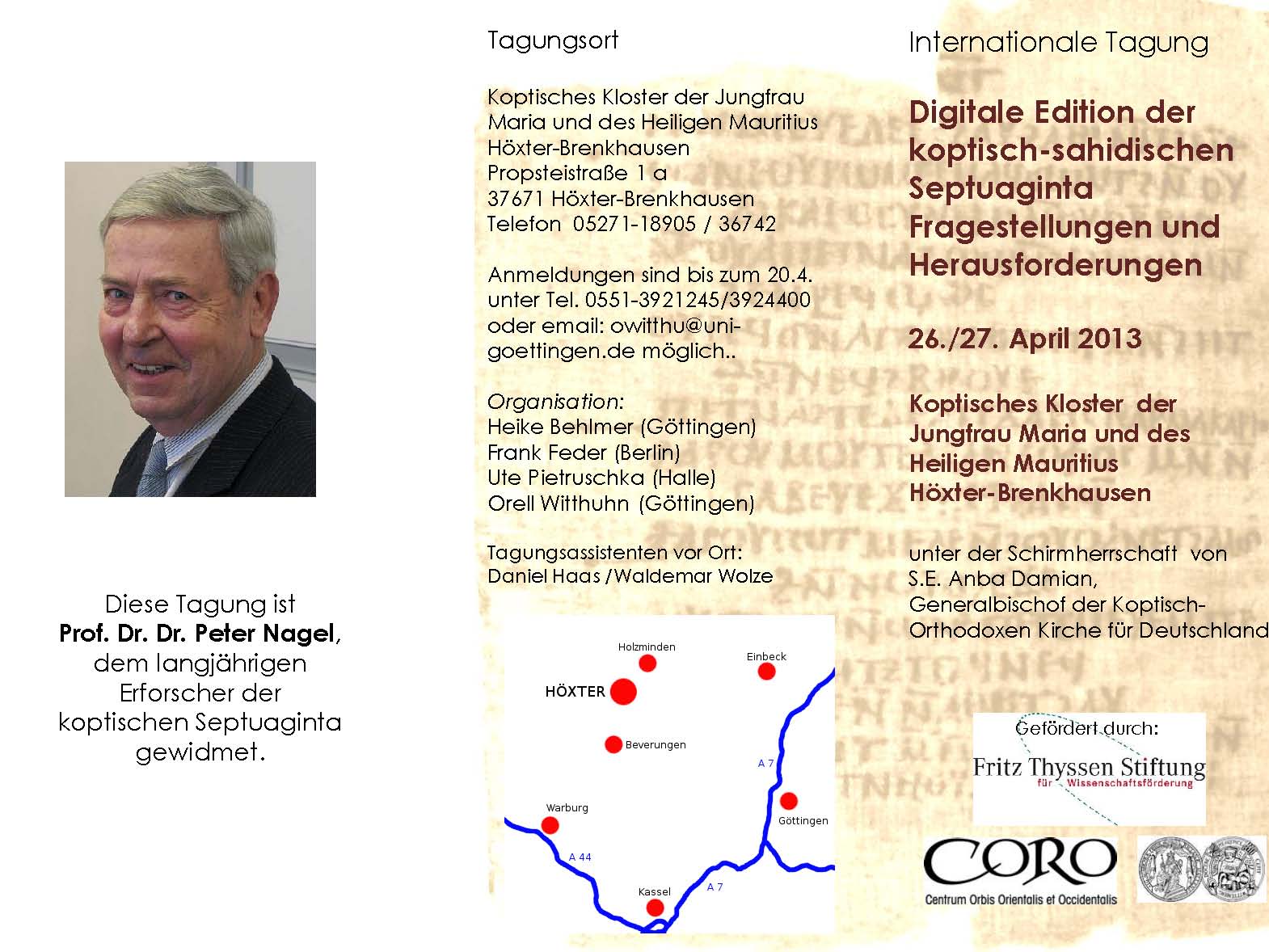
On April 26-27 I participated in a symposium organized on the occasion of Peter Nagel’s 75th anniversary. The symposium took place at the Coptic monastery of St. Mary and St. Mauritius in Höxter-Brenkhausen (near Göttingen). There I had the opportunity to see old friends and meet new people. I am grateful to the organizers (Heike Behlmer, Frank Feder and Ute Pietruschka) for inviting me to deliver a paper in the presence of the celebrated scholar. Our host, the Bishop Anba Damian, did his best to make us feel welcome. If you have enough patience and the topic interests you, you can read below a draft of my presentation (with some references added).

1

Honorable audience, distinguished Professor Peter Nagel,

Professor Nagel’s accomplishments have earned him international recognition. We have gathered here today to honor his work. My contribution to this symposium is about a certain passage in a text which has been studied by our esteemed colleague: the so-called Unbekanntes Berliner Evangelium. He wrote a seminal article on this text: “‘Gespräche Jesu mit seinen Jüngern von der Auferstehung’ – Zur Herkunft und Datierung des ‘Unbekannten Berliner Evangeliums’,” Zeitschrift für Neutestamentliche Wissenschaft 94 (2003) 215-257. When I say seminal, this is not just an encomiastic feature meant to praise him. In fact, Professor Nagel has been the first scholar who argued that this text is not an ancient gospel, but rather a work composed in Coptic, perhaps during the 4th or 5th centuries.

In the passage under scrutiny, Jesus says “I am the King, Amen. I am the Son of the King, Amen.” At a first glance, Jesus’ utterance sounds mysterious, like a riddle, but I will try to show that the passage is based on an interpretation of Psalm 71:1 (LXX), which was common during the 4th-5th centuries. Last but not least, I hope to show you by this example that we can experience great benefit by studying Coptic literature with the aid of Patristics.

The Apocryphon Berolinense/Argentoratense

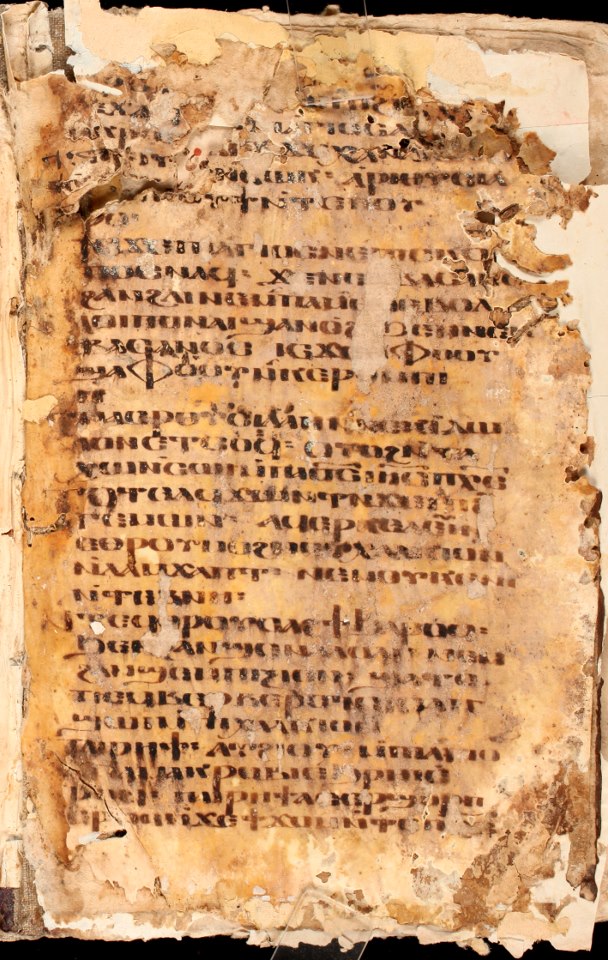
In 1999, Charles Hedrick and Paul Mirecki published together the editio princeps of a Sahidic manuscript in the papyrus collection of the Egyptian Museum in Berlin (P. Berol. 22220).[1] The text is a revelation dialogue of Jesus with the apostles, written in the first person plural. The narrators are the apostles. An important part of the text is occupied by an extensive hymn of the Cross. The hymn is sung by Christ while to apostles are apparently dancing around the Cross and answer “Amen.” The original title of the work has not survived, but because of the title conventionally assigned to it in the editio princeps, the text is largely known today as the Gospel of the Savior. However, as I find this title unsatisfactory, I will avoid it. My main objection to the label “Gospel of the Savior” is that it suggests that the text is an apocryphal gospel, which possibly bypassed the canon. The confusion is already set in motion and the work has often been included among the lost gospels of early Christianity.

The German scholarship usually calls the text the “Unbekanntes Berliner Evangelium,” according to the location of the manuscript edited by Hedrick and Mirecki. However, since Stephen Emmel has shown that several papyrus fragments in Strasbourg belong to the same work, this title is now obsolete. Moreover, it implies that the text belongs to the gospel genre.

Despite these shortcomings, establishing a new title for a text which has already been named in a variety of ways, would only generate more confusion. Thus, I think the most satisfactory title of the text is the one given by the Corpus dei Manoscritti Copti Letterari project, directed by Tito Orlandi (Rome/Hamburg). In the CMCL database our text is called Apocryphon Berolinense/Apocryphon Argentoratense. This title takes into consideration, at the same time, the tenor of the text and the location of the two manuscripts in which it is preserved. Besides, the term “apocryphon” is more generous than “apocryphal gospel,” because it does not set any chronological boundary.

Continue reading

Posted in Apocrypha, Athanasius of Alexandria, Bible, John Chrysostom, Macarius the Egyptian, Old Testament, Patristics | Tagged , , , , , | 10 Comments

2013 AELAC Meeting (Dole, June 29-July 1)

aelac01

The annual meeting of the Association pour l’étude de la littérature apocryphe chrétienne (AELAC) will take place June 29-July 1 in Dole, France. Although there is nothing Coptic this year, several papers sound very interesting. Here is the complete list:

Michel-Yves PERRIN, « Apocryphes chrétiens anciens » et participation des fidèles aux controverses doctrinales dans l’antiquité tardive.

Christoph MARKSCHIES, Überlegungen zum Begriff « christliche apokryphe Literatur ».

Caitríona O DOCHARTAIGH, L’Histoire de Thècle en irlandais.

Andrey VINOGRADOV, Les Actes d’André et de Matthias et leur place dans la tradition apocryphe.

Stephen J. DAVIS, The Childhood Deeds of Jesus in Arabic Christian and Muslim Encounter.

Stefan HAGEL, Présentation du logiciel « Classical Text Editor ».

Els ROSE, Editing the Virtutes apostolorum: Lectio improbabilior and other editorial principles tried on the Virtutes Simonis et Iudae.

Enrico NORELLI, Un chapitre du commentaire sur l’Apocalypse de Pierre.

Posted in Announcements | Tagged , , , | Leave a comment

Guest Post: Mark Sheridan, O.S.B. – The Homilies of Rufus of Shotep

Rufus was bishop of Shotep, known in Greek as Hypsele, a town located about seven kilomenters southeast of Assiut (Lycopolis) in Upper Egypt, in the last part of the sixth century. References to Rufus apart from the manuscripts containing his homilies make him a contemporary of Constantine of Assiut, who is known to have been ordained bishop by the Patriarch Damian (578-604). Rufus is also mentioned in the History of the Patriarchs of Alexandria.

CCI01172013_00003

These previously unpublished works consist of two sets of homilies on the Gospels of Matthew and Luke respectively. Of these only 126 pages or fragments thereof are known to survive. They belong to four principal manuscripts, all of which come from the White Monastery in Upper Egypt. The manuscripts, now scattered in eight different libraries, date probably from the ninth to the eleventh centuries. The surviving text represents a small portion of the original sets of homilies, which may have extended to more than two thousand pages. The portions of the Gospels commented on in these surviving fragments are Matt 1–5 and Luke 1:1-46.

The writings by Rufus belong to the genre of the text-based homily as opposed to the festal sermon or encomium of which there are numerous examples in Coptic as well as in Greek. They are the only surviving examples of this genre in Coptic. They are not stricly speaking  “commentaries” because the homilist was not expected to explain the whole text, but only selected portions.

An analysis of the Greek exegetical terminology and of the exegetical rules employed by Rufus, as well as of specific interpetations, reveals that he stands unambiguously in the Alexandrian tradition of allegorical exegesis represented by Origen, Didymus and Cyril. Moreover, the fact that a number of specific examples of his exegesis have close parallels in the works of Origen suggests that he may have had direct access to some of the works of Origen. This is particularly interesting in view of the polemic against Origen found in Coptic literature and in view of the condemnation of Origen, Didymus and Evagrius by the Council of Constantinople in 553. Notable also is the fact that these homilies represent original literary production in a period when such sets of running homilies were no longer being produced in the Greek speaking world.

These homilies contribute significantly to our knowledge of Coptic literary and religious culture in the last part of the sixth century, the period immediately before the Arab invasion of Egypt.  The period of the Patriarch Damian, whose long reign of over twenty-five years seems to have been conducive to the stability and consolidation of the non-Chalcedonian church in Egypt, was also a time of renewed literary activity in which Damian perhaps led the way. A passage from the History of the Patriarchs states: “And Damian, the blessed patriarch, remained all his days composing letters and homilies and treatises, in which he refuted the heretics.”

Since the publication of these homilies in 1998, a number of additional fragments have come to light. Their publication and additional studies regarding Rufus’ homilies are in preparation.

You can download the book here: J. Mark SHERIDAN, Rufus of Shotep: Homilies on the Gospels of Matthew and Luke. Introduction, text, translation, commentary, Roma, CIM, 1998, 360 p., ISBN 88-85354-05-X

Father Sheridan, O.S.B., (b. 1938) was Rector of the Pontificio Ateneo Sant’Anselmo, Rome. He received his PhD in 1990 from Catholic University of America. He is a monk of the Dormition Abbey in Jerusalem and professor emeritus in the Faculty of Theology of the Pontificio Ateneo Sant’Anselmo. Short list of publications (until 2001). His latest book is From the Nile to the Rhone and Beyond. Studies in Early Monastic Literature and Scriptural Interpretation (Studia Anselmiana, 156), Rome, 2012.

Posted in Guest Post, Mark Sheridan, Rufus of Shotep | Tagged , , , , , , | 6 Comments

Photographs of White Monastery Fragments on Gallica Website

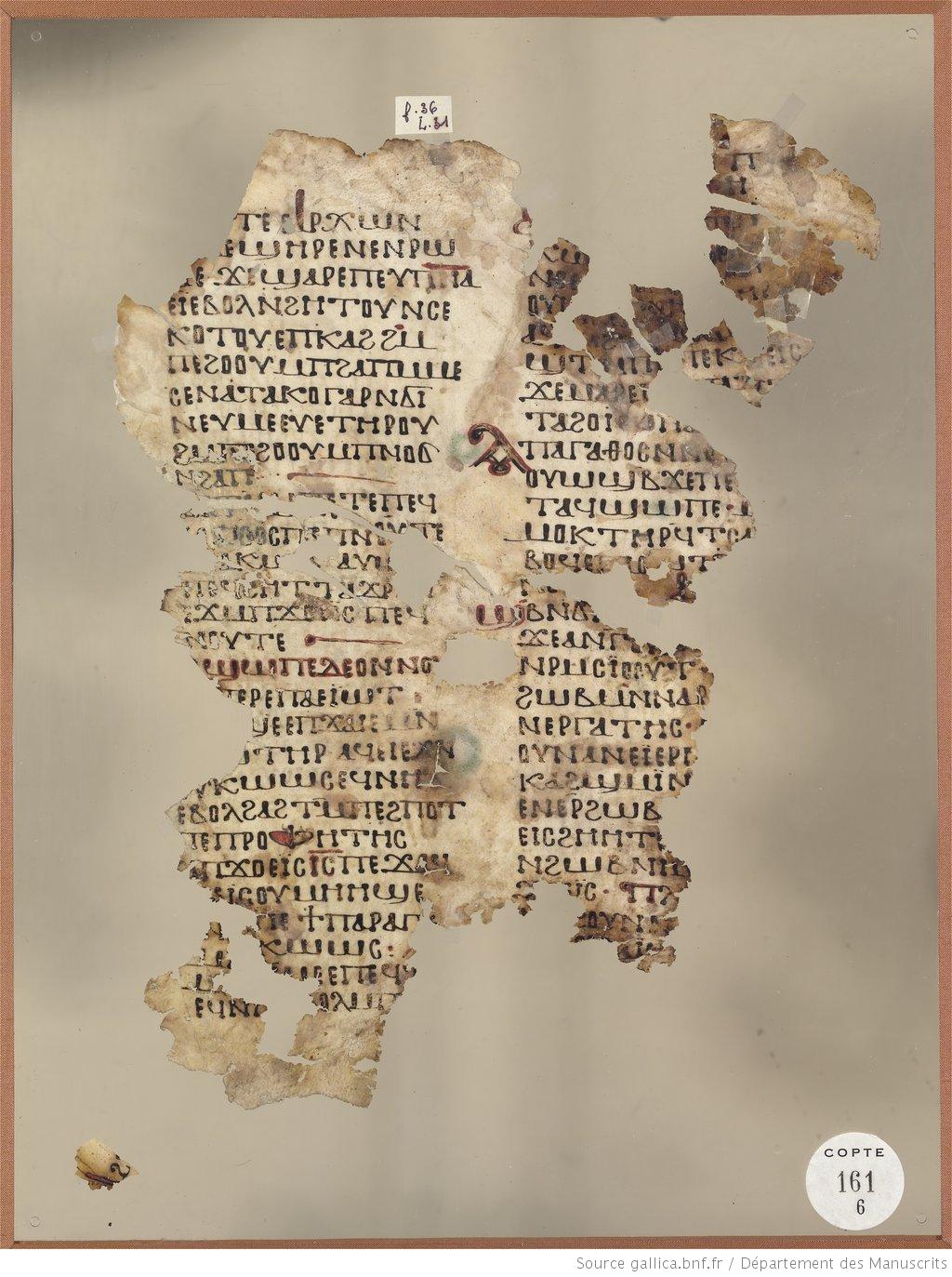
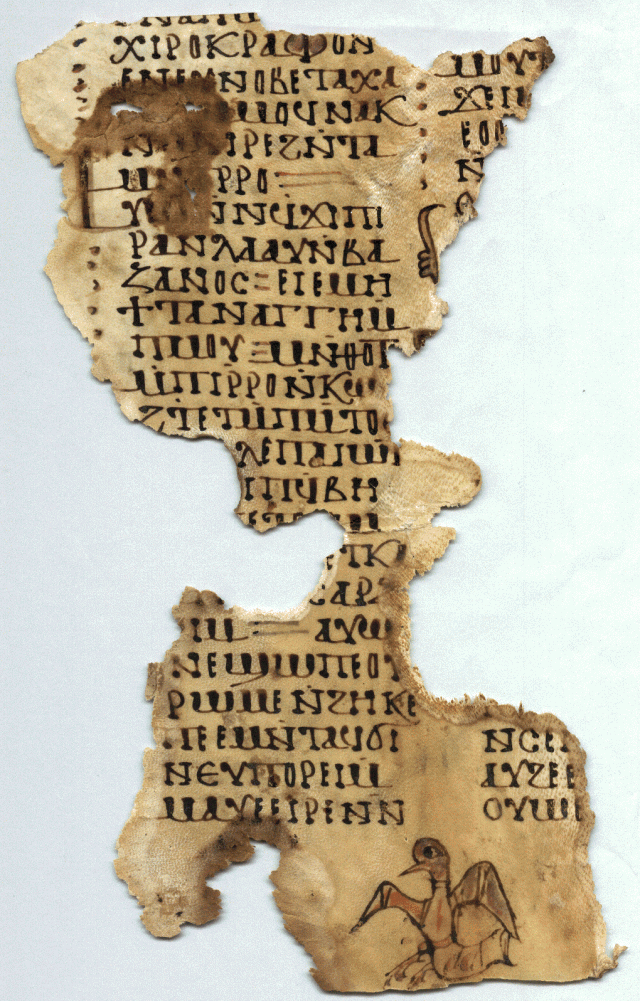
It was a nice surprise to discover a few days ago that the National Library in Paris put up on the Gallica website photographs of some of the Sahidic parchment fragments in their possession. More precisely, they have uploaded until now good quality reproductions of BnF Copte 161(6), fol. 36-44. It’s not much yet but it’s a start.

I suspect that the fragments included in BnF Copte 161(6) were donated to the library in Paris by the papyrologist Seymour de Ricci. It appears that they came from the Monastery of Apa Shenoute (aka the White Monastery) in Upper Egypt.

As most of the fragment available at Gallica have not been identified until now, here are some hints that may be helpful:

f1.highres

fol. 36 = Life of Shenoute attributed to Besa (BHO 1074-1078; clavis coptica 0461). I identified this fragment in an article to be published in Continue reading

Posted in Bible, Encomium on Pisenthius, New Testament, Shenoute of Atripe | Tagged , , , , , , , , | 5 Comments

The Martyrdom of Macrobius in Gǝʿǝz (and Arabic)

Adam McCollum has further details about Abba Macrobius, extracted from the Copto-Arabic and Gǝʿǝz synaxary.

adam_bremer-mccollum's avatarhmmlorientalia

Yesterday Alin Suciu posted a notice of a Bohairic Coptic leaf with some lines from the martyrdom of Macrobius that was recently found in a Syriac manuscript from Saint Mark’s Monastery in Jerusalem. He also mentioned the entry for that martyr in an Arabic synaxarion (published in PO 16.2, 190-193). The same entry also exists in the Gǝʿǝz synaxarion (published in PO 46.3, 304-309). The saint is commemorated on 2 Baramhāt (ⲡⲁⲣⲉⲙϩⲟⲧⲡ; see Crum 269a for the forms) in the Copto-Arabic synaxarion and 2 Mäggabit in the Gǝʿǝz synaxarion. (According to the Mensium tabulae in BHO, this date corresponds to Feb. 26 — “15 février” in the FT of PO 16 is an error; it is correctly given as “26 février” in the running title — but according to Colin’s table in PO 48.3, the Ethiopian date is Mar. 11.)

Alin notes that the new Coptic leaf has…

View original post 749 more words

Posted in Uncategorized | Leave a comment

A Coptic Bohairic Leaf Recovered from a Syriac Manuscript: A New Textual Witness of the Martyrdom of Macrobius

A couple of weeks ago, Adam McCollum (Hill Museum & Manuscript Library, Minnesota) sent me the photograph of the recto of a paper leaf written in the Bohairic dialect of Coptic. The fragment was used as an endpaper in a ca. 15th-16th century Syriac codex from the Monastery of Saint Mark in Jerusalem (shelfmark no. 64). Adam came across the fragment while cataloguing the Syriac and Arabic manuscripts in this location.

Jerusalem Bohairic

Upon inspection, it appeared to me that the leaf preserves a portion from the Martyrdom of Macrobius (clavis coptica 0286). According to Coptic hagiography, Macrobius was a bishop of Nikiou (Pshati) martyred under Diocletian.[1] The new fragment recovered from the Syriac manuscript is important because only one other fragment from this martyrdom has survived. Thus, in 1949, the Bollandist Paul Devos published a similar Bohairic leaf from the Martyrdom of Macrobius, which is preserved in the National Library in Paris as BnF Copte 151, fol. 1.[2]

Although only little has survived from the martyrdom itself, the passion of Macrobius can be reconstructed with the help of an encomium dedicated to him, attributed to a certain Menas of Pshati (BHO 583; clavis coptica 0224).[3] Similarly, the Copto-Arabic synaxary dedicates to Macrobius a note (cf. 2 Barmahat, the day of his commemoration).[4] The text of the Jerusalem fragment corresponds, grosso modo, to a portion of the Encomium on Macrobius attributed to Menas of Pshati.[5] The new fragment contains a part of the episode when Macrobius is boiled by the governor Armenius in grease, oil and pitch.

The paleographical features of the fragment suggest that it came from a codex produced in one of the monasteries of Scetis (Wadi el-Natrun), perhaps in the 10th or 11th century. Thus, its discovery in a 15th-16th century Syriac codex from Jerusalem stirs up some mystery. Luckily, we found an important clue for solving this mystery. My guess that the Bohairic manuscript came from Scetis was confirmed when Adam found the following note in Garshuni, written by the scribe of the codex in which the Coptic leaf has been pasted:

“May the mercy of God be on the one who has donated this book to the monastery of our lady the mother of God, the monastery of Scetis, and on the one who made effort again and returned it to the monastery of Scetis.”

This indicates that, before coming into the possession of the Monastery of St. Mark in Jerusalem, the Syriac manuscript belonged to the well-known monastery of Dayr al-Suryan in Scetis, Egypt. It becomes clear now that the one who manufactured the Syriac codex in the 15th or 16th century used a Bohairic manuscript fragment he had at hand, which, very likely, was not useful anymore.

Even more strikingly, the only other Bohairic fragment from the Martyrdom of Macrobius, published by Devos, has been reused in a similar way in another Syriac liturgical manuscript. However, Devos said that the Paris manuscript is a parchment fragment, while the one in Jerusalem is a paper fragment. Some further investigation of the two manuscripts may deem necessary in order to determine whether they have any connection.


[1] Cf. T. Orlandi, “Macrobius, Saint,” in A.S. Atiya, The Coptic Encyclopedia vol. 5 (New York: Macmillan, 1991) 1494.

[2] P. Devos, “Le fragment survivant de la Passion copte de S. Macrobe (Ms. Paris copte, 151),” Analecta Bollandiana 67 (1949) 153-164.

[3] Ed. in H. Hyvernat, Les actes des martyrs d’Égypte (Paris: Ernest Leroux, 1886) 225-246. Hyvernat edited the text after a manuscript in the Vatican library.

[4] R. Basset, Le synaxaire arabe Jacobite: (rédaction copte). IV, Les mois de barmahat, barmoudah et bachons (Patrologia Orientalis, 16/2; Paris: Firmin-Didot, 1922) 190-193.

[5] Hyvernat, Les actes des martyrs, 232-233.

Posted in Martyrdom of Macrobius | Tagged , , , , , , , , | 2 Comments

Latest Articles

pantocrator saqqara jeremiah cell 1795

Articles available to download.

A. Suciu, “A Coptic Fragment from the History of Joseph the Carpenter in the Collection of Duke University Library,” Harvard Theological Review 106:1 (2013) 93-104 (PDF)

The History of Joseph the Carpenter (BHO 532–533; CANT 60; clavis coptica 0037) is readily accessible in many collections of New Testament Apocrypha. The text is fully preserved in Arabic and Bohairic, which was the regional dialect of Lower Egypt, and fragmentarily in Sahidic (i.e., the dialect of Upper Egypt). The present paper introduces P. Duk. inv. 239, a previously unidentified Sahidic fragment of this writing, which surfaced recently among the manuscripts in the Special Collections Library of Duke University. The new textual witness supplies us with a portion of the History of Joseph the Carpenter previously unattested in Sahidic. Moreover, the Duke fragment displays at least one interesting variant reading, unrecorded in the Bohairic and Arabic versions of the text.

A. Suciu, “A Coptic Fragment from John Chrysostom, Quod nemo laeditur nisi a seipso (CPG 4400; BHG 488d),” Analecta Bollandiana 130 (2012) 283-293 (PDF)

Quod nemo laeditur nisi a seipso (CPG 4400) est une lettre écrite par Jean Chrysostome durant son second exil. Jusqu’à présent, on pensait que ce texte avait été conservé en grec, en latin, en syriaque et en vieux-slave. Le présent article met en lumière un frag­ment, jusqu’alors inconnu, d’une version copte du Quod nemo laeditur. Ce nouveau fragment provient du monastère d’Apa Shenouté (appelé aussi le Monastère Blanc), situé en Haute-Égypte. Sur la base d’arguments codicologiques, l’article suggère que cette version copte de la lettre de Jean Chry­sostome était abrégée. Il est en effet possible qu’un remaniement éditorial ait été réalisé en vue d’insérer la lettre Quod nemo laeditur dans un codex ha­gio­graphique consacré aux Trois Hébreux dans la fournaise.

A. Suciu, “Ps.-Theophili Alexandrini Sermo de Cruce et Latrone (CPG 2622): Edition of M595 with Parallels and Translation,” Zeitschrift für Antikes Christentum – Journal of Ancient Christianity 16 (2012) 181-225 (PDF)

Der vorliegende Beitrag bietet Edition und Übersetzung einer koptischen Homilie zum „Kreuz und dem guten Dieb“ (CPG 2622; clavis coptica 0395), welche Theophilus von Alexandria zugeschrieben wird. Die Edition basiert auf dem Pierpont Morgan Codex M595, ff. 141ro-148ro, einem Pergament-Codex aus dem 9. Jahrhundert, der zum Kloster des Erzengels Michael bei Hamuli in der Fayyum Oase gehörte. Der kritische Apparat belegt die verschiedenen Lesarten der drei anderen verbliebenen Manuskripte dieser Predigt. In der Einleitung fi ndet sich eine Beschreibung der Manuskripte sowie ein Kommentar, der die Predigt über das „Kreuz und den guten Dieb“ von Pseudo-Theophilus ins Verhältnis zur patristischen exegetischen Tradition setzt. Auf literarische Verbindungen zwischen der langen Hymne auf das Kreuz im hier editierten Text und vergleichbarem Stoff im pseudo-Chrysostsomischen Werk In venerabilem crucem sermo (CPG 4525) wird hingewiesen.

Posted in Apocrypha, Articles, History of Joseph the Carpenter, John Chrysostom, Patristics | Tagged , , , , , , , | 3 Comments

Deutschsprachiger Koptologenverband / Deutscher Orientalistentag 2013

I have received this message from Dr. Stephen Emmel. Please share.

Sehr geehrte Kolleginnen und Kollegen,

während des Koptologenkongresses in Rom im September letzten Jahres haben sich einige von uns getroffen, um den Vorschlag von Theofried Baumeister, Alessandro Bausi und Tito Orlandi, einen deutschsprachigen Koptologenverband zu gründen, zu besprechen. Bei der Gelegenheit kündigte ich an, dass der XXXII. Deutsche Orientalistentag (DOT 2013) vom 23.–27. September 2013 in Münster stattfinden wird. Im Rahmen dessen ist eine eigene Sektion “Ägyptologie / Koptologie und Christlicher Orient” geplant. In Rom wurde mein Vorschlag angenommen, dass wir den DOT 2013 als Gelegenheit nutzen sollen, die Idee eines deutschsprachigen Koptologenverbandes weiter zu diskutieren.

Zu diesem Anlass möchte ich Sie/Euch jetzt auf den DOT-2013 “Call for Papers” aufmerksam machen. In Zusammenarbeit mit meiner Münsteraner Kollegin Prof. Dr. Angelika Lohwasser (Ägyptologie) ist ein Tag im Laufe des DOT geplant, der zwischen “Ägyptologie” und “Koptologie und Christlicher Orient” geteilt wird. Ich erfülle dabei die Aufgaben des Sektionsleiters für “KCO”. Im Gegensatz zum ägyptologischen Teil unserer Sektion, der das Thema “Pharaonische Traditionen im modernen Ägypten” haben wird (als Gastvortragende wurde bereits Dr. Nadja El Shohumi, Granada, gewonnen), ist der Teil “KCO” themenoffen (und ohne Ehrengast).

Für die Diskussion der Idee eines deutschsprachigen Koptologenverbands schlage ich vor, dass wir uns am Ende des Tages im Institut für Ägyptologie und Koptologie treffen, entweder kurz nach dem letzten Vortrag (also gegen 18:00) oder etwas später, nach dem Abendessen.

Die Anmeldung für die Teilnahme am DOT 2013 sowie die Anmeldung eines Vortrags muss über die DOT-2013-E-Mail-Adresse erfolgen: dot2013@uni-muenster.de (bitte, mit cc an mich: emmstel@uni-muenster.de oder stephen.emmel@t-online.de).

Für die Anmeldung eines Vortrags werden Vortragstitel, Abstract (ca. 250 Wörter), Name, Postanschrift, Institution oder Universität, an der das Studium absolviert wurde, sowie gewünschte Sektion (“Koptologie und Christlicher Orient”) per E-Mail sowohl als .doc (oder .odt) als auch als .pdf erbeten.

Die Frist für die Anmeldung von Vorträgen ist der 31. März 2013.

Für die verbindliche Teilnahme wird um Zusendung des Namens und der Postanschrift per E-Mail an die DOT-2013-E-Mail-Adresse gebeten.

Die Teilnahmegebühr von € 100 (ermäßigt € 50) ist vor Beginn der Tagung zu entrichten, für Anmeldungen bis zum 31. Mai gilt eine reduzierte Gebühr von € 80 (ermäßigt € 40).

Alle Informationen zur Tagung finden Sie unter: http://www.dot2013.de.

Ich freue mich auf Ihre/Eure Teilnahme an DOT 2013, ob mit oder ohne Vortrag.

Mit freundlichen Grüßen
Ihr/Euer

Stephen Emmel

DOT2013-KCO-Einladung_Page_1

Posted in Announcements | Tagged , , , | 1 Comment

2nd International Symposium ‘Georgian Manuscripts’, Tbilisi, 25-30 June, 2013

I got this message today from Buba Kudava, the director of the National Centre of Manuscripts (ეროვნული ცენტრის დირექტორი) in Tbilisi, so I thought I might share:

Georgian Manuscript is an important part of the world’s cultural heritage. It represents the major phases of the evolution of the Georgian culture – development of the Georgian alphabet, written language, and philosophical, literary, legal and scientific thought, cultural contacts of the Georgian people with the outside world…

Exceptional monuments of the Georgian history and culture – handwritten books, historical documents, archives of the writers, statesmen and scholars, old printed editions are preserved in the Fonds of the National Centre of Manuscripts. Another part of the Centre’s treasury – ancient documents, manuscripts and old printed books in Greek, Arabic, Persian, Turkish, Hebrew, Armenian, Slavic, Latin and other languages – is also of
great interest for the academic circles.

The Fonds of the National Centre of Manuscripts attract Georgian and foreign scholars with their variety and antiquity. These Fonds gave birth to many interesting ideas, new interpretations, important discoveries.

Together with the study and popularization of the handwritten heritage, the National Centre has another priority – protection of this treasury: preservation, conservation and restoration, cataloguing and description, digitalization, creation of the information database of the manuscripts.

The First International Symposium “Georgian Manuscript” was held in 2009 in celebration of the 50th anniversary of the National Centre of Manuscripts. At that time it was decided that this type of scholarly forum must be organized on a regular basis once in a few years.

The aim of the current Symposium is to offer an opportunity to scholars who study Georgian and other language manuscripts, to present the results of their work in the different spheres of research. Although the title of the Symposium indicates that the forum will be mostly focused on Georgian handwritten heritage, studies of manuscripts in other languages will be also highly welcomed.

efrem_asuri

Posted in Announcements | Tagged , , , , | 2 Comments

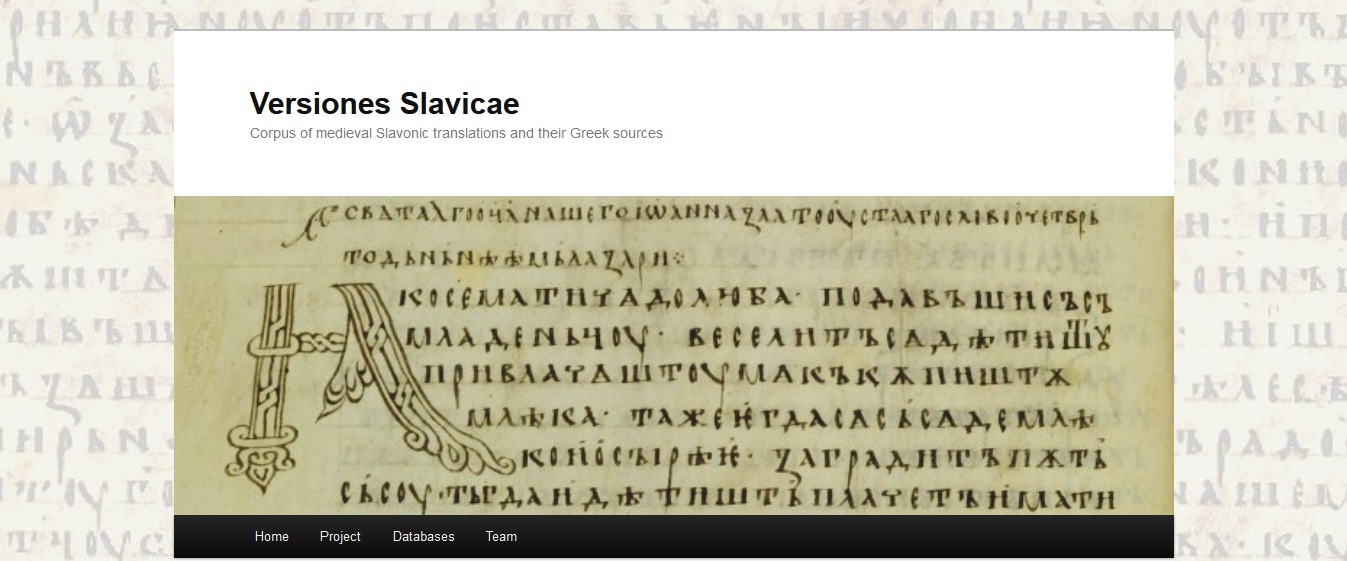
The Website of the Versiones Slavicae Project. Corpus of Medieval Slavonic Translations and Their Greek Sources

In May 2012, Dr. Yavor Miltenov introduced on this blog a new project titled The Versiones Slavicae. A Corpus of Medieval Slavonic Translations and Their Greek Sources. You can read his post here.

The aim of VERSIONES SLAVICAE initiative is to elaborate a freely accessible Internet-based electronic corpus of medieval Slavic translations and their corresponding Byzantine sources. By adding more and more data it would hopefully expand to Clavis versionum slavorum Medii Aevi – a unique research tool with no analogue in its field (Byzantine and Slavic medieval studies).

The first task during this 2-years project is to start cataloguing the works of John Chrysostom in order to test and develop our software and metadata. Chrysostomian homilies have very rich Slavonic tradition that is only partly investigated so there is also much of research to be done. We’ll add soon other texts too – hagiographical, homiletic, hymnographical, among others. Our ambiton is to represent exhaustively and bring together all the texts with their Greek parallels identified in different articles, studies, monographs and indices.

The website of the project was launched yesterday. You can find it at http://www.versiones-slavicae.com/en/

versiones slavicae

Posted in Announcements | Tagged , , , , , | 1 Comment

The Network for the Study of Esotericism in Antiquity (NSEA)

nsea

The Network for the Study of Esotericism in Antiquity announces their new website http://ancientesotericism.org/. Two dear friends, Dylan Burns (University of Copenhagen) and David Tibet (Macquarie University), are among the founding members of NSEA.

Ancient religious literature often demands a deeply interdisciplinary approach, which can be both exhilarating and challenging. This is definitely the case with online resources for the study of ancient esoteric literature, which is represented so strongly in the Nag Hammadi corpus; any student of Nag Hammadi has a wide variety of Greek, Latin, Syriac, and of course Coptic tools at their disposal to use in making sense of this material, and keeping up all these tools can seem like a job in itself. The goal with ancientesotericism.org is then to provide a website that doubles in providing news about ongoing scholarship across the various fields that deal with esotercism (e.g., Gnosticism, Neoplatonism, Jewish mysticism, etc.) alongside a portal that guides on to the sources and tools one can use to explore it.

Dylan Burns

Posted in Announcements | Tagged , , , , , | Leave a comment

Seymour de Ricci on Jean Dujardin

A few days ago, I pointed out that some of the White Monastery parchment fragments  kept in the John Rylands Library, Manchester, were collected in 1838 by a certain Jean Dujardin, during his short stay in Egypt. Dujardin died of dysentery in Cairo in August 12, 1838. In the Bibliothèque Nationale in Paris are preserved three handwritten volumes  with transcriptions of numerous Hieroglyphic, Demotic, Greek and Coptic manuscripts, which Dujardin made while he was in Egypt.

I found out about these transcriptions in 2006 from an article by Seymour de Ricci. Here is what de Ricci wrote in Revue des études grecques 13 (1900) p. 227a:

Les démotisants et les papyrologues devront désormais inscrire parmi leurs ancêtres un certain Jean Dujardin dont le nom ne m’était connu que par un passage de Letronne, jusqu’au jour où je m’aperçus qu’il existait à la Bibliothèque nationale un fonds Dujardin composé de trois volumes manuscrits. J’y trouvai nombre de copies de papyrus hiéroglyphiques coptes et grecs, un véritable Corpus de contrats démotiques dessinés à la perfection, et enfin quelques ostraka réunis de droite et de gauche.

Henceforth, the Demotists and the papyrologists will have to include among their ancestors a certain Jean Dujardin, whose name was known to me only through a passage in Letronne, until I found out that there was in the National Library a Dujardin collection, composed of three manuscript volumes. I found in them many copies of hieroglyphic, Coptic and Greek papyri, a veritable Corpus of Demotic contracts perfectly drawn, and finally some ostraka gathered from here and there.

It would be interesting if somebody could check at a certain point what texts were copied by Dujardin. I think it is likely that some of the manuscripts he transcribed are lost for good.

Posted in Memorabilia | Tagged , , , , | 2 Comments

2012 in review

When I started this blog, in January 2011, I did not believe that ‘Patristics, Apocrypha, Coptic literature and Manuscripts’ can attract so many readers. I hope to keep it up next year too and thanks to everyone who read the posts I wrote! Happy New Year!

The WordPress.com stats helper monkeys prepared a 2012 annual report for this blog.

Here’s an excerpt:

19,000 people fit into the new Barclays Center to see Jay-Z perform. This blog was viewed about 100,000 times in 2012. If it were a concert at the Barclays Center, it would take about 5 sold-out performances for that many people to see it.

In 2012, there were 85 new posts, growing the total archive of this blog to 144 posts. There were 234 pictures uploaded, taking up a total of 903 MB. That’s about 5 pictures per week.

The busiest day of the year was September 26th with 1,692 views. The most popular post that day was On the So-Called Gospel of Jesus’s Wife. Some Preliminary Thoughts by Hugo Lundhaug and Alin Suciu.

Click here to see the complete report.

Posted in Uncategorized | 2 Comments

Memorabilia: Georg Zoega on Reconstructing Coptic Manuscripts from Scattered Leaves

As the readers of my blog probably know well, the main challenge of Coptic literature is the fragmentary state in which most of the manuscripts in this language are preserved. Of course, I am not referring to the late Bohairic paper manuscripts, which are generally well-preserved, but to the papyrus and parchment codices of the first millennium in general, and to the Sahidic manuscripts of the White Monastery in particular.

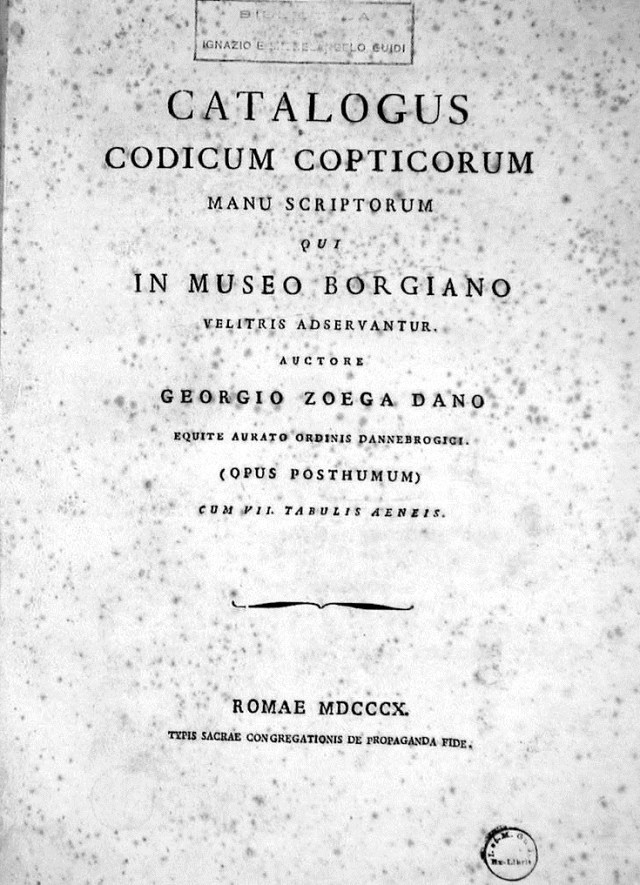
I know myself that a feeling of discouragement, ‘giving up’ and doubt inevitably arises in front of the mass of disparate manuscript fragments, apparently without connection with each other. This feeling must have been even more acute among the past generations of Coptologists, on whose shoulders we now stand. Here is an interesting passage in which the Danish scholar Georg Zoega (1755-1809) talks about the challenges he faced while cataloguing the Coptic manuscripts which are now in the Vatican (cf. G. Zoega, Catalogus codicum Copticorum manu scriptorum [printed post-mortem, Rome 1810]). I think Zoega is the first scholar to mention the reconstruction of the dismembered codices of the Monastery of Apa Shenoute (i.e. the White Monastery).

zoega

I extracted the fragment from a personal letter of Zoega (dated Rome, December 2, 1803) to his friend Arsène Thiébaut de Berneaud. The letter is quoted by Thiébaut in his Notice sur la vie et les écrits de Georges Zoëga (Paris 1809) (you can read the whole paper here):

Voilà l’idée principale de mon travail, voilà la marche et le plan de mon livre. Je peux dire avoir créé moi-même la collection que je consulte, car la plus grande partie en arrivant de l’Égypte n’étaient que des feuilles de parchemin détachées des livres auxquels elles appartenaient, et jetées ensemble dans une telle confusion, qu’il m’a fallu beaucoup de temps et de fatigues pour les développer, et découvrir leurs points de contact ou d’éloignement. C’est en consultant parfois l’écriture, le goût des ornements, la grandeur et la qualité du parchemin, et d’autres circonstances plus minutieuses encore, que je parvins à former de ces feuilles éparses des livres, ou du moins des fragments suivis, à les coordonner et distribuer par classes.

This is the main idea of ​​my work, this is the direction and the plan followed in my book. I can say that I have created myself the collection that I am consulting, because most of what came from Egypt were only sheets of parchment detached from the books to which they belonged, and thrown together in such confusion, that it took me a lot of time and fatigue to elaborate upon and discover their points of contact or dissimilitude. It was only by checking sometimes the writing, the taste for ornaments, the size and quality of the parchment, and other circumstances even more painstaking, that I managed to form from these scattered leaves books, or at least consecutive fragments, to organize and distribute them into classes. (Translation A.S.)

Posted in Memorabilia, Uncategorized | Tagged , , , , , , , | 1 Comment

The Coptic Manuscripts of Monsieur Dujardin and the Crawford Collection in the John Rylands Library, Manchester

Much of the modern circulation of the Coptic manuscript fragments from the library of the Monastery of Apa Shenoute (or, alternatively, the White Monastery) still remains unknown to us. With some exceptions, we do not know exactly how the fragments came out of their cache, from the end of the 18th century onwards, or through which hands they passed before ending up in the collections where we can now access them. Although little explored, this topic is so generous that it can constitute at any time a separate field, apart from the philological endeavor of editing and translating the manuscripts into modern languages.

Here I would like to sketch, very briefly, an interesting episode from the modern history of a cluster of fragments from the Monastery of Apa Shenoute. During my readings, I became aware of the case of a certain Jean Dujardin, a French doctor who, at the beginning of the 19th century, quit his profession in order to learn Egyptian. At that time, Egyptology was the newborn baby of philology, due to Champollion’s decipherment of the hieroglyphs. Dujardin’s good knowledge of Coptic, which was surpassed, said one of his contemporaries, only by that of the great Étienne Quatremère, recommended him to the Minister of France for a scientific expedition to Egypt. The purpose of this expedition was to rectify the embarrassing penury of Coptic manuscripts in the French collections. France could not boast  in that epoch with a collection of Coptic documents comparable to those that one could find in Italy (the Vatican collection of the cardinal Stefano Borgia or that of Giacomo Nani in Venice) or England (the British Library and  the collection of Charles Woide in Oxford).
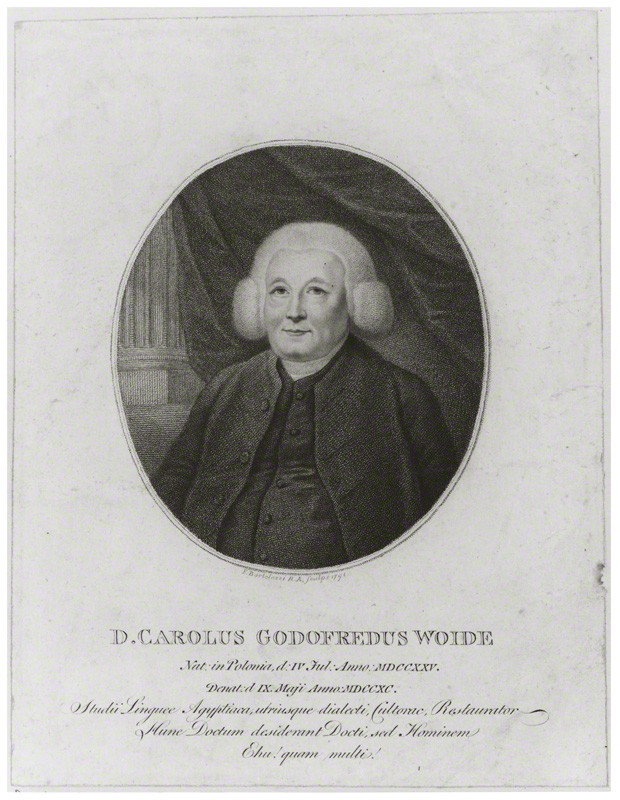
NPG D14155; Charles Godfrey Woide by Francesco Bartolozzi Portrait of Charles Woide. Copyright: National Portrait Gallery, London (source of the image)

This was a reason good enough for the authorities to send Dujardin in 1838 in search of Coptic manuscripts in Egypt. Unfortunately, not long after his arrival there, Dujardin died of dysentery, which he contacted on the Nile. However, the sure thing is that, after less than a month spent in Cairo, he managed to acquire quite a large number of Coptic manuscripts, which he was supposed to bring with him to France upon his return.  This is obvious from a report which Dujardin sent to France on July 3, 1838. The same year, an article based on this report was published in Nouvelles annales des voyages et sciences géographiques  vol. 3/1838 (Paris: Librairie de Gide, 1838) p. 363-364:

He (scil. Dujardin) had collected from various individuals thirty manuscripts … some of which are in the memphitic  dialects (sic! A.S.), others in the Sahidic dialect. Among these manuscripts, copies of which will be sent to the Minister, are: the Prophet Isaiah, the prophet Jeremiah (including Lamentations), Baruch and the Letter to the Jews taken captives to Babylon, the Book of Job, the first fourteen chapters of Proverbs, and fragments of the Books of Kings, Wisdom of Solomon, Ecclesiastes, etc.
The manuscripts in the Sahidic dialect were discovered by chance in a bundle of old parchments. These are the first two Books of Kings, a part of the Psalms of Jeremiah, of the Gospels of St. Mark and St. Luke, the Letter to the Galatians, the Acts of St. Andrew, of St. George, of St. Pteleme; the Life of St. Hilaria, the daughter of the Emperor Zeno, the Panegyric of the forty martyrs, fragments of St. Athanasius, St. John Chrysostom, St. Basil, etc. … During his stay in Egypt, he hopes to further increase significantly the mass of material that we already possess, in order to achieve the perfect knowledge of the Egyptian language. (Trans. from French A.S.)

For some reason, none of the manuscripts purchased by Dujardin has ever made it to France. Instead, the National Library in Paris possesses only his transcription of the material, made immediately after the acquisition.[1]

I am not sure what happened to the manuscripts of Dujardin after his premature death in 1838, but their description in the aforementioned report, however brief, allows us to identify their current location. Thus, the John Rylands Library in Manchester preserves in its rather small collection of Coptic parchments exactly the same works mentioned by Dujardin as being in his possession. I enumerate them here, together with their numbers in Crum’s Catalogue of the Coptic Manuscripts in the Collection of John Rylands Library, Manchester (1909):

Kings (Crum no. 2; 3 leaves); Jeremiah (Crum no. 8; 4 leaves); Gospel of Mark (Crum no. 11; 6 leaves); Gospel of Luke (Crum no. 12; 7 leaves); Galatians (Crum no. 14; 8 leaves); Acts of Andrew (Crum no. 87; 4 leaves); Martyrdom of George (Crum no. 91; 8 leaves); Martyrdom of Pteleme (i.e. Ptolemy) (Crum no. 92; 4 leaves); Life of Hilaria (Crum no. 96; 4 leaves); Panegyric on the 40 Martyrs (of Sebaste) (Crum no. 94; 8 leaves) sermons by Athanasius, Basil of Caesarea and John Chrysostom (Crum no. 62; 6 leaves).
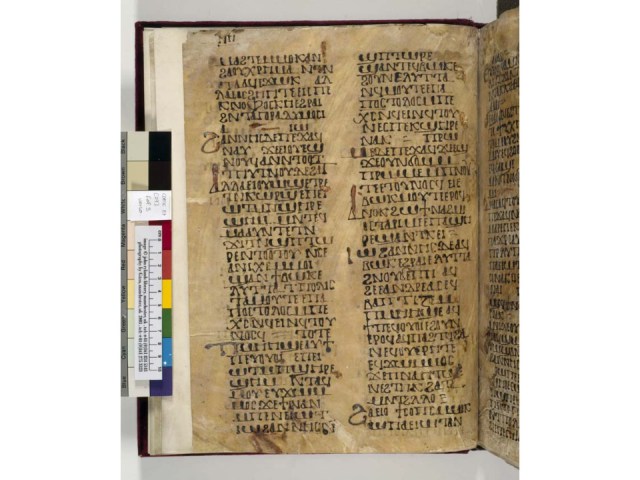
John Rylands Coptic 87 fol. 3vJohn Rylands Coptic 87, fol. 3v: the Acts of Andrew. One of the Coptic fragments in the John Rylands Library formerly in the possession of Jean Dujardin. Copyright: the John Rylands Library.

As we can see, all the Sahidic works mentioned by Dujardin are recoverable in the John Rylands collection. Although the final proof will come only after we will compare the transcription of the fragments made by the unfortunate explorer with the originals in Manchester, I would say that we already have good enough reason to believe that they are the same documents.

A further argument in this direction is supplied by what Walter Crum already knew about the John Rylands collection when he catalogued it. The collection formerly belonged to the Earl of Crawford, who bought an important part of them on June 16, 1868, at Sotheby’s. This lot of manuscripts was owned before by Henry Tattam, but his family decided to sell it in the auction six months after the death of the owner. It is noteworthy that, with the sole exception of no. 62, Crum managed to ascertain that all the other call numbers given above came from Tattam’s collection. Moreover, among the Crawford Bohairic manuscripts, formerly owned by Tattam, Crum nos. 417-418 contain exactly the same sequence of Biblical books as given by Dujardin. This makes me believe that not only the Sahidic fragments in the possession of Tattam came from Dujardin, but also some of the Bohairic codices.

I think it is likely to infer that Tattam’s collection was actually the one formed by Dujardin during his first and last journey to Egypt. What I can only guess is that some avaricious person stole Dujardin’s manuscripts after his death and sold them further. Thus, the documents never arrived to France, as they were supposed to do, but they ended up into Tattam’s hands, who was at that time travelling to Egypt and Middle East for the same purposes as Dujardin. The memoirs of this voyage were recorded by Tattam’s niece, Miss Platt, in her Journal of a Tour through Egypt, the Peninsula of Sinai, and the Holy Land, in 1838, 1839 (2 vols., printed for private circulation by R. Watts, 1841-1842). From her notes, it is clear not only that the English travellers knew about Dujardin and his unfortunate destiny, but also that they were aware that he collected Coptic manuscripts. At one point, it becomes apparent that Tattam was trying to track down these manuscripts. Here is what Miss Platt wrote in this regard:

Friday, Nov(ember) 9 (1838): … (Tattam) called … on the French Consul; with whom, and Mr. Fresnell, he went to the Frank (i.e., Catholic) Convent, to see M. Dujardin’s MSS.; but found he had only copied the first nine chapters of the Book of Job, a chapter of the Book of Kings, and one or two of the Psalms. (Platt, Voyage, vol. 1, p. 94)

It is clear, thus, that Tattam was looking for Dujardin’s manuscripts, but he managed to acquire them only after this date (i.e. November 9, 1838).

These facts reveal that the John Rylands Coptic parchments are actually part of one of the earliest collection of such documents, formed in the late 1830s. A collection which was built upon the sacrifice of a little-known pioneer in Coptology: Jean Dujardin.


[1] Bibliothèque de l’Ecole des chartes vol. 61 (Librairie Droz : Paris, 1900) p. 53 : “20391-20393. Papiers de Jean Dujardin, chargé de mission en Égypte (1838) : Copies de manuscrits coptes, de papyrus égyptiens et grecs et d’inscriptions hiéroglyphiques. – Une notice des pièces est en tête du premier volume.”; Nouvelles acquisitions du Département des manuscrits pendant les années 1900-1910 (E. Leroux : Paris, 1911) p. 53.
Posted in Uncategorized | Tagged , , , , , , , | 6 Comments

Guest Post: Ivan Miroshnikov – An Unpublished Coptic-Latin Dictionary from the Nineteenth Century

I am happy to host again here Ivan Miroshnikov, this time with an article concerning a very interesting discovery which he made in a Russian library.
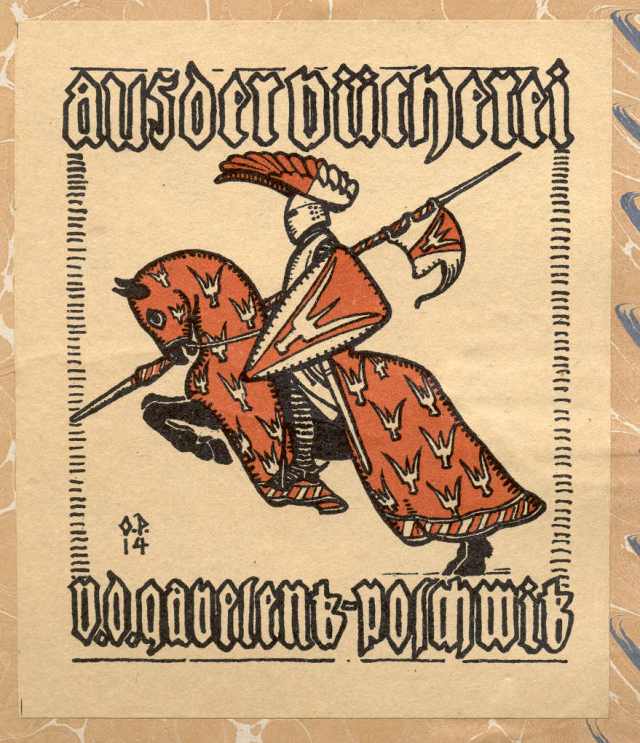
After the Allies won the World War II, many so-called ‘items of cultural value’ were moved from Germany to the Soviet Union as restitution. The items, including numerous books, were divided between various Soviet museums and libraries. This is how the Library of Foreign Literature in Moscow came into the possession of the book collection of Hans Conon von der Gabelentz and his son, Georg von der Gabelentz. According to the library’s website, the collection is ‘a marvelous example of a private professional library

E105,5-86Photo: The ex libris of the von der Gabelentz family

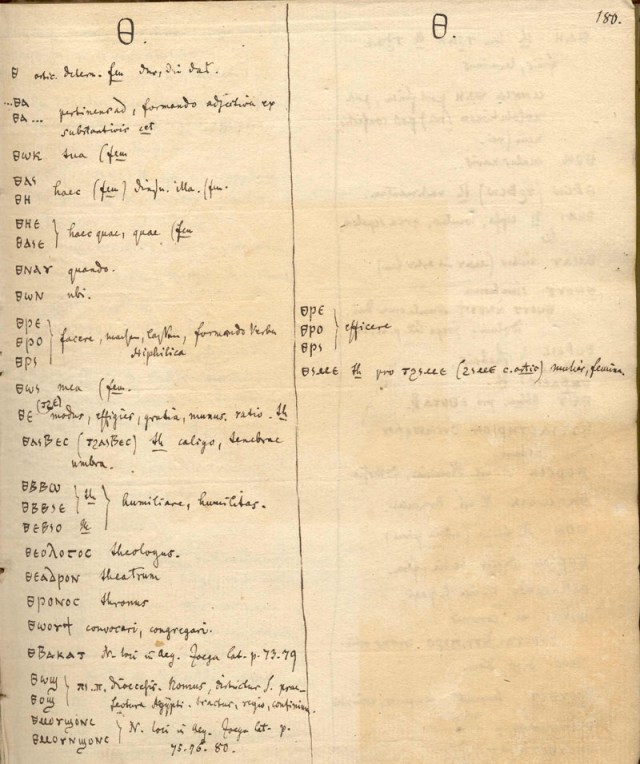
One of the items stored at the library’s department of rare books is a 4° manuscript, written on watermarked paper, called Dictionarii aegyptiaci vol<umen> II. The title is written on the back of the volume and it might had been given to the book at a later date. The book is a Coptic-Latin dictionary that apparently was never published. The volume starts on page 180 and ends on page 368. It covers the words that start with letters Θ to Ψ. There are no chapters on words starting with ΟΥ and Ω, which means that a third volume was at least in project. The first volume that might have had an introduction and the author’s name is missing. It is possible that a part of the collection is stored in some other Russian library (curiously enough, some books of the von der Gabelentz family collection belonged to the Moscow Planetarium before they were transferred to the Library of Foreign Literature).

1776376Photo: Page 180 of the dictionary (page 1 of its second volume)

The dictionary includes both Egyptian-Coptic and Greek-Coptic words. The Egyptian-Coptic words are marked as either ‘Theban’ of ‘Memphite’. The Greek-Coptic words are sometimes duplicated in their conventional form with diacritic symbols.

The manuscript seems to be a draft. Each page is divided into two parts, so that the author might fill the left part and leave the right part blank for later additions and corrections.

The author’s name is never mentioned in the manuscript. It seems that the most probable candidate for authorship is Hans-Conon von Gabelentz (1807-1874), not his son Georg (1840-1893). One argument in favor of such a suggestion is that a small piece of Herzoglich Sachsen-Altenburgisches Amts- und Nachrichtsblatt dated 1 May 1838 was found between pages 312 and 313 of the volume.

Even though the dictionary itself is obviously outdated, it still might be of some importance for those interested in the history of Coptic lexicography. Hopefully, the manuscript will be digitized next year, even though the libraries in Russia are greatly underfunded and understaffed. All in all, I will be glad to offer my help to those who are interested in studying and publishing the dictionary.

Posted in Guest Post, Memorabilia | Tagged , , , , , , , | 1 Comment

Two Forthcoming Articles on Christian Apocrypha

Here are two of my forthcoming studies on Coptic Christian traditions concerning the childhood of Christ. The versions of the papers are subsequent to the peer-review process.

1) “‘Me, This Wretched Sinner’: A Coptic Fragment from the Vision of Theophilus Concerning the Flight of the Holy Family to Egypt,” forthcoming in Vigiliae Christianae 67 (2013);

Abstract: The Vision of Theophilus is one of the important apocryphal narratives concerning the flight of the Holy Family to Egypt. Although the text is known to survive in Arabic, Ethiopic and Syriac, a lost Coptic original has long been accepted by scholars. The present paper introduces a hitherto unidentified fragment from the Coptic version of this text. The fragment came from the White Monastery in Upper Egypt and it is currently kept in the National Library in Paris. The fragment is edited in this article together with its Arabic and Ethiopic parallels.

2) “A Coptic Fragment from the History of Joseph the Carpenter in the Collection of Duke University Library,” forthcoming in Harvard Theological Review 106:1 (2013).

Abstract: The History of Joseph the Carpenter (BHO 532–533; CANT 60; clavis coptica 0037) is readily accessible in many collections of New Testament Apocrypha. The text is fully preserved in Arabic and Bohairic, which was the regional dialect of Lower Egypt, and fragmentarily in Sahidic (i.e. the dialect of Upper Egypt). The present paper introduces P. Duk. inv. 239, a previously unidentified Sahidic fragment of this writing, which surfaced recently among the manuscripts in the Special Collections Library of Duke University. The new textual witness supplies us with a portion of the History of Joseph the Carpenter previously unattested in Sahidic. Moreover, the Duke fragment displays at least one interesting variant reading, unrecorded in the Bohairic and Arabic versions of the text.

P. Duk. inv. 239r

P. Duk. inv. 239: fragment of the Sahidic version of the History of Joseph the Carpenter (source of the image)

Posted in Apocrypha, History of Joseph the Carpenter, Theophilus of Alexandria | Tagged , , , , , , | Leave a comment

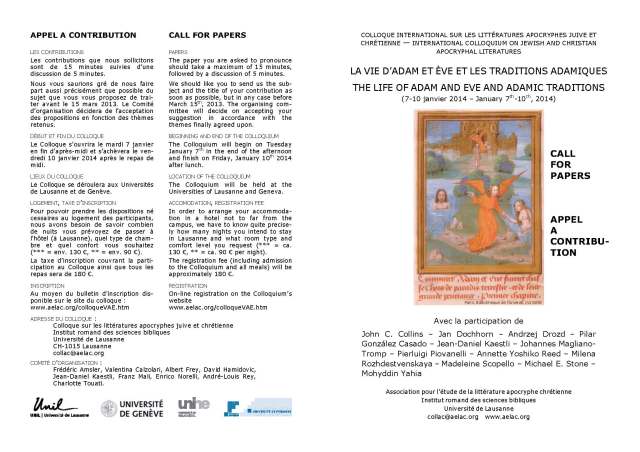
THE LIFE OF ADAM AND EVE AND ADAMIC TRADITIONS (7-10 janvier 2014 – January 7th-10th, 2014)

Merry Christmas everyone! It’s been a bit hectic around here lately and this made me take a blogging break.

However, here is an interesting message I just got from Pierluigi Piovanelli concerning the next colloquium organized by the Association pour l’étude de la littérature apocryphe chrétienne:

Pages from collac14callforpapers-1

This fourth international Colloquium on apocryphal literature is devoted to Adam and Eve in apocryphal traditions. The new edition of the Vita latina Adae et Evae just published in the Corpus Christianorum Series Apocryphorum led the AELAC to organise this meeting. It should be an opportunity to honour the memory of Jean-Pierre Pettorelli, who devoted much time and energy in the last years of his life to the completion of this outstanding edition.

In the same spirit as the 2006 Colloquium on the Pseudo-Clementine Romance, this Colloquium will focus on the different forms of the Life of Adam and Eve, and at the same time be open as regards topics and methodology. On the one hand it welcomes original research on Adamic texts and traditions from Antiquity to modern times. On the other hand it aims at promoting a dialogue between scholars using different scientific
approaches.

The members of the Organising Committee aim to encourage the participation of representatives of various disciplines in order to cast new light on the Life of Adam and Eve, in a fruitful dialogue with researchers particularly involved in the study of apocryphal
literature. They hope this meeting will highlight the fact that research on Jewish apocrypha and research on Christian apocrypha are closely interrelated.

To further an interdisciplinary approach built on a common text, the work of the Conference will be divided into two main fields:
1. Texts
1.1. At the origin of the project, the Life of Adam and Eve will be questioned from various perspectives: what are the different recensions and how do they relate? Is the work originally Jewish or Christian? How was it transmitted, interpreted and reused?
1.2. The Life of Adam and Eve belongs to a larger corpus of texts and traditions related to the protoplasts, in different languages and cultural areas. Where, when and how did these other texts and traditions originate, survive and change? What have been
their functions?
2. Themes
The Life of Adam and Eve conveys a wide range of themes, such as paradise, Satan, reflections on the origin of evil, Adam’s ultimate fate, mysteries revealed to Adam, human birth, food, relationship of man with animals, physical suffering, death,
etc.

The Colloquium is hoped to foster the understanding of the mental, cultural and religious representations found in the Adamic texts and traditions by exploiting a diversified range of knowledge (anthropology, philosophy, history of mentalities, history of social practices).

Posted in Apocrypha | Tagged , , , | Leave a comment

SBL Coptic Breakfast

Here is a message from Christian Askeland to those who will attend the SBL meeting later this month:

Society of Biblical Literature attendees with interest in Coptic language and literature are warmly invited to meet Monday morning (19 Nov) at 7am for breakfast.  We will gather at the McCormick convention center gates 43-44, where the shuttles drop conference attendees.  Afterwards, many will probably attend the 9am Nag Hammadi session.  A map is available here:

http://www.mccormickplace.com/attendees/pdf/transportation-gates.pdf


Posted in Uncategorized | Tagged , , , | Leave a comment

Guest Post: Timothy Pettipiece – Jesus’ Wife and the Failure of Early Christian Studies

On Thursday Oct 25, Karen King gave a lecture at Carleton University in Ottawa called “Controversies over Sexuality and Marriage among Early Christians: What a New Papyrus Fragment Can (or Can’t) Tell Us.” While Prof. King did little to respond to the many criticisms that have circulated as to the authenticity of the fragment, she did explain that her initial skepticism nearly prevented her from working on this document at all. Her belief in its authenticity only gradually emerged after a long period of reflection. She was equally emphatic that even if the papyrus is judged to be authentic, it provides absolutely no evidence about the historical Jesus’ marital status. This last point, she lamented, has been completely overlooked in recent media coverage and largely lost on the public. The reality of this situation was amply demonstrated by the fact that, in spite of a very nuanced presentation about early Christian debates about marriage and sexuality (to which this fragment may contribute a small piece of evidence), questions from the audience largely belaboured the point about whether or not this text proves that Jesus was wed.

In my view, the question of whether Jesus was actually married is the least interesting aspect of this whole controversy. Ironically, Karen King’s own contextualization of the fragment in comparison with other non-canonical texts such as the Gospel of Thomas and the Gospel of Philip make the superficial historical interpretation the least plausible, given what we know about the evolution of early Christian debates. The real interest of this fragment, assuming its authenticity, is to underscore the immense and ongoing diversity of opinions within the early church during the 2nd and 3rd centuries. This sophisticated analysis, which scholars of early Christianity have been building for over a century (and which is arguably more offensive to conservative Christian sensibilities than Jesus’ marriage), is simply not part of the general public’s imagination. The impression, bolstered by many in the often equally conservative Biblical Studies community, that early Christian history is only about Jesus continues to shape the public’s perception of new textual and archaeological discoveries. Clearly, the scholarly community has failed to communicate the fruits of its dynamic interdisciplinary research to the general public. At the same time, however, it has increasingly become the norm for prominent scholars to submit new discoveries to the court of public opinion before a thorough international scholarly analysis is allowed to take place. Book deals and television rights now take precedence over peer-review and patient research.

I am also disturbed at the way in which the tenor of the blogosphere debate over the fragment has degenerated from a healthy degree of skepticism over prematurely publicized results to blatant displays of academic elitism and ad hominem attack. Those critical of the fragment are labelled as either Vatican apologists or dismissed as third-rate scholars who presumptuously dare to challenge the wisdom of the Ivy League. Such rhetoric does nothing to advance the cause of Early Christian Studies, a field whose credibility is seriously weakened when its leading lights put media spin before methodological rigor.

Timothy Pettipiece is Sessional Instructor for Carleton’s College of Humanities and the University of Ottawa’s Department of Classics and Religious Studies. He received his Hon. BA in Classical Languages from the University of Guelph in 2000, and then went on to complete an MA in Religion and Culture from Wilfrid Laurier University in 2002, where he wrote a thesis on the Greek fragments of Heracleon, the earliest known commentary on the Gospel of John. He received his doctorate in Religious Studies from Université Laval in 2006, where he studied numeric patterning in Coptic Manichaean literature at the Institut d’études anciennes . He is interested in the religious culture of Late Antiquity in both the later Roman and Sasanian Persian contexts, with a specialized focus on the translation and interpretation of texts in Coptic, Greek, and Syriac. He is currently writing a biography of Mani and a commentary on Manichaean fragments found in Titus of Bostra. SOURCE

Posted in Guest Post | Tagged , , , , , | 7 Comments