J.A. de Aldama – Repertorium pseudochrysostomicum

The Repertorium pseudochrysostomicum, compiled by José Antonio de Aldama, is an invaluable tool for those interested in Patristic studies. The repertory consists of a total of 581 pseudo-Chrysostomic works preserved in Greek, which are arranged alphabetically according to their incipit. As the book is a clavis, it is not always necessary to refer to it with full bibliographical information. For example,  a simple reference like “de Aldama no. 8” inserted in an article will make clear that the author refers to the pseudo-Chrysostomic homily In parabolam de filio prodigo.
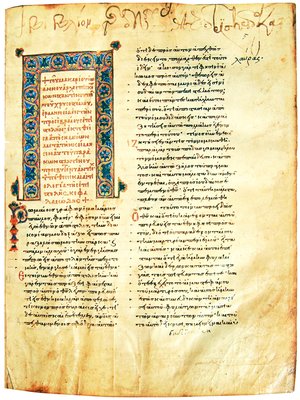
De Aldama supplied arguments concerning the spurious character of each piece he inventoried. As can be observed by flipping through the book, a good number of the pseudo-Chrysostomic homilies can be attributed to their real authors, notably to Severian of Gabala and Proclus of Constantinople. Other authors whose works are sometimes falsely attributed in the manuscripts to John Chrysostom include Asterius the Sophist, Hesychius of Jerusalem or Nestorius. Further details concerning other possible attributions can be found in the first complementum of the volume. The fourth complementum lists the genuine sermons of Chrysostom which were partly used or incorporated in the spurious ones. Of course, much work has been done in this regard since the publication of the Repertorium (1965), especially by Sever Voicu.

Download the book here: J.A. de Aldama, Repertorium pseudochrysostomicum (Documents, études et répertoires publiés par l’Institut de Recherche et d’Histoire des Textes, 10; Paris: Éditions du CNRS, 1965).

Posted in Bibliographies, John Chrysostom, Patristics, Proclus of Constantinople, Severian of Gabala | Tagged , , , , , , , , | 12 Comments

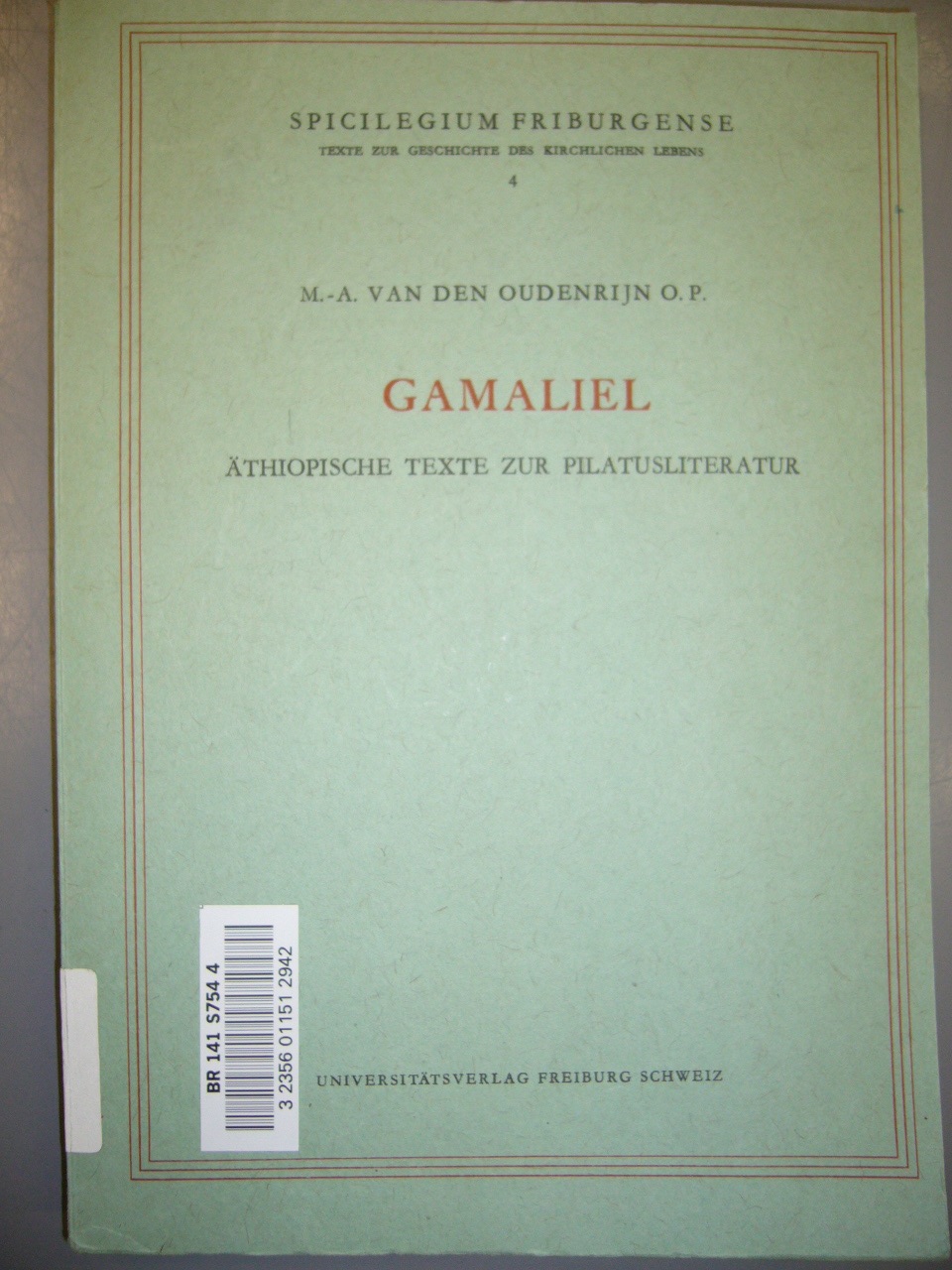
Apocrypha Bibliography: M.-A. van den Oudenrijn – Gamaliel. Äthiopische Texte zur Pilatusliteratur

This book contains the Ethiopic version of two texts attributed to Cyriacus, bishop of Behnesa (Oxyrhynchus): the Lament of Mary (ላሐ፡ ማርያም) and the Martyrdom of Pilate (ስምዐ፡ ጲላጦስ).

The first text narrates the events surrounding the Resurrection of Christ, interwoven with large portions in which Virgin Mary is portrayed as stricken by grief, weeping over the death of her son. The Lament of Mary tends to absolve Pilate from the guilt of killing Jesus Christ, putting the whole responsibility on the Jews. Convinced by the miracles which occurred during Crucifixion and Resurrection, Pilate confesses Jesus’ divine nature and becomes his follower. The Martyrdom of Pilate constitutes the continuation of the Lament of Mary, narrating the circumstances which ultimately lead to the martyr’s death of Pilate and his family. Both stories were allegedly written by Gamaliel the Elder, and later retold by Cyriacus of Behnesa, who found them in secret books deposited in the library of Jerusalem.

The Arabic version of both texts can be read in Alphonse Mingana’s Woodbrooke Studies vol. 2. Recently, I edited a Coptic fragment of the Lament of Mary together with its Arabic and Ethiopic parallel versions. The article will appear by the end of this year in the journal Aethiopica. Some preliminary notes on this fragment can be found HERE.

M.-A. van den Oudenrijn, Gamaliel. Äthiopische Texte zur Pilatusliteratur (Spicilegium Friburgense, 4; Freiburg: Universitätsverlag, 1959).

Posted in Bibliographies, Cyriacus of Behnesa | Tagged , , , , , , , , , | Leave a comment

Pachomian Bibliography 5: Boon – Pachomiana Latina

This book contains Jerome’s Latin translation of several works of Pachomius and his disciples:

1) the Rules of Pachomius;

2) the Epistles of Pachomius;

3) an Epistle of Theodorus of Tabennesi;

4) the Testament of Orsiesius;

5) the Monita S. Pachomii.

In the appendix, L.-T. Lefort offers the Coptic and Greek fragments of the Rules of Pachomius.

DOWNLOAD HERE: Amand Boon, Pachomiana latina. Règle et épîtres de s. Pachôme, épître de s. Théodore et ‘Liber’ de s. Orsiesius. Texte latin de s. Jérôme (Bibliothèque de la Revue d’histoire ecclésiastique, 7; Louvain: Universiteitbibliotheek, 1932).

Posted in Bibliographies, Pachomius | Tagged , , , , , , , , , | 3 Comments

Dr. Stephen Emmel Elected Member of the Accademia Nazionale dei Lincei

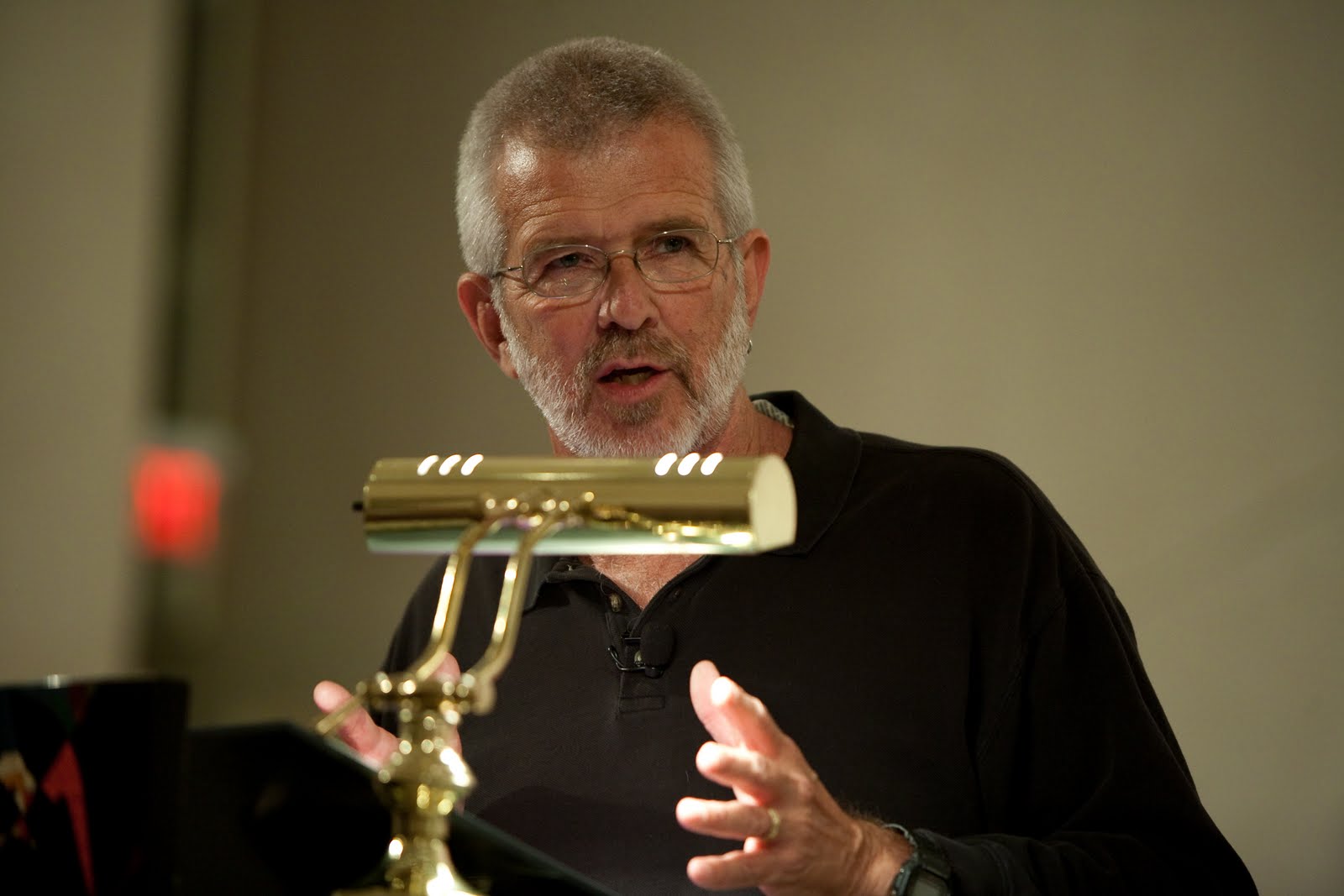
Wonderful news has come out from the Accademia Nazionale dei Lincei, the Italian academy founded in 1603. The prestigious institution has elected the Coptologist Stephen Emmel as “foreign member” (socio straniero).

Here is the news taken from the website of the Westfälischen Wilhelms-Universität, Münster (SOURCE):

Pressemitteilung upm

Große Ehre für münsterschen Koptologen

Italienische “Accademia Nazionale dei Lincei” nimmt Prof. Dr. Stephen Emmel als Mitglied auf

Prof. Dr. Stephen Emmel, Professor für Koptologie an der Westfälischen Wilhelms-Universität Münster (WWU), ist als “Socio Straniero” (ausländisches Mitglied) in die “Accademia Nazionale dei Lincei” in Rom gewählt worden.

Stephen Emmel wurde in die Klasse der Geisteswissenschaften, Kategorie Philologie und Linguistik, aufgenommen. Die Nominierung des Koptologen, der seit 1996 Professor am Institut für Ägyptologie und Koptologie der WWU Münster ist, basierte auf seinen zahlreichen Publikationen zur Literatur und Sprache der koptischen Periode in der Geschichte Ägyptens, vor allem auf seinen Beiträgen zur Erforschung der antiken koptisch-gnostischen Schriften aus den berühmten Nag-Hammadi-Codices und zur Rekonstruktion und Edition des umfangreichen Corpus der Schriften des wichtigsten koptischen Schriftstellers, des Mönchs Schenute von Atripe. Seit 2000 führt Stephen Emmel die Geschäfte der “International Association for Coptic Studies” und machte so das Institut für Ägyptologie und Koptologie der Universität Münster zu einem Hauptsitz der Gesellschaft, der er von 1996 bis 2000 auch als Präsident vorsaß.

Die “Accademia dei Lincei” wurde 1603 als private Institution zur Förderung der Naturwissenschaften gegründet. Heute gliedert sich die “Akademie der Luchsartigen” (“Lincei”) in eine natur- und eine geisteswissenschaftliche Klasse, die in verschiedene Kategorien unterteilt sind. Jeder Klasse gehören 90 ordentliche und 90 korrespondierende Mitglieder aus Italien sowie 90 ausländische Mitglieder an. Aufgabe und Ziel der Akademie ist die Förderung und Verbreitung wissenschaftlicher Erkenntnisse.

Ausländische Mitglieder der Akademie waren zum Beispiel Theodor Mommsen (Altphilologe, Archäologe, Jurist und Politiker, 1817–1903), Louis Pasteur (Chemiker und Mikrobiologe, 1822–1895), Wilhelm Röntgen (Physiker, 1845–1923), Ulrich von Wilamowitz-Moellendorff (Altphilologe, 1848–1931) und Albert Einstein (Physiker, 1879–1955). Das wohl bekannteste Akademiemitglied war Galileo Galilei (1564 – 1642), der 1611 in die Akademie aufgenommen wurde.

Posted in Articles | Tagged , , , , , , | Leave a comment

Orientalia Article

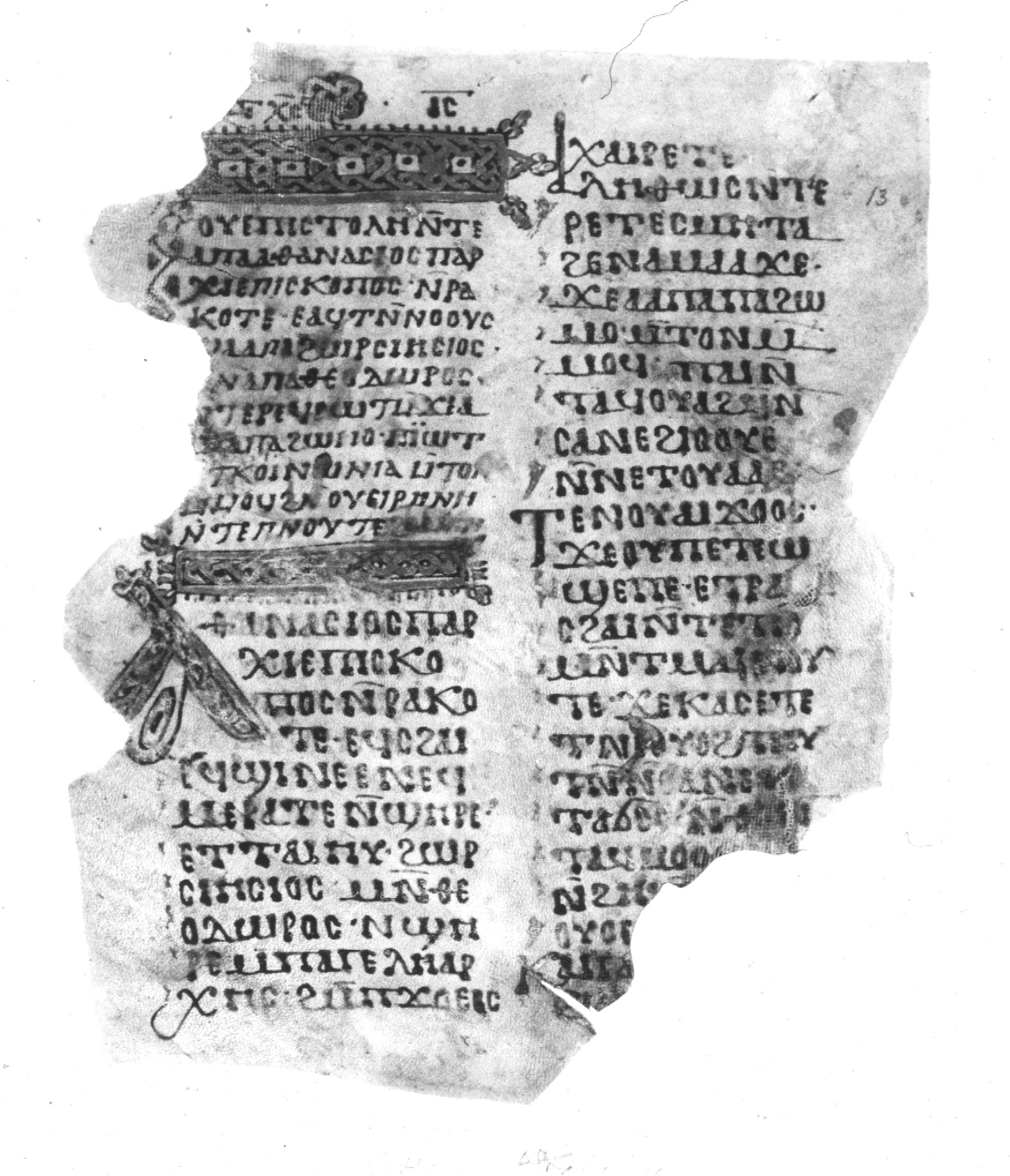
My article concerning three supplementary leaves from a Coptic parchment codex which contained texts attributed to Athanasius of Alexandria (CPG 2190 & 2191) appeared in the latest issue of the journal Orientalia (ed. by the Pontificium Institutum Biblicum, Rome). The article touches on the following fragments: Paris, Bibliothèque Nationale, Copte 131(6), f. 28; Paris, Bibliothèque Nationale, Copte 131(7), f. 32 (both from Ps-Athanasius, De homicidis, but misattributed in the past to Shenoute of Atripe) and London, British Library Or. 6807, f. 6 (Ps-Athanasius, De homicidis/Athanasius, Letter to Horsiesius and Theodorus Concerning the Death of Pachomius.

DOWNLOAD THE ARTICLE HERE: A. Suciu, “Further Leaves from a White Monastery Codex Containing Texts Attributed to Athanasius of Alexandria,” Orientalia 81 (2012) 87-90 + tab. XXII-XXVII

A better scan HERE.

Posted in Articles, Athanasius of Alexandria, Pachomius | Tagged , , , , , , , , , , , | Leave a comment

Provisional Bibliographies for the Coptological Congress

During the next Coptological congress (Rome, 17-22 September 2012), eleven scholars will deliver reports concerning the recent developments in various fields of Coptic studies:

  • Alessandro Bausi, Ethiopic literary production related to the Egyptian culture
  • Heike Behlmer, Coptic Literature (2008-2012)
  • Heinzgerd Brakmann, Coptic Liturgy (2004-2012)
  • Andrew Crislip, Shenoutean studies
  • Alain Delattre, Documentary papyrology (2008-2012)
  • James E. Goehring, Egyptian Monasticism (2008-2012)
  • Karel C. Innemée, Coptic Archaeology (2008-2012)
  • Gertrud J.M. van Loon, Coptic Art (2008-2012)
  • Tonio Sebastian Richter, Coptic Linguistics (2008-2012)
  • Sofía Torallas Tovar, Coptic Codicology and Palaeography (2004-2012)
  • Gregor Wurst, Gnosticism and Manichaeism (2008-2012)

Useful provisional bibliographies have already been supplied by Karel C. Innemée (Leiden University) and Sofía Torallas Tovar (Instituto de Lenguas y Culturas del Mediterráneo y del Próximo Oriente, Madrid). See the 2004-2012 bibliography on Coptic Codicology and Palaeography and the 2008-2012 bibliography on Coptic Archaeology.

Posted in Uncategorized | Tagged , , , , , | 1 Comment

R.I.P. Marvin Meyer

Stephan Huller announces that Marvin Meyer died yesterday. His wife, Bonnie, posted the following message on Marvin’s Facebook wall: “Hello, Facebook friends of Dr. Marvin Meyer: This is Marv’s wife Bonnie writing the sad news that Marv passed away yesterday, Aug. 16, after a battle with melanoma. His passing was peaceful, surrounded by our family. Our hearts are broken.”

I met him only once, in Helsinki, when he told us about how he came be one of the editors of the Tchacos Codex.

From his academic webpage:

Dr. Marvin Meyer (Ph.D., Claremont Graduate University; M.Div., Calvin Theological Seminary) is Griset Professor of Bible and Christian Studies and Co-Chair of the Department of Religious Studies, Chapman University. He is also Director of the Chapman University Albert Schweitzer Institute. Recently he has served as Chair of the Chapman University Faculty and President of the Faculty Senate. He is Director of the Coptic Magical Texts Project of the Institute for Antiquity and Christianity, Claremont Graduate University, Fellow of the Jesus Seminar, and a past President of the Society of Biblical Literature (Pacific Coast).

Dr. Meyer is the author of numerous books and articles on Greco-Roman and Christian religions in antiquity and late antiquity, and on Albert Schweitzer’s ethic of reverence for life. Among his most recent books are The Gnostic Gospels of Jesus (HarperCollins, 2005), The Gospels of Mary (HarperCollins, 2004), Secret Gospels: Essays on Thomas and the Secret Gospel of Mark (Trinity Press International, 2003), The Ancient Mysteries: A Sourcebook of Sacred Texts (Pennsylvania, 1999), The Unknown Sayings of Jesus (HarperCollins, 1998), The Magical Book of Mary and the Angels (P. Heid. Inv. Kopt. 685): Text, Translation, and Commentary (Heidelberg, 1996), and The Gospel of Thomas: The Hidden Sayings of Jesus (HarperCollins, 1992). He has also edited or co-edited The Gnostic Bible (Shambhala, 2003), Reverence for Life: Albert Schweitzer for the 21st Century (Syracuse, 2002), Magic and Ritual in the Ancient World (Brill, 2002), Jesus Then and Now: Images of Jesus in History and Christology (Trinity Press International, 2001), From Quest to Q (Peeters, 2000), and Ancient Christian Magic: Coptic Texts of Ritual Power (Princeton, 1999).

His books and articles have been translated into Spanish, Portuguese, French, and Japanese, and the Gospel of Thomas, of which his is the standard edition, has been listed as one of the 100 best spiritual books of the 20th century. He has been interviewed on television programs that have aired on ABC, BBC, CNN, A&E, the History Channel, and Odyssey, and on radio programs that include BBC Radio, National Public Radio, and the Voice of America. He lives with his wife, children, and dog in Orange, California.

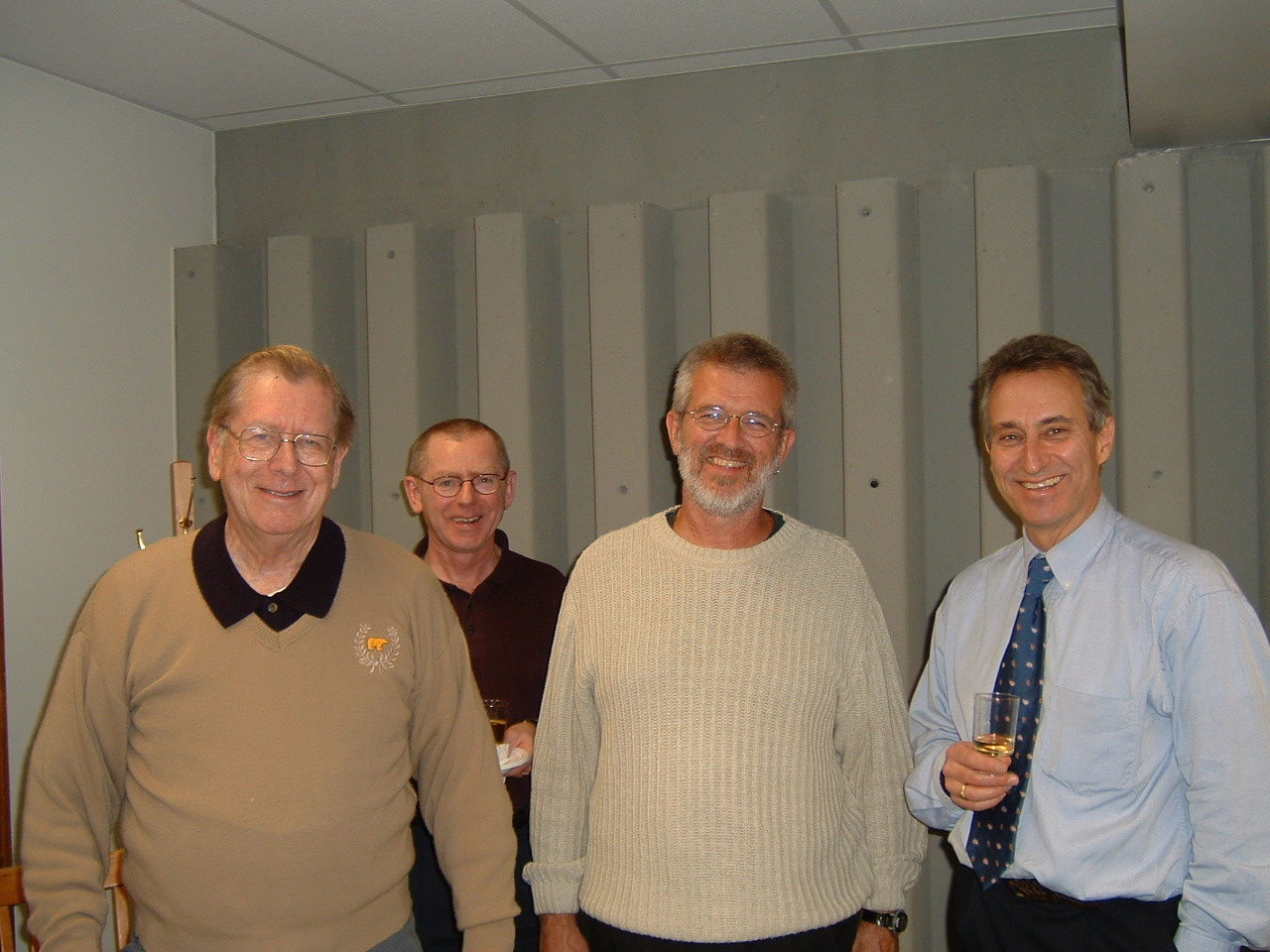
Photo: Marvin Meyer visiting the Faculty of Theology, Université Laval, Québec. From left to right: James Robinson, Paul-Hubert Poirier, Marvin Meyer and Louis Painchaud.

Posted in Uncategorized | Tagged , , , , , | 16 Comments

Guest Post: Tonio Sebastian Richter – Contact-Induced Language Change of Egyptian-Coptic: Loanword Lexicography in the DDGLC Project

Prof. Tonio Sebastian Richter (Ägyptologisches Institut der Universität Leipzig): 1992 Diploma in Protestant Theology; 1996 MA in Egyptology and Religious Studies; 1999 PhD thesis on language and style of Coptic legal documents (printed as Rechtssemantik und forensischeRhetorik Leipzig 2002; 2nd ed. Wiesbaden: Harrassowitz 2008), 2005 habilitation Pacht nach koptischen Quellen.

He specializes in Coptology; his research interests include Coptic linguistics, papyrology and epigraphy, and topics in the history of Byzantine and early Islamic Egypt, such as the history of law, social and economic history, plurilingualism and language change, pagan and Christian religion, magic, hermetism, alchemy and late antique sciences. Tonio Sebastian Richter is co-editor of the Zeitschrift für Ägyptische Sprache und Altertumskunde and of the Archiv für Papyrusforschung und verwandte Gebiete and advisory board member of Lingua Aegyptia (SOURCE).

Coptic is the name of the last phase (ca. 300 CE – 1300 CE) of the longest-attested human language available to linguistic study, the Ancient Egyptian language (Loprieno 1995 & 2001; Schenkel 1990). Next to Greek, Latin and Syriac, Coptic is one of the most important languages of ancient Christian literature. Biblical books and other early Christian texts have been translated into, and composed in Coptic. In addition, writings of ‘heretical’ movements, such as Manichaeism and Gnosticism, survived (often exclusively) in Coptic manuscripts; among them the notorious Gospel of Judas. Besides its significance as a written medium of literary texts, Coptic also served the written communication of day-to-day life. Massive finds of papyri in Egypt have revealed thousands of Coptic documentary texts, such as private and business letters, administrative writings and private legal documents. Apart from the contrast between the language used in formal, literary circumstances and that of the wider social sphere, Coptic also includes up to a dozen highly standardized written dialects (Funk 1991, Kasser 1991b), as well as a number of less standardized (or de-standardized) norms. In terms of ancient languages, the corpus of Coptic texts is extraordinarily extensive and diverse. This diversity makes generalizing work on Coptic more complex, but also more informative.

Coptic was an eminent ‘language in contact,’ mainly borrowing from two donor languages, Greek and Arabic. Continue reading

Posted in Guest Post, Uncategorized | Tagged , , , , , , | Leave a comment

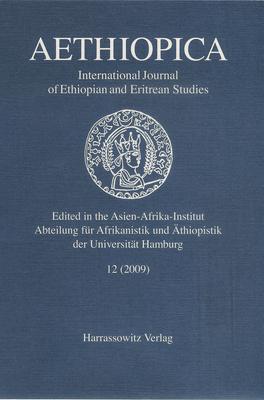
Freely Accessible Issues of the Journal Aethiopica

The website of the journal Aethiopica, edited by the Hiob Ludolf Centre for Ethiopian Studies, Hamburg University, has recently added some issues which are freely accessible.

Recommended readings for those interested in Coptic and Patristic literature:

Robert Beylot, “Cyrille de Jérusalem: Homélie sur la Présentation de Jésus,” Aethiopica 10 (2007) 58-69;

Gianfrancesco Lusini, “Gli Atti apocrifi di Marco,” Aethiopica 12 (2009) 7-47.

Posted in Uncategorized | Tagged , , , , , , | 1 Comment

Two Research Positions in Coptic Studies (Georg Steindorff Egyptological Institute, University of Leipzig)

Franziska Naether announces on Facebook that two positions in Coptic studies are available in Tonio Sebastian Richter’s project in Leipzig (Database and Dictionary of Greek Loanwords in Coptic [DDGLC]). Details concerning this project can be found HERE.

Two research positions in the field of Coptology,
– a Research Associate position (full time) and
– a Research Assistant position (half time)

are available to work with Professor Tonio Sebastian Richter on the project Database and Dictionary of Greek Loanwords in Coptic (DDGLC), a long-term project funded by the Deutsche Forschungsgemeinschaft and hosted by the Egyptological Institute –Georg Steindorff– of the University of Leipzig. The DDGLC project aims at a systematic, comprehensive and detailed lexicographical compilation and description of Greek loanwords as attested in the entire Coptic corpus through all dialects and sorts of text. Its intended outcome shall be provided in an online database and in a printed dictionary. For further particulars about the DDGLC project please follow this link: http://www.unileipzig.de/~ddglc/.

Applicants for the research associate position should have a PhD in Classical Studies, Coptology, Early Christian Studies, Egyptology, Linguistics, or related disciplines. A deep knowledge of Coptic, a profound knowledge of Greek, and an active acquaintance with linguistics are preconditions. Previous experience in e-humanities is desirable. The successful candidate will be expected to co-direct the DDGLC team, to substantially contribute to the lexicographical input, to do research in Coptic language and linguistics, and to carry out some administrative duties. The opportunity to academic teaching at small scale is given, if wanted.

The post is available from 1 January 2013 and will be initially appointed for up to 31 October 2015. The funds for this post are available until 31 October 2015 in the first instance with the possibility of funding for a further three years. Salary is within grade E14 according to the German collective labour agreement for the public service (TV-L).

Applicants for the research assistant position should have a degree (B.A. hons. or M.A.) in Classical Studies, Coptology, Early Christian Studies, Egyptology, Linguistics, or related disciplines. Good skills in Coptic and a sound knowledge of Greek are preconditions. Previous experience in e-humanities would be an advantage. Applicants will be expected to have the intention to work on a PhD in the field of Coptic language and linguistics. If the thesis topic has a focus on linguistic typology, such as loanword typology or diachronic typology, a temporary affiliation to the Department of Linguistics of the Leipzig Max Planck Institute for evolutionary anthropology (Professor Bernard Comrie) would be an option.

The post, which is a fixed term contract, is available from 1 January 2013 until 31 October 2015. Salary is within grade E13 according to the German collective labour agreement for the public service (TV-L).

Applicants for both positions are required to submit a CV, certificates of academic degrees, and a cover letter outlining the applicant’s research interests, academic background and suitability for the role, and giving the full contact details of two referees, on paper to

Prof. Dr. Tonio Sebastian Richter
Ägyptologisches Institut –Georg Steindorff–
Goethestr. 2, 04109 Leipzig
Germany

or in electronic files to <sebricht@rz.uni-leipzig.de>

by 15 October 2012.

SOURCE OF THE DOCUMENT

Posted in Uncategorized | Tagged , , , , , | 2 Comments

Lorenzo Perrone’s Lecture on Origen’s Homilies on the Psalms

On July 9, 2012, Dr. Lorenzo Perrone (University of Bologna) delivered a lecture entitled “Rediscovering Origen Today: First Impressions on the Newly Discovered Collection of Homilies on the Psalms,” at the Israel Institute for Advanced Studies in Jerusalem. The website of the Institute made available the video recording of the lecture.

Posted in Articles | 4 Comments

Kartvelological Summer School “Georgian Script” (July 17-26, 2012, Tbilisi)

I received from Dr. Buba Kudava, the director of the National Centre of Manuscripts in Tbilisi, an interesting announcement concerning the Kartvelological Summer School “Georgian Script,” which shall take place from 17th to 26th July 2012 in Tbilisi, Georgia.

“The school program is intended for foreigners interested in Georgian culture, especially in Georgian script and manuscript heritage.

The target groups of the program are foreign researchers and students. The working language of the Summer School is English.

The aims of the kartvelological summer school “Georgian Script” is to spread “Georgian Script”, as an important achievement of Georgian culture, on an international level; to popularize Kartvelological sciences, focusing on the multi-faceted, multi-national foundations of Georgian manuscript culture; and to prepare the basis of future international cooperation among the Centre and Summer school attendees.

All costs regarding to accommodation, food and traveling within Georgia of the Summer School’s participants, EXCEPT OF THE TRAVELING COSTS TO AND FROM GEORGIA will be covered by the National Centre of Manuscripts. The Project is financed by the Shota Rustaveli National Science Foundation of Georgia.”

The application form must be sent “no later than 2nd of July, 2012, on this e-mail address: summerschool@manuscript.ac.ge. Successful candidates will be notified by the 7th of July, 2012.” Continue reading

Posted in Uncategorized | Tagged , , , , , , | 1 Comment

Update: AELAC Meeting, Dole, June 28-30 2012. Schedule and Paper Abstract

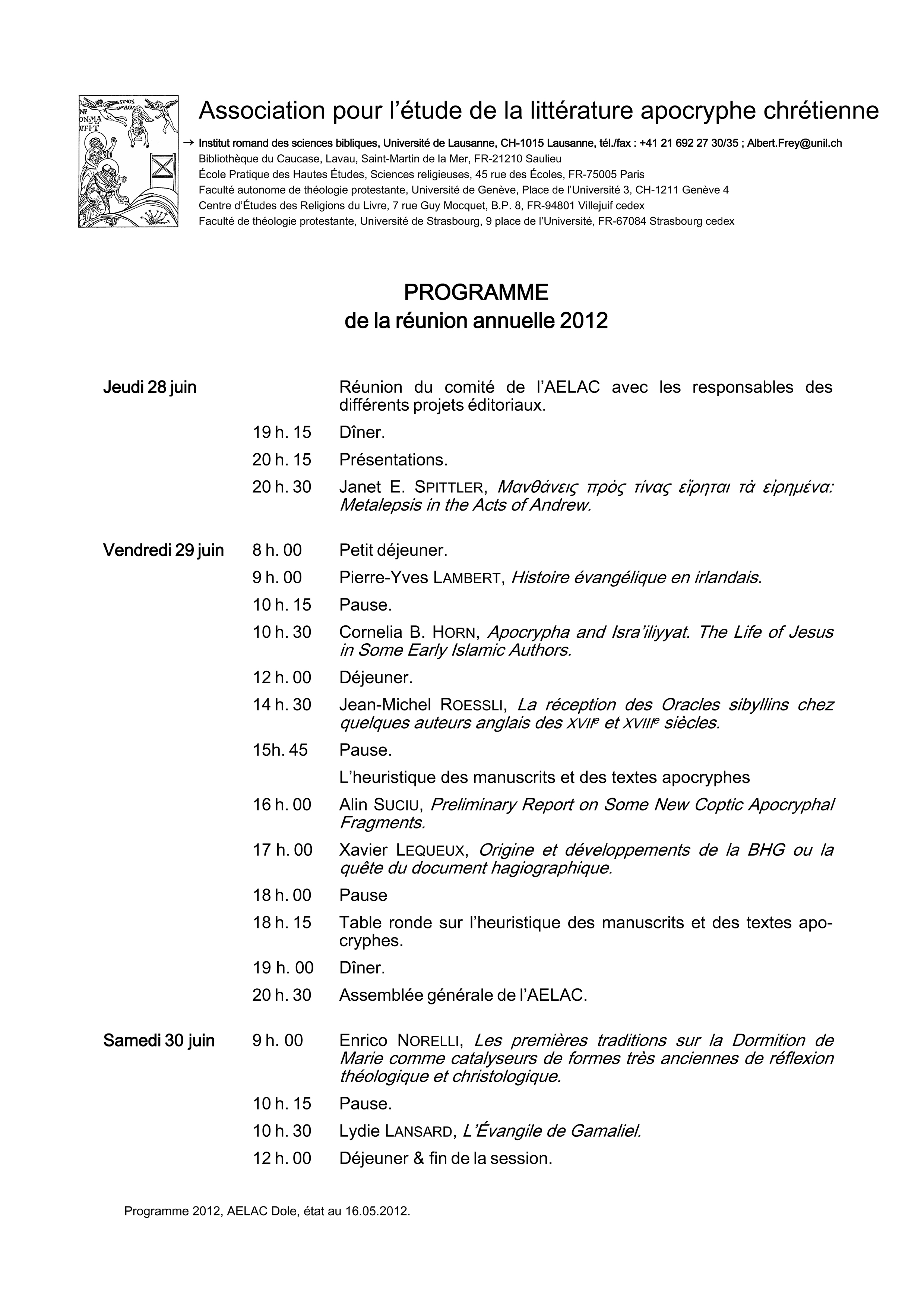
On June 29, I will be presenting a paper at the Association pour l’étude de la littérature apocryphe chrétienne (AELAC) meeting, which shall take place in Dole, France. You can find below the complete program of the conference and the abstract of my paper.

Preliminary Reports on Some New Coptic Apocryphal Fragments

Alin Suciu (Université Laval, Québec/Hiob Ludolf Zentrum für Äthiopistik, Hamburg)

My presentation is formed of three brief reports concerning several new Coptic apocryphal fragments.

1. Coptic Apocryphal Fragments Sold at Sotheby’s

In July 2009, Sotheby’s auctioned ten fragments of Coptic parchment manuscripts from the White Monastery. These were purchased by the Bolaffi house in Turin. It seems that the Italian antiquities dealers then sold them on, the current whereabouts of the fragments being unknown. Several apocryphal writings have been identified in the Sotheby-Bolaffi lot: a fragment from the Acts of John, two fragments from the writings attributed to Evodius, the disciple of the apostle Peter, and two others from the sermons of Ps.-Cyril of Jerusalem which also contain apocryphal material. My presentation of the fragments shall touch upon their identification and on the reconstruction of the White Monastery codices to which they originally belonged.

2. New Fragments from the Coptic Version of Visio Pauli

The Coptic version of the Visio Pauli has been known to survive only in a Sahidic paper codex which was published by E.A. Wallis Budge in 1915. Two new fragments from a different Sahidic manuscript surfaced recently in a private collection.  These fragments can be dated on paleographical grounds to the 6th or 7th century CE, thus being the earliest testimony of the Visio Pauli. It is interesting to note that, unlike most of the other versions, which are written in the first person singular, the new textual witness recounts Paul’s visions in the third person singular. This rare feature has been attested, until now, only by some late Latin manuscripts.

3. Newly Identified Fragments from Codex Tchacos

It has been already established that Bruce Ferrini sold several fragments from codex Tchacos before the court obliged him to return the manuscript to Frieda Nussberger-Tchacos, its legal owner. Some of the fragments sold piecemeal by Ferrini have been introduced by Herbert Krosney, Marvin Meyer, and Gregor Wurst in a 2010 issue of the journal Early Christianity. Recently, during research carried on some small size collections of Coptic manuscripts, I identified several previously unknown fragments of the same codex. They belong to the writing conventionally called the Book of Allogenes, which immediately follows the Gospel of Judas in Codex Tchacos. One of the fragments is especially interesting as it has helped us to recover some of the opening lines of this gnostic text.

Posted in Uncategorized | Tagged , , , , , , , , | 2 Comments

Doctoral and Postdoctoral Positions Available for Those Interested in Nag Hammadi (and Related) Codices

A few days ago, Hugo Lundhaug announced me that a doctoral and a postdoctoral fellowship are available in his project New Contexts for Old Texts: Unorthodox Texts and Monastic Manuscript Culture in Fourth- and Fifth-Century Egypt (NEWCONT). The project is developed under the umbrella of the Faculty of Theology, University of Oslo. “It is a project that aims to shed new light on the production, use, and significance of the Nag Hammadi codices and related manuscripts, in the context of Fourth- and Fifth-Century Christianity in Egypt.” For more information about this interesting project check THIS PAGE.

PhD fellowship (original announcement here):

PhD Fellowship on the Nag Hammadi (and related) Codices in Their Fourth- and Fifth-Century Contexts

A PhD-position is available at the Faculty of Theology, University of Oslo. The position is attached to the ERC-project New Contexts for Old Texts: Unorthodox Texts and Monastic Manuscript Culture in Fourth- and Fifth-Century Egypt (NEWCONT). The fellowship is for a period of 3 years. Continue reading

Posted in Uncategorized | Tagged , , , , , , | Leave a comment

Greek Paleography Tutorial Based on Bayerische Staatsbibliothek, Cod. graec. 314

Alex Poulos posted a Greek paleography tutorial with examples taken from Bayerische Staatsbibliothek, Cod. graec. 314 (Origen, Homilies on the Psalms). The tutorial “[i]s targeted at people who have at least an intermediate knowledge of Greek, but haven’t done much paleography themselves (ie, they haven’t read from manuscripts) … it will allow one to take part in excitement of the new discovery.” SEE THE TUTORIAL HERE.

Posted in Uncategorized | Tagged , , , , , | 2 Comments

Alex Poulos translated some portions of Bayerische Staatsbibliothek, Cod. graec. 314.

Alex Poulos's avatarAlex Poulos, PhD

As promised, this post will contain a short transcription and translation of Bayerische Staatsbibliothek, Codex graeca 314, the codex which scholars recently have rediscovered and believe contains a large number of homilies of Origen of Alexandria. Alin Suciu and Roger Pearse both have great summaries of the discovery. Mark Bilby has noted on Suciu’s blog that these may well be the earliest, large scale treatments on the Psalms extant, which means they are a big deal.

I picked a rather arbitrary spot to transcribe and translate. I decided to start with the 3rd homily on Psalm 76 (LXX). This begins on folio 193v (page 393 in my PDF). In this excerpt, Origen is commenting on the nature of the “waters which see God,” which comes from Psalm 77:16 (Hebrew numbering). The NETS translates it thus, “The waters saw you, O God, the waters saw you and writhed; the very depths…

View original post 807 more words

Posted in Articles | 3 Comments

Roger Pearse on Origen’s Homilies on the Psalms

Over at Roger Pearse’s blog, you can read two interesting posts about the homilies on the Psalms by Origen, which have been recovered recently in a Greek manuscript kept in the Bavarian State Library in Munich.

In the first post, Roger discusses Jerome’s Letter 33, listing the works of Origen. In the second, he tells Which of Origen’s homilies on the Psalms were previously known, and more on Jerome.

Posted in Old Testament, Patristics, Psalms | Tagged , , , , | 2 Comments

Lorenzo Perrone About Origen’s Newly Discovered Homilies on the Psalms

Via Lorenzo Perrone:

Bologna, the 10th of June 2012

Dear Colleagues and Friends,

On the 21st of May, a day after the first severe earthquake since centuries began to shake my region, I was asked an expertise on a Greek manuscript of Munich.

Prof. Anna Meschini Pontani, from Padua University, informed me that Dr. Marina Molin Pradel, who is preparing the new catalogue of the Greek manuscripts of the Bayerische Staatsbibliothek, wished to submit to my attention a discovery she had made on Holy Thursday. While examining the content of Codex Monacensis Graecus 314 (11th-12th century), an anonymous collection of 29 homilies on the Psalms, she discovered that the manuscript included the Greek text of four of the five homilies of Origen on Psalm 36 (H36Ps I-IV). Moreover, she noticed that the list of the other homilies corresponded to a large extent to that presented by Jerome in his Letter 33 to Paula, the most important group being the series of nine homilies on Psalm 77.

I worked hastily in the following weeks to go through the considerable manuscript (371 folios) and check its content. More and more, albeit still provisionally, I have come to the conclusion that we have to do with a lot of lost homilies of Origen. My conviction is supported, among other things, by the exegetical treatment presented by the homilies, the doctrinal elements they preserve, the stylistic features which are typical of the great Alexandrian. In addition, some excerpts of these homilies were already known to us under his name in some catenae fragments edited in PG 17 and the Analecta Sacra of Pitra, especially with regard to Psalm 77.

Only a thorough examination of the texts transmitted by the Codex Monacensis Graecus 314 will permit to extend with reasonable certainty the attribution to Origen of all the remaining homilies or of part of them, besides the Homilies I-IV on Psalm 36.

I have already begun with the transcription of the manuscript and hope to complete it before the end of the summer, in order to make the texts accessible to scholars. Together with my colleagues Chiara Barilli, Antonio Cacciari and Emanuela Prinzivalli I plan to prepare without delay a critical edition of the homilies.

Marina Molin Pradel will present her discovery and offer some samples of the manuscript in the next issue of Adamantius, due to be published before the autumn.

A series of initiatives are planned to announce the discovery of the new texts to the scholarly world and to promote their knowledge and study.

On monday the 11th of June the Bayerische Staatsbibliothek will release a public statement about the discovery.

A seminar will take place at Padua University the 25th of June and a day-conference is planned for the 5th of December in Munich at the Bayerische Staatsbibliothek.

Together with the colleagues of the Italian Research Group on Origen and the Alexandrian Tradition we plan a conference in Bologna next February, exactly one year after the one devoted to the prospect of a new edition of Origen’s commentaries on the Psalms, in cooperation with the colleagues of the Berlin-Brandenburgische Akademie der Wissenschaft.

At the time we were submerged by the snow no less than by the uncomfortable impression of the heavy task still waiting the editors of the catenae fragments. Now, in the middle of renewed quakes, we have been given an unexpected gift that we would like to share with all those who love Origen.

Lorenzo Perrone

Posted in Patristics, Psalms, Uncategorized | Tagged , , , , , , | 5 Comments

Guest Post: Mark Bilby on the Recent Discovery of Origen’s Homilies on the Psalms

N.B.: Mark relied on the information supplied in the modern Latin note which opens the manuscript. For the real content of the codex cf. “update 2” of my previous post.

This is a major find. The note in the Corpus Patrum Graecorum (vol 1, pg 149), which assigns the reference # 1426 to this work of Origen’s on the Psalms, only lists the smallest of fragments and catena excerpts previously extant. This may well be the earliest major Christian treatment of the Psalms now extant.

I took a look at the title and summary page to get a better sense of the contents. The title says “Homilies on the Psalter, by an uncertain author, up to Psalm 81 as the end.” According to the summary page at the front of the manuscript, there are two parts.

The first contains:

  • two homilies on Psalm 16 (LXX 15)
  • four on Psalm 32 (LXX 31)
  •  two on Psalm 68 (LXX 67)
  • three on Psalm 74 (LXX 73)
  • one on Psalm 75 (LXX 74)
  • one on Psalm 76 (LXX 75)
  • one on Psalm 77 (LXX 76)
  • one on Psalm 78 (LXX 77)

The second contains:

  • four on Psalm 78 (LXX 77)
  • one on Psalm 81 (LXX 80)
  • one on Psalm 82 (LXX 81)

The commentaries on Ambrose and Augustine on the Psalms have been translated into English and have gained hearings in various scholarly settings. Perhaps this major find will bring about a renewed interest in Origen’s other works on the Psalms (CPG 1425, 1427-1429, 1503.9), as well as the many, many other Greek commentaries still awaiting translation, analysis, and broader circulation. The list of neglected works for the fourth century alone includes those by Eusebius of Caesarea (CPG 3467), Athanasius (CPG 2140), Evagrius Ponticus (2455), Didymus of Alexandria (CPG 2550-2551), Basil of Caesarea (CPG 2836), Diodore of Tarsus (CPG 3818), Theodore of Mopsuestia (CPG 3833), and Asterius Ignotus (so renamed by Wolfram Kinzig; CPG 2815-2816).

Posted in Guest Post, Patristics, Psalms | Tagged , , , , , , | 8 Comments

The Rediscovery of Origen’s Homilies on the Psalms (Bayerische Staatsbibliothek, Cod. graec. 314)

The Bavarian State Library in Munich announces that Origen’s homilies on the Psalms have been discovered in an 11th century Greek manuscript. Excerpt from the press release:

Spektakulärer Fund: Griechische Originalpredigten des Origenes von Alexandria entdeckt

Bei der Katalogisierung der griechischen Handschriften aus der Büchersammlung Johann Jakob Fuggers wurde kürzlich in der Bayerischen Staatsbibliothek eine spektakuläre Entdeckung gemacht. Die Philologin Marina Molin Pradel identifizierte bei der Katalogisierung einer Handschrift zahlreiche Texte der bislang nicht im Original bekannten griechischen Predigten zu den Psalmen von Origenes von Alexandria (185 – 253/54 n. Chr.), dem bedeutendsten Theologen der frühen christlichen Kirche vor Augustinus. Dieser Fund ist für die Forschung von nicht hoch genug einzuschätzender Bedeutung. Die Zuordnung zu Origenes wurde vom international anerkannten Origenes-Experten Lorenzo Perrone von der Universität Bologna mit höchster Wahrscheinlichkeit bestätigt.

More details on the website of the library. Roger Pearse already offered an English translation of the press release. The photographic reproduction of the entire codex is available HERE.

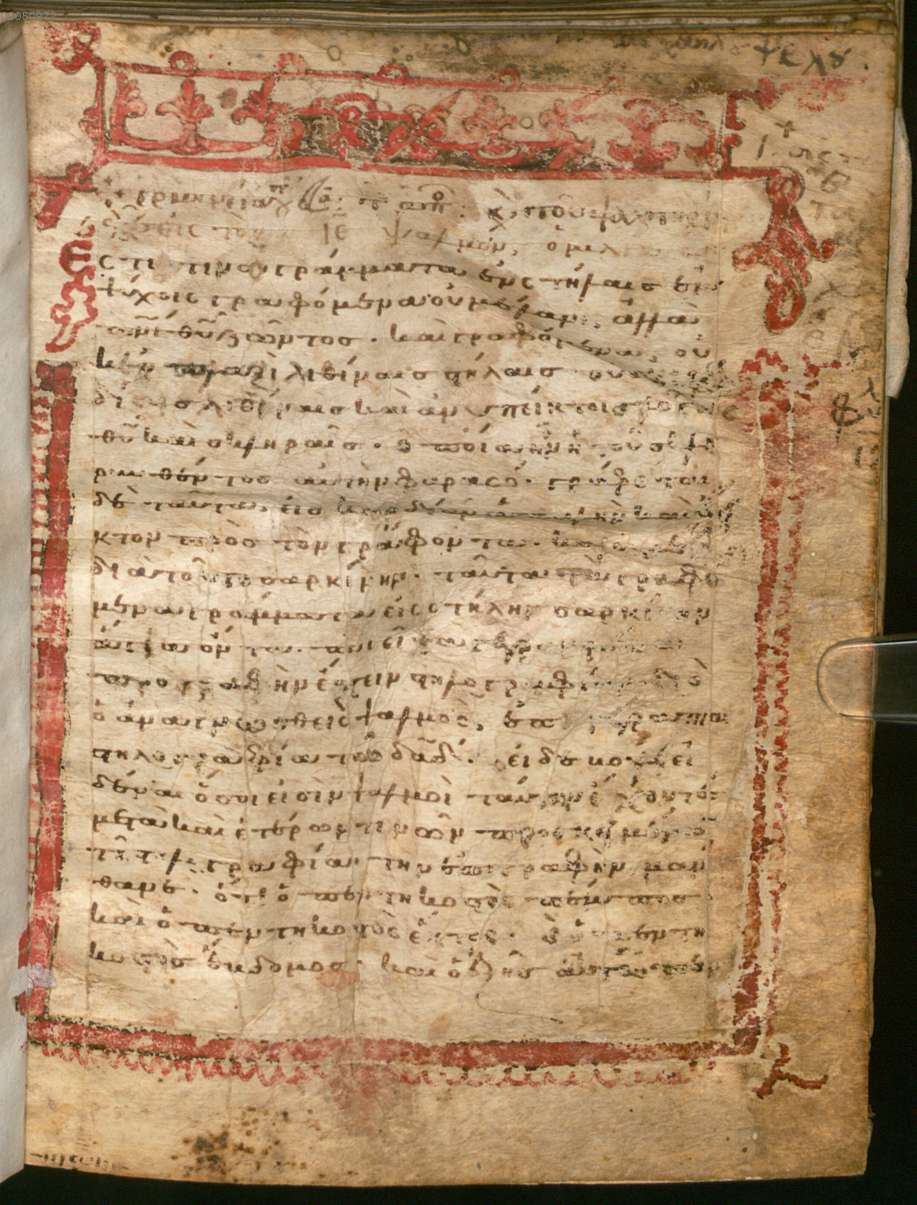
Photo: Title page of Bayerische Staatsbibliothek, Cod.graec. 314, which contains Origen’s Homilies on the Psalms (source of the photograph)

UPDATE 1: Dr. Lorenzo Perrone (University of Bologna), who identified Origen’s homilies, will soon present his discovery on this blog. Stay tuned.

UPDATE 2: The homilies are arranged into two books (tomos). The first book (foll. 1-273 according to a modern foliation) contains 2 homilies on Ps. XV, 4 homilies on Ps. XXXI, 2 homilies on Ps. LXVI (although the modern note in Latin which opens the manuscript mentions 3 homilies on this Psalm), 3 homilies on Ps. LXXIII, 1 homily in Ps. LXXIV, 1 homily in Ps. LXXV, 4 homilies on Ps. LXXVI. The volume ends with the first 5 homilies on Ps. LXXVII.

The second book starts on the verso of fol. 273. It contains homilies 6-9 on Ps. LXXVII, 2 homilies on Ps. LXXX and 1 homily on Ps. LXXXI.

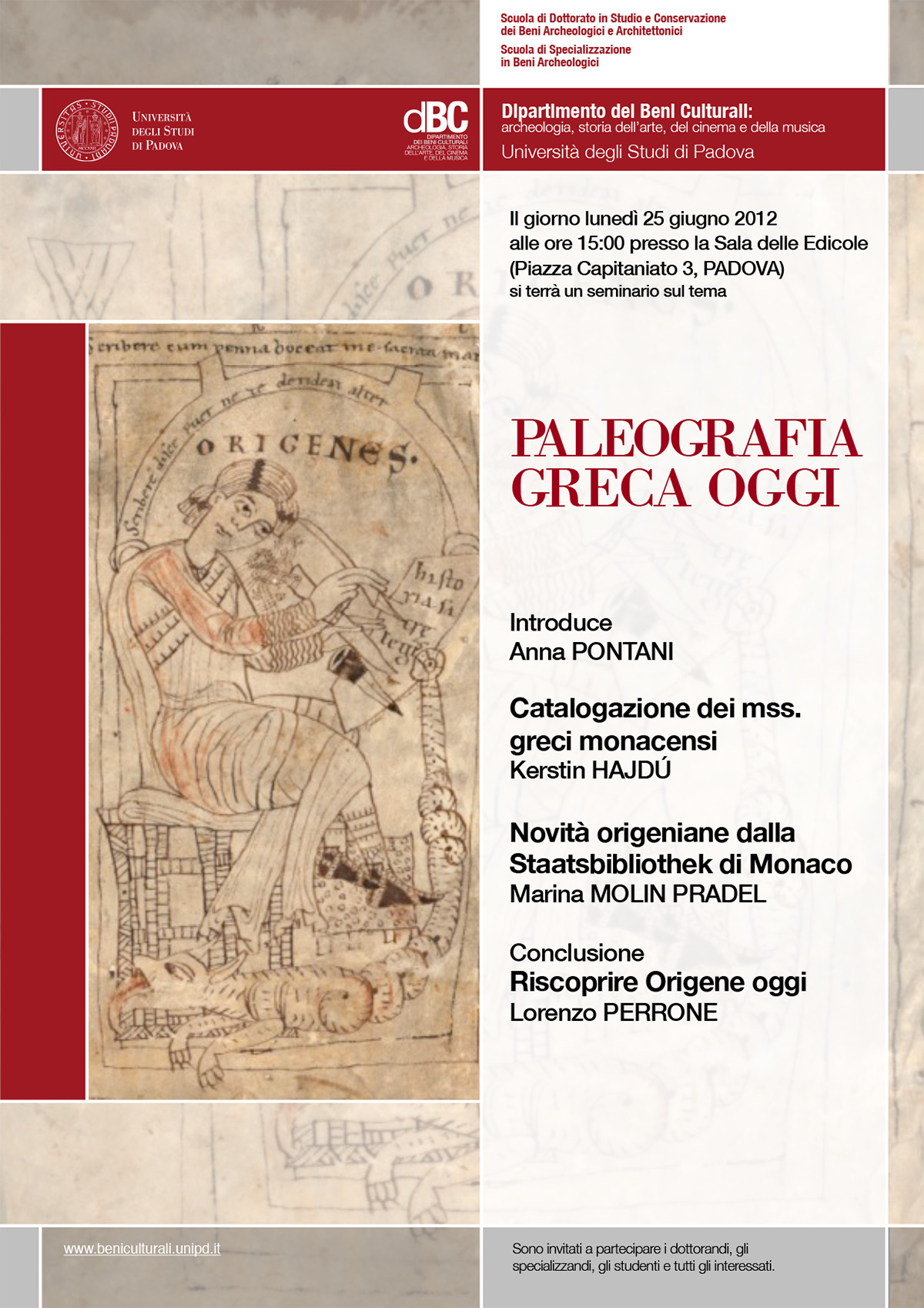
UPDATE 3: The blog Paleografia Greca announced yesterday the schedule for the seminar “Paleografia greca oggi” (“Greek Paleography Today”), which will take place at Padua University on June 25. Marina Molin Pradel shall present a paper titled “Novità origeniane dalla Staatsbibliothek di Monaco,” in which she will be talking about her identification of Origen’s homilies on the Psalms.

UPDATE 4: On Evangelical Textual Criticism blog, Dirk Jongkind discusses a quotation from 1 Cor 4:13 in one of the newly discovered homilies of Origen, remarking that the New Testament text is “cited with δυσφημουμενοι instead of the more widespread βλασφημουμενοι.”

UPDATE 5: Alex Poulos writes about The Genre of the Origen Homilies.

Posted in Patristics, Psalms | Tagged , , , | 11 Comments