A Book Dedication by Gérard Garitte

A few years ago, I bought from a second-hand bookstore the edition of the Georgian version of St. Antony’s letters. The book was published in 1955 by Gérard Garitte in the Corpus scriptorum christianorum orientalium (CSCO) collection and appeared in two separate volumes (G. Garitte, Lettres de S. Antoine. Version géorgienne et fragments coptes [CSCO, 148 & 149. Scriptores iberici, 5 & 6; Louvain: Imprimerie orientaliste L. Durbecq, 1955]). The first volume contains the critical edition of the Georgian text together with the surviving Coptic fragments. The second volume offers their translation into Latin.
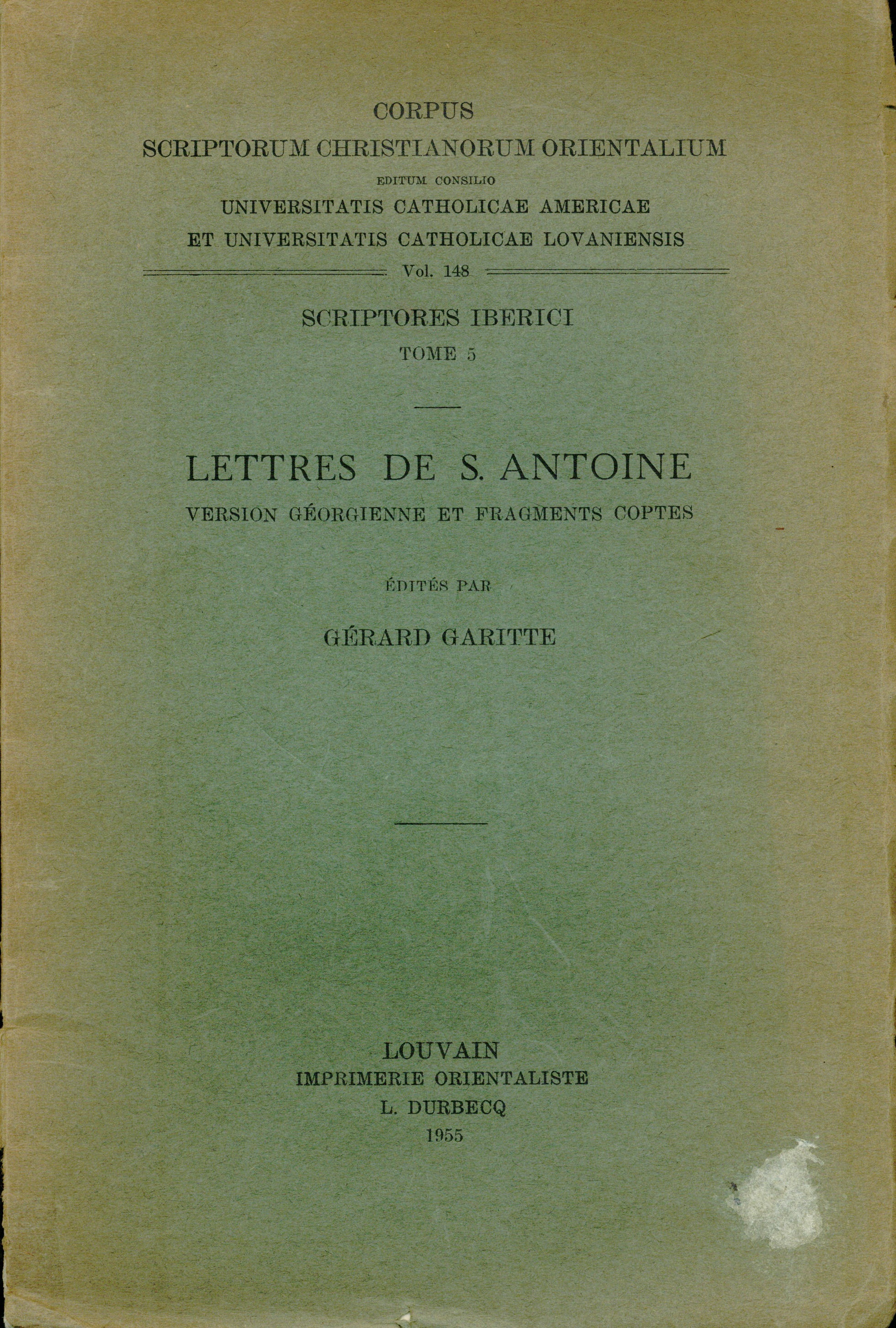
When I first opened the book, I was surprised to discover on the front page of the first volume a dedication in Georgian written by Gérard Garitte himself:
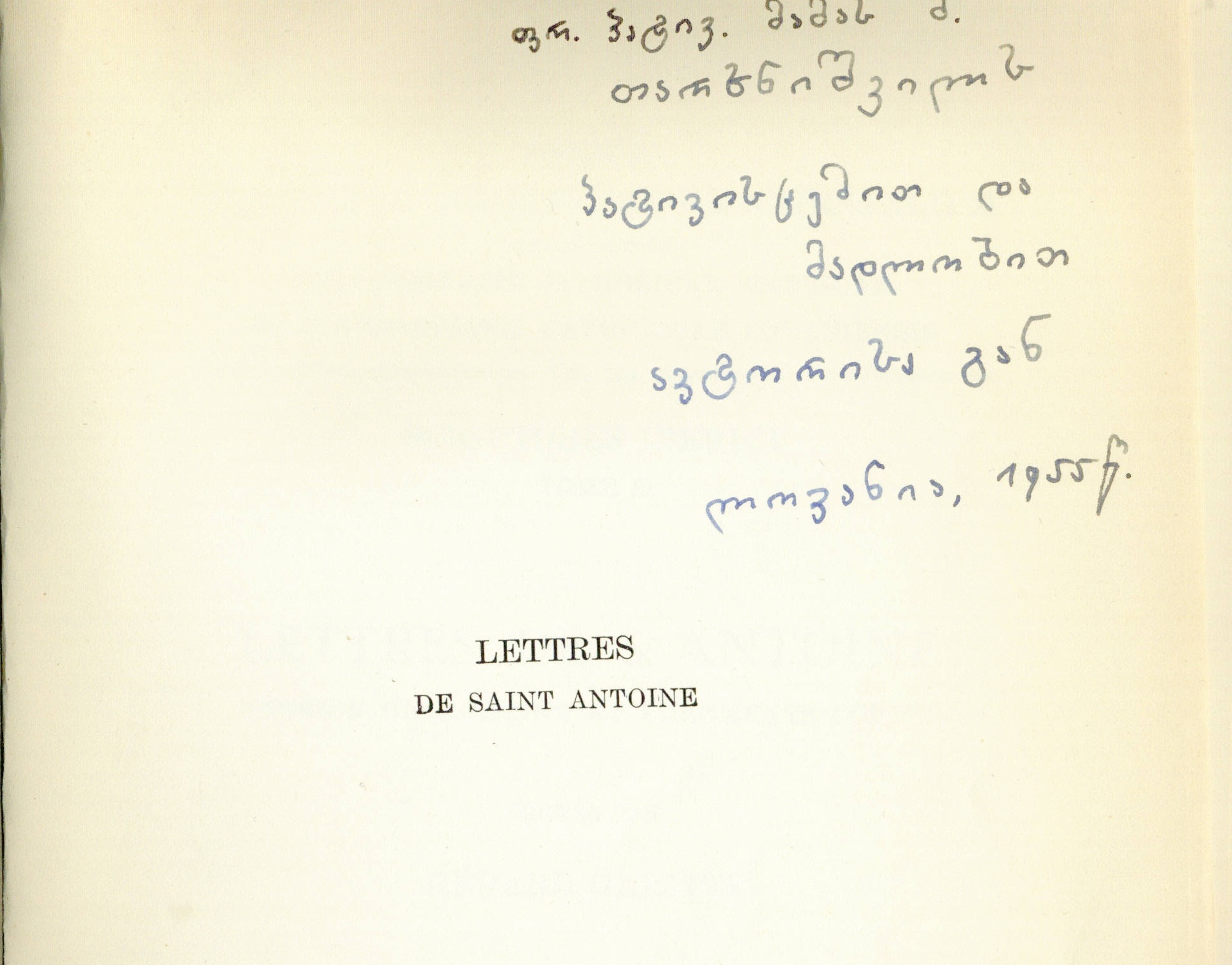
ფრ. პატივ. მამას მ.თარხნიშვილს პატივისცემით და მადლობით ავტორისაგან ლოვანია, 1955წ.

To dearest father M. Tarkhnishvili, with respect and gratitude from the author. Louvain, 1955.

Both volumes are still marked in several places with the stamp of their former owner, “P. Michele Tarchnišvili.”

For those who do not know, it was M. Tarkhnishvili (1897-1958) who made known to Western scholars the treasures of Georgian literature, especially through his magnum opus Geschichte der kirchlichen georgischen Literatur (Vatican 1955). If you want to read more about this brilliant scholar, you can find some information HERE. Gérard Garitte (1914-1990) was Tarkhnishvili’s disciple and taught at the Catholic University in Louvain.

Dr. Buba Kudava, who helped me to read Garitte’s dedication, told me that there is little material related to Father Tarkhnishvili in Georgia. This is largely due to the fact that he never returned to his native country after 1919, spending most of his life in the Vatican, as a scholar and Catholic priest. In 1921, Georgia was attacked by the Soviet army and a few years later, in 1924, it became part of the Transcaucasian Socialist Federative Soviet Republic. The reasons why Tarkhnishvili was stuck in the West are thus obvious.

This being the case, I decided to offer the book to the National Centre of Manuscripts in Tbilisi (director: Buba Kudava), an institution which is doing an excellent job in preserving the Christian heritage of Georgia. This is just a small sign of my esteem for a scholar who had done so much for our knowledge of Eastern Christianity.

Posted in Uncategorized | Tagged , , , , , | 3 Comments

More Fragments From the Catechetical Orations of St. Cyril of Jerusalem in Coptic

In 1974, Tito Orlandi published a volume containing some of the Coptic literary papyri in the collection of the Austrian National Library in Vienna.[1] His publication revealed the existence of several previously unknown Coptic versions of Greek Patristic works. Equally interesting are the fragments K 8502a-i, which had been identified by Prof. Orlandi as coming from the Catechetical Orations of St. Cyril of Jerusalem.[2] Before the discovery of the Vienna material, only one other Coptic fragment from the catecheses of Cyril was known to exist. This fragment, which is kept today in the Heidelberg University Library (P. Heid. inv. kopt. 450), was published by the German papyrologist Friedrich Bilabel but it was identified only later by Carl Schmidt.[3] The Heidelberg papyrus contains a portion of the 6th Catechetical Oration. Here is the photograph of the fragment’s verso:

(source of the photograph)

In his turn, Tito Orlandi published nine fragments (K 8502a-i) from a different papyrus codex, but which all belong to the same catechesis (the sixth) Continue reading

Posted in Cyril of Jerusalem, Patristics | Tagged , , , , , , , , , , , | 1 Comment

Christie’s Auction of an Early Christian Papyrus Document

On June 13, Christie’s will be organizing an auction that will include the opportunity to purchase several Coptic manuscripts. The details of this auction can be found on their website (HERE, HERE, or HERE). From the information supplied by Christie’s, I was able to infer that the manuscripts on sale belonged to Lawrence Feinberg, an American collector who died in 2009. THIS WEBSITE gives the following information concerning Feinberg:

“Lawrence Feinberg was originally on the path to becoming a chemical engineer, but changed direction and followed his passion for papyrology. Mastering Greek, Latin, Egyptian, and various Semitic languages, he received his Master’s Degree from Columbia University in 1967.
He was hired by Columbia in 1968 to sort and preserve more than 1,000 papyri and vellum fragments that the university had acquired from Egyptian dealers. During this project, he discovered one of the oldest written fragments of Homer’s Odyssey, dating to the third century B.C.
Lawrence became a specialist in ancient manuscripts and established a business in rare books and manuscripts out of his home”

It is interesting to note that among the items on sale there are five papyrus fragments which contain portions from 1 Kingdoms (1 Samuel) in Greek. They were edited by their former owner in 1969 in the Harvard Theological Review.[1]

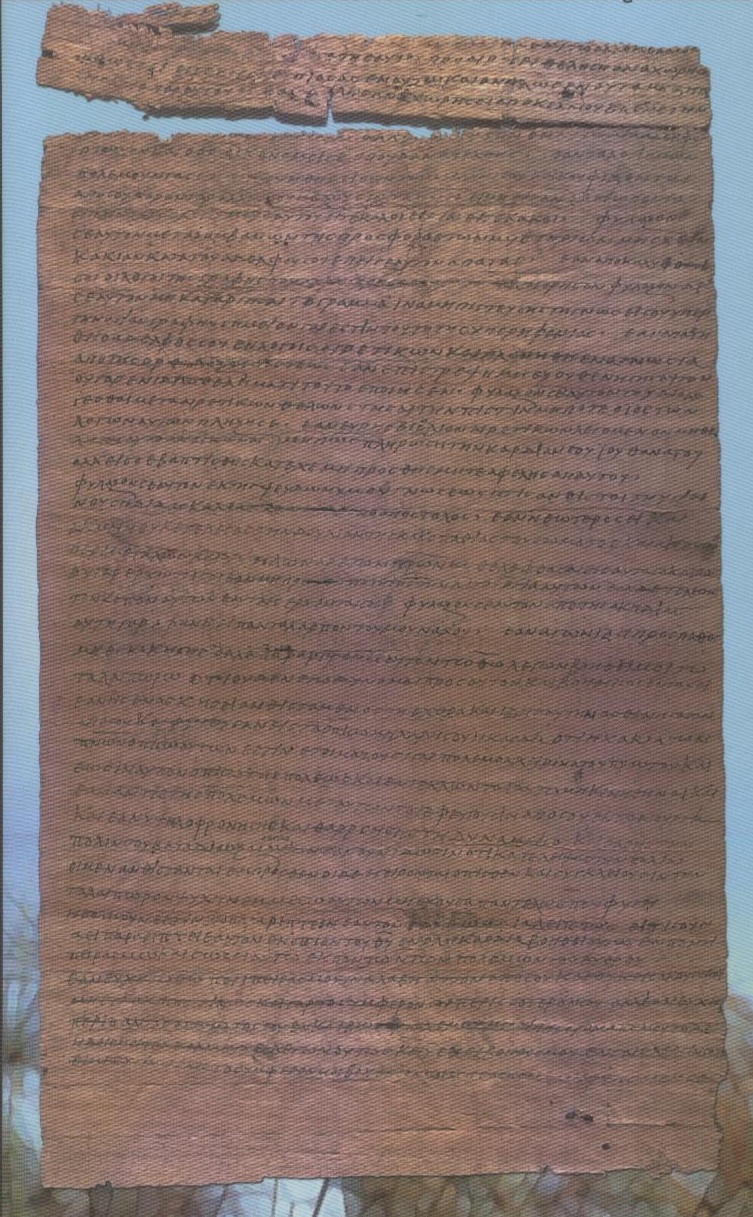
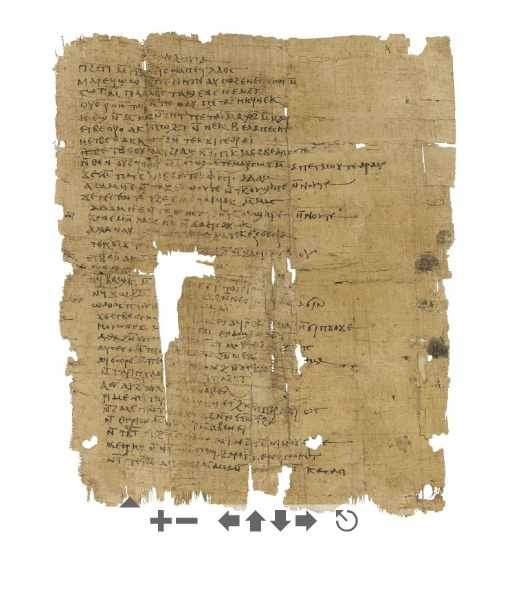
However, there is another manuscript to be sold in the auction which, to me, is even more remarkable. The item appears to be a large fragment from a papyrus roll, described by the auction house as, “A very early Manichaean Psalm text, Ode on the Judgment of God on a papyrus leaf in Akhmimic Coptic.” This sounds, indeed, intriguing. Is this a new Manichaean text? A new document in the Akhmimic dialect? Doubtless, this is also extremely thought provoking for those interested in early Christian literature. Here is a description of the text’s content provided by the seller:

The text of the present manuscript, which is substantial, contains references to the serpent (line 10: ‘even as a serpent ceases [its] strike, that [serpent] hears [and] speaks to them), to Patek (line 11), to Adam (lines 11-12: ‘Adam, as you [are] a God, you [are] a son of God’) and to Genesis 3.2 (line 30: ‘Weep for me all ye trees which [are] in paradise’).

Now below is the picture of the manuscript taken from Christie’s site:

After I examined the picture, I discussed this papyrus with Wolf-Peter Funk and we came to some conclusions. In all certainty, the document is of high interest, being perhaps one of our earliest Coptic literary manuscripts (4th century AD?). This is suggested not only by the script and dialectal features, but also by the fact that it comes from a papyrus roll, not a codex, and Coptic literary scrolls are very rare. Continue reading

Posted in Apocrypha, Bible, Psalms | Tagged , , , , , , , , , | 13 Comments

Paul C Dilley's avatarHieroi Logoi

From March 14-July 8, 2012, the Metropolitan Museum of Art is hosting a special exhibition, “Byzantium and Islam: Age of Transition.”  The exhibition has a strong online presence, including an extraordinary video of the Red Monastery, one of the best-preserved examples of Late Antique church architecture, especially noted for its vibrantly colored paintings.

View original post 166 more words

Posted in Articles | Leave a comment

Another Patristic Text Attested in Coptic: Gregory of Nazianzus Oration 16 (Pennsylvania University Museum E 16310)

A few days ago, I pointed out that the Pennsylvania University Museum holds a previously unidentified fragment from the Coptic version of the Apophthegmata Patrum. I shall now discuss another unidentified fragment from this collection.

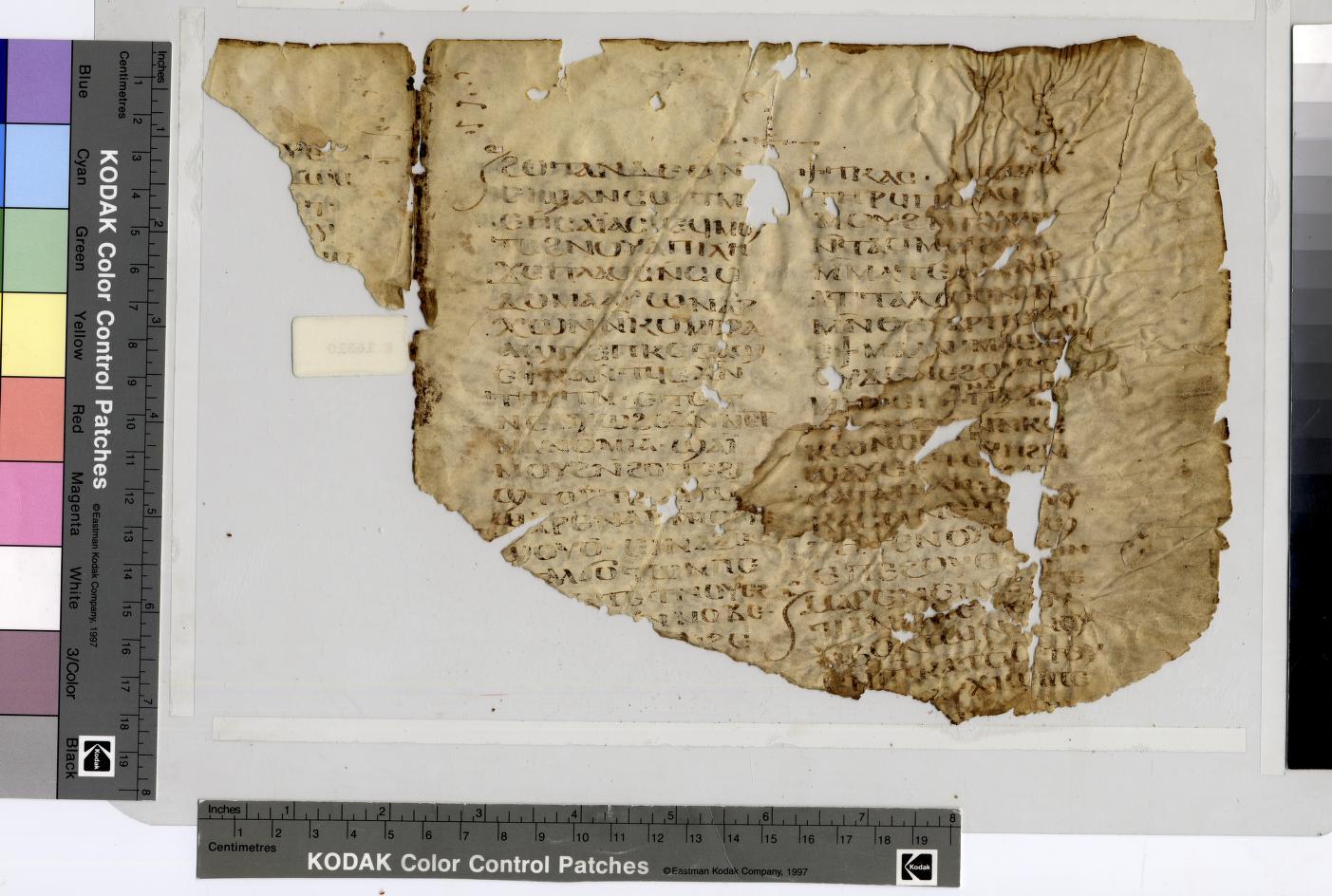
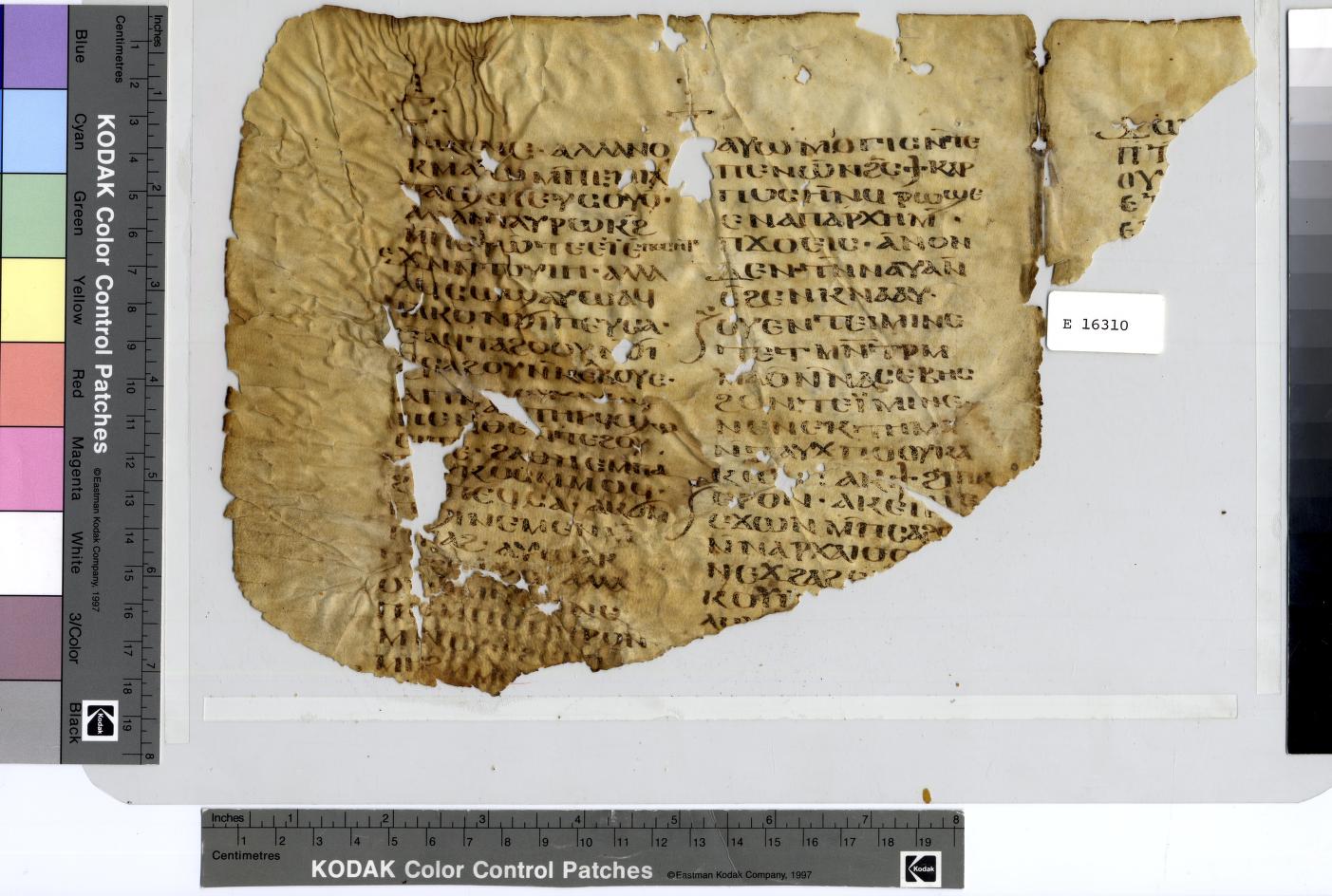
Pennsylvania University Museum E 16310 is a parchment fragment which consists of the upper part of a codex leaf. As can be seen in the pictures below, a stub from the conjoint leaf also survives. The quire ornaments and signatures, which occur in the top margin of both leaves’ flesh side, (see Photo 1) indicate that these vestiges originally formed the outermost bifolio of a quire. Unfortunately, the ink of the signature and page numbers has faded away, making it impossible to situate with any precision the positioning of the fragment in the original manuscript.

(source of the image)

(source of the image)

A photographic reproduction of the verso of E 16310 was included in an article published by John R. Abercrombie in an issue of Expedition (Winter 1978). The text which accompanies the photograph describes the fragment as part of a “Coptic homily on Isaiah I.” On the webpage Papyri and Related Materials at the University of Pennsylvania, Robert A. Kraft noted, with much hesitation, that the fragment might belong to the works of Shenoute.

In fact, E 16310 contains a portion from the Coptic version of the 16th Oration of St. Gregory of Nazianzus. Continue reading

Posted in Gregory of Nazianzus, Patristics | Tagged , , , , , , , , | 3 Comments

Guest Post Yavor Miltenov: The Versiones Slavicae Project – An Electronic Corpus of Medieval Slavic Translations Is Under Construction

I am delaying my post about the identification of another Coptic fragment in the Pennsylvania University Museum in order to publish Yavor Miltenov’s interesting report on a new Patristic project.

As a result of the work of generations of philologists, the researchers in the field of Byzantine studies have at hand numerous index-catalogues dealing with classification of texts. The most recent and significant of them are, of course, Clavis patrum Graecorum, Bibliotheca hagiographica Graeca, Clavis apocryphorum Veteri Testamenti, Clavis apocryphorum Novi Testamenti, and many others – a centuries-old tradition, that serves as a base for these exceptional reference books. Any study on (or even related to) certain medieval literary monuments must as a rule consult them, as they cover an enormous material, facilitate identifications of certain works, offer standardization, unification and classification, contain the primary bibliography, and represent not only the basics of our knowledge about one particular text, but also give an opportunity to study groups of texts and corpora. Recently, the intensive research has even brought the process to further development – an online Clavis Clavium will be built upon the base of previous indexes[1].

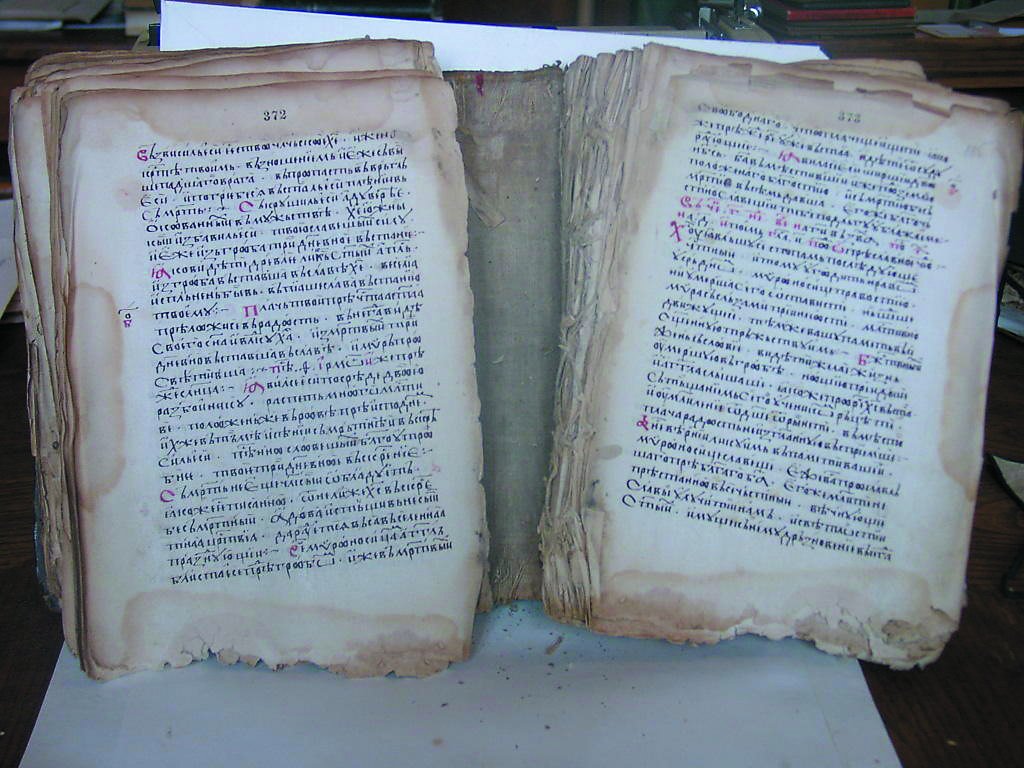
It is a well-known fact, that almost all medieval Slavic literary monuments (9th–16th c.) are translations from Byzantine works: whole miscellanies, single texts, excerpts used in compilations. In this sense, their adequate study is possible only if a comparison with the Byzantine originals is made. In Slavic medieval studies, however, there is no such instrumentum studiorum that contains a) classification of the translated texts and b) reference to their Greek originals[2]. For this main reason the Slavic tradition, unlike the Armenian, Georgian, Arabic, Coptic, is not “visible” to the researchers of the Byzantine cultural commonwealth, it is not fully reflected in the above-mentioned and other Claves[3], and, finally, remains isolated and thought more as a subject to be researched by the “national philologies”, than as a full member of the Byzantine-Slavic cultural space in the Middle Ages.

(source of the image)

In 2011 the Bulgarian Science Fund announced a call for Young Scientists Program. I and four other colleagues decided to apply with a project entitled “Electronic database Operum patrum Graecorum versiones slavicae: cataloguing and study of the writings of John Chrysostom in Old Church Slavonic” with the kind institutional support of Central Library of Bulgarian Academy of Sciences. Surprisingly, we won a grant and the project has started in the beginning of 2012!

Continue reading

Posted in Guest Post, Patristics | Tagged , , , , , | 4 Comments

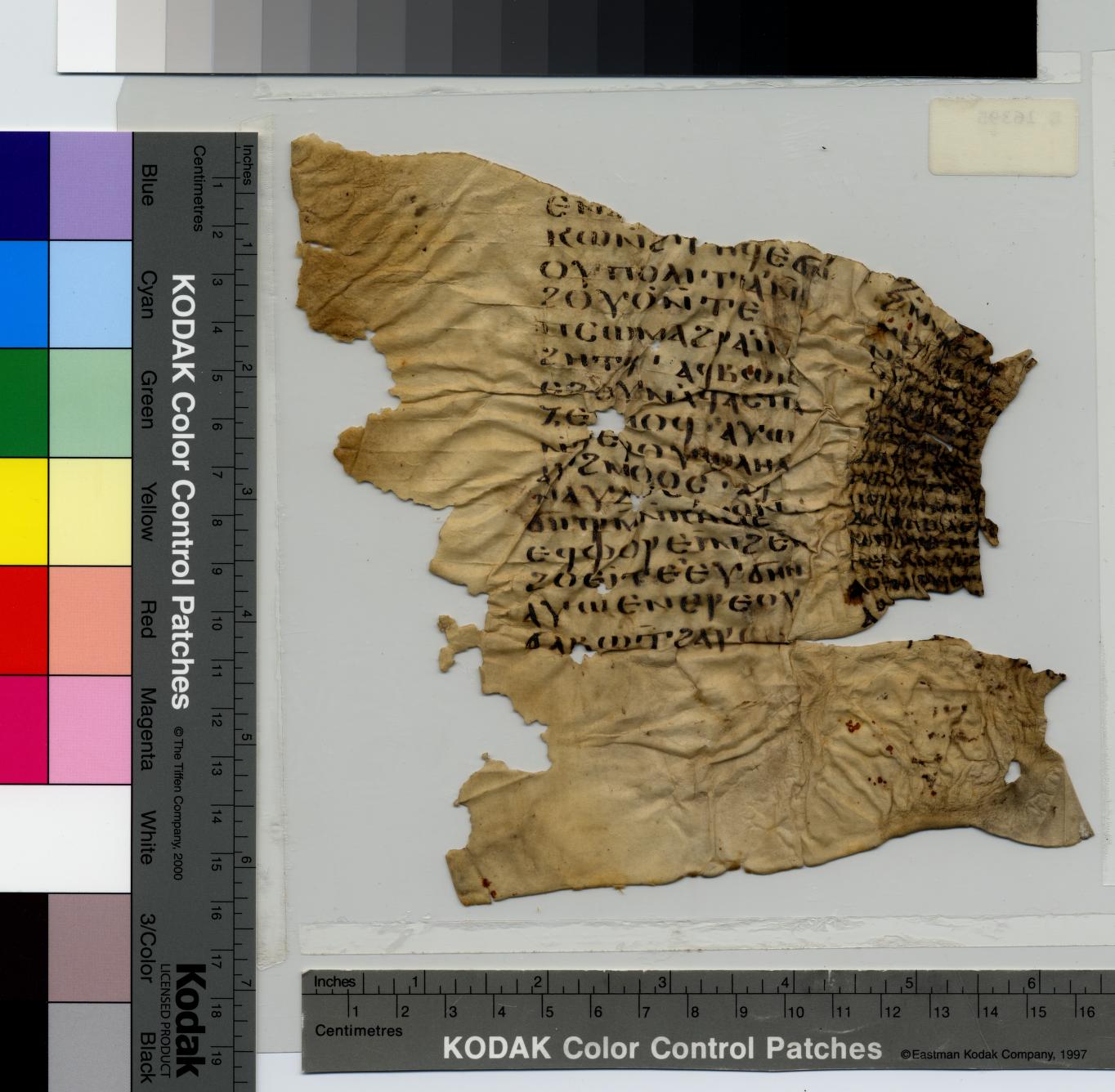
A New Fragment from the Sayings of the Desert Fathers: The University of Pennsylvania Coptic Fragment E 16395

Dr. Janet Timbie, from the Catholic University of America, informed me some time ago that Robert A. Kraft has been working on a catalogue of the manuscripts and papyri held in the University of Pennsylvania Museum. Those interested in the Coptic manuscripts in this collection can check the webpage, Papyri and Related Materials at the University of Pennsylvania, which offers good quality reproductions, transcriptions and descriptions of these items.

The Pennsylvania collection of Coptic manuscripts is mainly formed of small papyrus and parchment fragments with very little surviving text. Even so, Robert Kraft has performed excellent work in identifying many of them. In this, and the following post, I should like to introduce two previously unidentified parchment fragments from the University of Pennsylvania Museum collection.

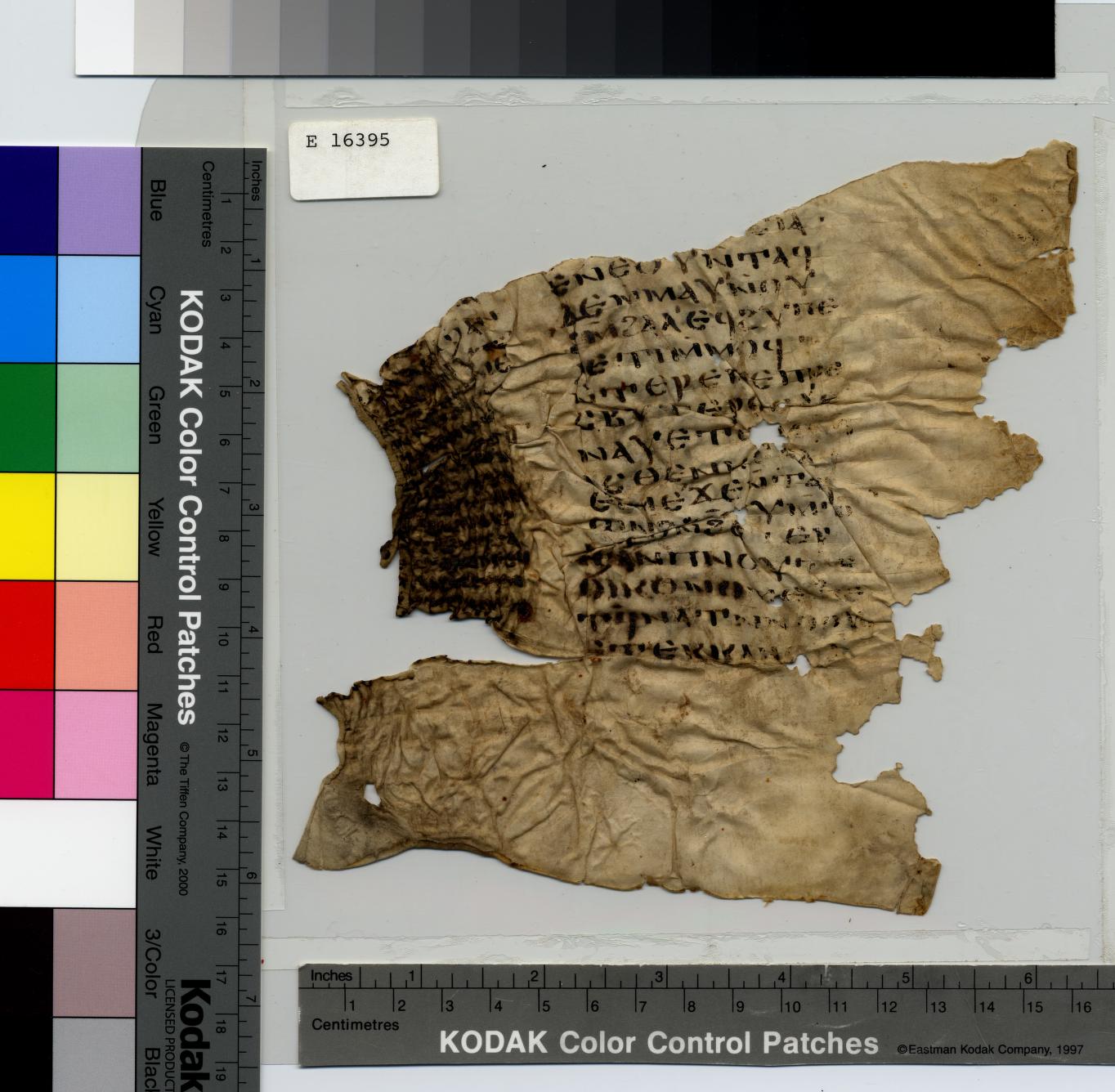
I shall start with fragment E 16395. This is a parchment fragment from a two-column codex elegantly written in uncial letters. The left hand column of the recto and the right hand one on the verso are wrinkled, those portions being very difficult to decipher solely on the basis of the photographic reproductions.

(source of the image)

(source of the image)

However, the decipherable text allows us to identify the fragment as part of the Sayings of the Desert Fathers (Apophthegmata Patrum). More precisely, the Pennsylvania fragment contains an apophthegm concerning Abba Arsenius the Great. Continue reading

Posted in Apophthegmata Patrum, Monasteries, Patristics | Tagged , , , , , , , , , | 3 Comments

adam_bremer-mccollum's avatarhmmlorientalia

(Reposted here for easy access and future convenience from the HMML Chronicle, Aug 4, 2011; see here.)

I hope the title is not too grandiose for the little petition here offered: my intent can be made clear in few words, but the practical working out of its actual implementation will naturally require more time and purposeful planning.

Manuscript study has been and will continue to be the focus of codicological learning and the preparation of text editions (however one might envision this latter task), but does it not, too, have a broader setting in the study of the languages and literatures of this or that community? From the title of this post, it is obvious that my answer to that question is in the affirmative. But is there any justification for this answer among our past masters? To state the question differently, is there plausible evidence that the expertise…

View original post 722 more words

Posted in Articles | Leave a comment

2012 AELAC Meeting (Dole, June 28-30)

The Association pour l’étude de la littérature apocryphe chrétienne (AELAC) has announced on its website the programme for the 2012 meeting, which will take place June 28-30 in Dole, France. Here are the titles of the papers which will be presented this year:

Janet E. SPITTLER, Μανθάνεις πρὸς τίνας εἴρηται τὰ εἰρημένα: Metalepsis in the Acts of Andrew.

Pierre-Yves LAMBERT, Histoire évangélique en irlandais.

Cornelia B. HORN, Apocrypha and Isra’iliyyat. The Life of Jesus in some early islamic authors.

Jean-Michel ROESSLI, La réception des Oracles sibyllins chez quelques auteurs anglais des XVIIe et XVIIIe siècles.

Alin SUCIU, Preliminary Report on Some New Coptic Apocryphal Fragments.

Xavier LEQUEUX, Origine et développements de la BHG ou la quête du document hagiographique.

Enrico NORELLI, Les premières traditions sur la Dormition de Marie comme catalyseurs de formes très anciennes de réflexion théologique et christologique.

Lydie LANSARD, L’Èvangile de Gamaliel.

I shall put up soon on the blog the abstract of my paper. More information about the Réunion de l’AELAC HERE.

Posted in Uncategorized | Tagged , , , , | Leave a comment

Two Joint Fragments from the Proverbs of Solomon in Coptic and the Extinction of the White Monastery Library

I have presented here several times some interesting cases of torn leaves from the library of the Monastery of Apa Shenoute (or the White Monastery), which can be reconstructed out of two or more fragments which are presently scattered around the world (see HERE, HERE, HERE, HERE, or HERE). In my opinion, these damaged manuscripts give us an important clue about the extinction of the Coptic library at the White Monastery.

The current theory, which is quite old and unsatisfactory, is that the library fell into decay when Coptic language started to be forgotten by the monks. According to this hypothesis, when Arabic became the lingua franca of the Copts, the old parchment codices were abandoned somewhere in a remote corner of the monastery where they gradually decayed. Beginning with the second half of the 18th century, the monks sold piecemeal the manuscripts to various European travelers, breaking them into pieces in order to obtain a higher price. In this way, the leaves of the manuscripts were scattered throughout the world.

However, I think that a multitude of fragments, which join perfectly and do not exhibit signs of a natural form of decay, show that the codices were destroyed systematically and deliberately by someone. In my opinion, the White Monastery parchment fragments actually bear clear signs of trauma and mutilation done by human hand. It is possible that, at a certain point in the Arabic period, suppressing the monastic libraries was considered to be a necessity in order to extinguish Christian culture in Egypt.  I will develop this hypothesis, together with Prof. Tito Orlandi, in a paper which we shall deliver at the next Coptological congress which will take place next September in Rome.

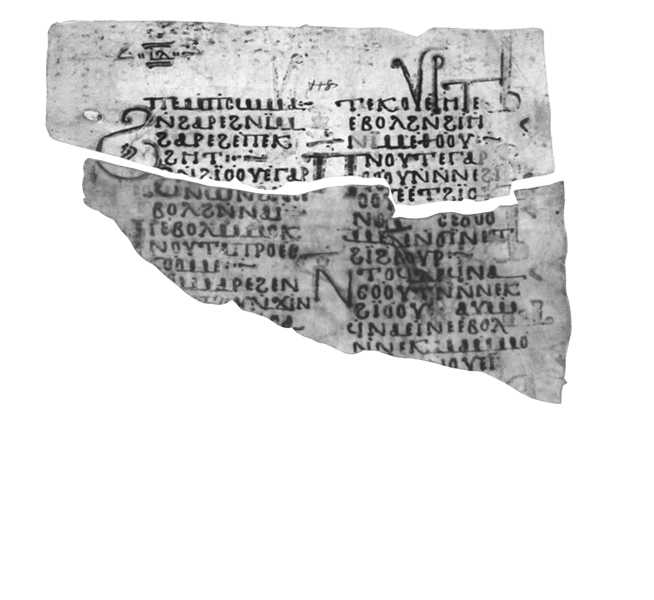
Until then, I shall introduce here the illustrative case of two fragments from a codex which contained the Proverbs of Solomon in Coptic. The first fragment is currently kept in the British Library and was identified by Walter Ewing Crum in his catalogue of Coptic manuscripts in this collection.[1] The inventory number of this fragment is Or. 3579A(27) (= Crum no. 39). The second fragment, identified here for the first time, is housed in the National Library in Paris as BnF, Copte, 1324, fol. 293.

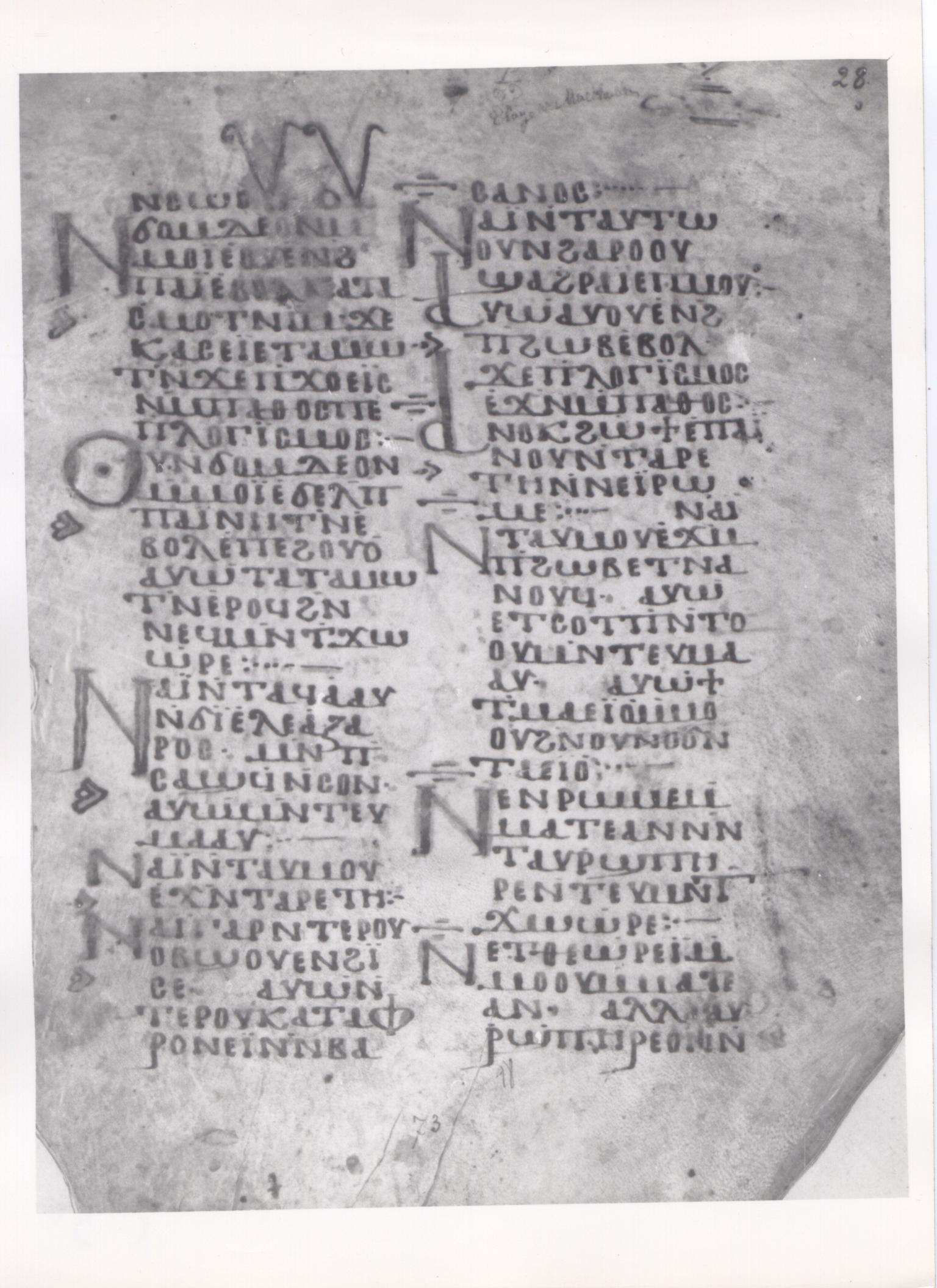
Here is a Photoshop collage which shows the two fragments joined together. The damage pattern indicates that they were torn to pieces on purpose.

As can be seen in the picture above, the London fragment (the superior one) still bears the ancient pagination of the leaf: 13-14. The fragments contain the text of Proverbs 4:13-27. To the same codex belonged several other fragments. These include: Paris, BnF, Copte, 1315, fol. 119 (pages 9-10); London, British Library, Or. 3579A(27) + Paris, BnF, Copte, 1324, fol. 293 (pages 13-14); Paris, BnF, Copte, 1315, fol. 83 (pages 41-42) Paris, BnF, Copte 1293, fol. 129 (pages 49-50); Paris, BnF, Copte 1293, foll. 123-128 (pages 51-63); Paris, BnF, Copte 1293, fol. 130 (101-102); Cairo, French Institute, Copte 150-151 (103-106).

Posted in Bible, Monasteries, Old Testament, Proverbs | Tagged , , , , , , , , , | Leave a comment

The Louvain Papyrus Fragments from the Asceticon of Abba Isaiah

Recently, I wrote on the blog about some papyrus fragments of a codex which contained the Coptic version of the Asceticon of Abba Isaiah. The fragments were kept in the library of the Catholic University in Louvain, but they were destroyed during the WW2 bombings. Apparently, the Louvain collection owned more than one hundred such fragments, which are, unfortunately, irremediably lost. My identification was based on Louis-Théophile Lefort’s catalogue, published shortly before the fragments disappeared for good.[1]

Accordingly, the lemma “On Repentance (metanoia),” which appeared on one of the papyrus fragments, and the incipit “The elder was asked: ‘What is the repentance (metanoia)?’” indicate that this fragment belonged to Greek Logos 21 (= Syriac Logos 14 – Draguet) of Abba Isaiah’s Asceticon. A few biblical quotations mentioned by Lefort as occurring on other fragments suggest that those damaged papyri represented the poor vestiges of a once complete copy of the Asceticon of Isaiah of Scetis in Coptic. If Lefort’s 6th to 7th century dating of the fragments is correct, it must had been the most ancient Coptic manuscript of this important ascetic corpus.

However, I omitted to say that in 1945, just a few years after his catalogue was printed, Lefort published in Le Muséon an article in which he edited and translated into French some additional fragments. Continue reading

Posted in Ascetic Authors, Isaiah of Scetis, Patristics | Tagged , , , , , , , , | Leave a comment

Paola Buzi – Beyond the Papyrus

Those interested in Coptic manuscripts will find an excellent article by Paola Buzi in the Comparative Oriental Manuscript Studies‘ Newsletter 2 (2012) 10-16. The article is titled “Beyond Papyrus. The Writing Materials of Christian Egypt Before the Tenth Century: Ostraca, Wooden Tablets and Parchment.” The Newsletter is available here. The other issues of the newsletter, with many interesting contributions on Oriental manuscripts, can be read here.


Posted in Uncategorized | Tagged , , , , , , , | Leave a comment

Coptica Online: Oscar von Lemm

Somebody has pointed out to me that many Coptological studies by Oscar von Lemm are available on a Russian website. Here is the list (the links will redirect you to the original website):

1. Koptische Miscellen. CXLV–CXLVIII
O. von Lemm
Извѣстія Императорской Академіи Наукъ. VI серiя, 9:3 (1915), 205–226
2. Koptische Miscellen. CXLI–CXLIV
O. von Lemm
Извѣстія Императорской Академіи Наукъ. VI серiя, 8:13 (1914), 915–934
3. Koptische Miscellen. CXXXV–CXL
O. von Lemm
Извѣстія Императорской Академіи Наукъ. VI серiя, 8:8 (1914), 525–540
4. Koptische Miscellen. CXXXIII. CXXXIV
O. von Lemm
Извѣстія Императорской Академіи Наукъ. VI серiя, 8:7 (1914), 485–513
5. Koptische Miscellen. CXXXI. CXXXII
O. von Lemm
Извѣстія Императорской Академіи Наукъ. VI серiя, 7:11 (1913), 627–638
6. Koptische Miscellen. CXXVI–CXXX
O. von Lemm
Извѣстія Императорской Академіи Наукъ. VI серiя, 7:10 (1913), 533–554
7. Koptische Miscellen. СХХI–СХХV
O. von Lemm
Извѣстія Императорской Академіи Наукъ. VI серiя, 6:7 (1912), 517–529
8. Koptische Miscellen. CXIV–CXX
O. von Lemm
Извѣстія Императорской Академіи Наукъ. VI серiя, 6:2 (1912), 163–180
9. Koptische Miscellen. СIХ–CXIII
O. von Lemm
Извѣстія Императорской Академіи Наукъ. VI серiя, 5:18 (1911), 1237–1266
10. Koptische Miscellen. СVІ–СVIII
O. von Lemm
Извѣстія Императорской Академіи Наукъ. VI серiя, 5:16 (1911), 1135–1158
11. Koptische Miscellen. CI–CV
O. von Lemm
Извѣстія Императорской Академіи Наукъ. VI серiя, 5:13 (1911), 927–940
12. Koptische Miscellen. XCVIII–C
O. von Lemm
Извѣстія Императорской Академіи Наукъ. VI серiя, 5:6 (1911), 453–468
13. Koptische Miscellen. XCV–XCVII
O. von Lemm
Извѣстія Императорской Академіи Наукъ. VI серiя, 5:5 (1911), 327–348
14. Koptische Miscellen. XCI–XCIV
O. von Lemm
Извѣстія Императорской Академіи Наукъ. VI серiя, 4:17 (1910), 1461–1468
15. Koptische Miscellen. LXXXIV–XC
O. von Lemm
Извѣстія Императорской Академіи Наукъ. VI серiя, 4:14 (1910), 1097–1128
16. Koptische Miscellen. LXXIX–LXXXIII
O. von Lemm
Извѣстія Императорской Академіи Наукъ. VI серiя, 4:5 (1910), 347–370
17. Koptische Miscellen. LXXIII–LXXVIII
O. von Lemm
Извѣстія Императорской Академіи Наукъ. VI серiя, 4:2 (1910), 169–185
18. Koptische Miscellen. LXVIII–LXXII
O. von Lemm
Извѣстія Императорской Академіи Наукъ. VI серiя, 4:1 (1910), 61–86
19. Koptische Miscellen. LXVI. LXVII
O. von Lemm
Извѣстія Императорской Академіи Наукъ. VI серiя, 3:6 (1909), 393–404
20. Koptische Miscellen. LXII–LXV
O. von Lemm
Извѣстія Императорской Академіи Наукъ. VI серiя, 3:5 (1909), 341–364
21. Koptische Miscellen LI–LXI
O. von Lemm
Извѣстія Императорской Академіи Наукъ. VI серiя, 2:18 (1908), 1323–1354
22. Koptische Miscellen. XLVII–L
O. von Lemm
Извѣстія Императорской Академіи Наукъ. VI серiя, 2:13 (1908), 1067–1089
23. Koptische Miscellen. XLI–XLVI
O. von Lemm
Извѣстія Императорской Академіи Наукъ. VI серiя, 2:7 (1908), 589–605
24. Koptische Miscellen. XXXIII–XL
O. von Lemm
Извѣстія Императорской Академіи Наукъ. VI серiя, 2:2 (1908), 191–208
25. Koptische Miscellen. XXVI–XXXII
O. von Lemm
Извѣстія Императорской Академіи Наукъ. VI серiя, 2:1 (1908), 55–72
26. Koptische Miscellen XVI–XXV
O. von Lemm
Извѣстія Императорской Академіи Наукъ. VI серiя, 1:13 (1907), 495–510
27. Koptische Miscellen. I–XV
O. von Lemm
Извѣстія Императорской Академіи Наукъ. VI серiя, 1:5 (1907), 141–151
28. Kleine koptische Studien. XXVI–XLV. (Schluss.)
Oscar v. Lemm
Извѣстія Императорской Академіи Наукъ, 21:5 (1904), 151–239
29. Kleine koptische Studien. XXVI–XLV
Oscar v. Lemm
Извѣстія Императорской Академіи Наукъ, 21:3 (1904), 41–150
30. Kleine koptische Studien. XXI–XXV
Oscar von Lemm
Извѣстія Императорской Академіи Наукъ, 14:3 (1901), 289–313
31. Kleine koptische Studien. X–XX
Oscar von Lemm
Извѣстія Императорской Академіи Наукъ, 13:1 (1900), 1–163
32. Eine dem Dionysius Areopagita sugeschriebene Schrift in koptischer Sprache
Oscar von Lemm
Извѣстія Императорской Академіи Наукъ, 12:3 (1900), 267–306
33. Kleine koptische Studien. I–IX
Oscar von Lemm
Извѣстія Императорской Академіи Наукъ, 10:5 (1899), 403–434
34. Nachtrag zu den «Koptischen Fragmenten zur Patriarchengeschichte Alexandriens»
Dr. O. v. Lemm
Извѣстія Императорской Академіи Наукъ, 4:2 (1896), 237–243
35. Sahidische Bibelfragmente. III
O. von Lemm
Извѣстія Императорской Академіи Наукъ. VI серiя, 1:2 (1907), 45
Posted in Bibliographies | Tagged , , , | 4 Comments

Guest Post: Diliana Atanassova on the Coptic Liturgical Typika from the White Monastery

Diliana Atanassova is member of the Copus dei Manoscritti Copti Letterari project (Hamburg/Rome) and research fellow at the Department of Biblical Studies and Ecclesiastical History, Faculty of Catholic Theology of the Salzburg University.

N.B.: A much longer (and slightly different) version of this article appeared in Coptica 9 (2010) 1-23. This portion is published with the permission of the editor.

Already at the beginning of my research in the field of Coptic Liturgy, my interest in studying the typika of the White Monastery, available only in dispersed fragments, was awoken. Working on the Sahidic lectionaries I soon realized that one could not analyze the lectionaries without taking into consideration the typika and vice versa.[1] At the Eighth Congress of Coptic Studies in Paris 2004, I emphasized the importance and usefulness of the comparison between these two liturgical sources.[2]  In the following years, my efforts in investigating the typika increased. In 2007, this resulted in a research project[3], which was carried out at the Department of Biblical Studies and Ecclesiastical History at Salzburg University and funded by the Austrian Science Fund (FWF). Preliminary notes and detailed results were reported regularly in national and international gatherings of the scholars.[4] In order to reconstruct the original liturgical codices, I started to use the abbreviation system developed by Tito Orlandi in his  Corpus dei Manoscritti Copti Letterari (Rome) (CMCL)[5]. The White Monastery’s codices with liturgical typika have the sigla MONB.AW and MONB.NP, as well as all letters from MONB.WA to MONB.WT. In this article, the CMCL sigla for the parchment typika are quoted only with the inventory numbers of their core leaves (cf. here 6). The complementary leaves can be looked up in a forthcoming volume of the Jerusalemer Theologisches Forum (Münster).

In the following lines, I shall introduce to our readers some important issues for the understanding of the Coptic typika from the White Monastery.

(source of the image)

1. Term and Definition

Stephen Emmel describes a liturgical typikon as “a book containing a list of lections for church services, arranged according to the liturgical calendar. As distinct from a lectionary, a typikon gives not the full text of any lection, but only the opening words and a cross-reference to where the full text can be found.”[6] However, this definition is too narrow since the typikon do not only include biblical or patristic lections but also other liturgical texts such as different chant types. For this reason, parts of such manuscripts are sometimes also named “directories” or “indices”[7]. Following Hans Quecke[8], one of the foremost specialists in Coptic liturgical manuscripts, the term “typikon” is preferred among the German and English writing scholars. In my studies I am using both terms: “typikon” as to name the entire codex, and “directory” in order to differentiate between the distinct parts of the codex, as for example “directory of pericopae” and “directory of hymns”.

Investigations on the typikon fragments revealed that “typikon” needs to be defined more precisely.

2. The Content of a Typikon Leaf

Typika have two important characteristics. Firstly, they represent only incipits or desinits of liturgical texts. In addition, these are listed according to the liturgical calendar. The incipits of lections mainly derive from the Psalter and the NT. Continue reading

Posted in Articles, Bible, Guest Post, Liturgical Books, Monasteries, Shenoute of Atripe | Tagged , , , , , , , | Leave a comment

Guest Post: Mark Bilby – As the Bandit Will I Confess You: Luke 23.39–43 in Early Christian Interpretation

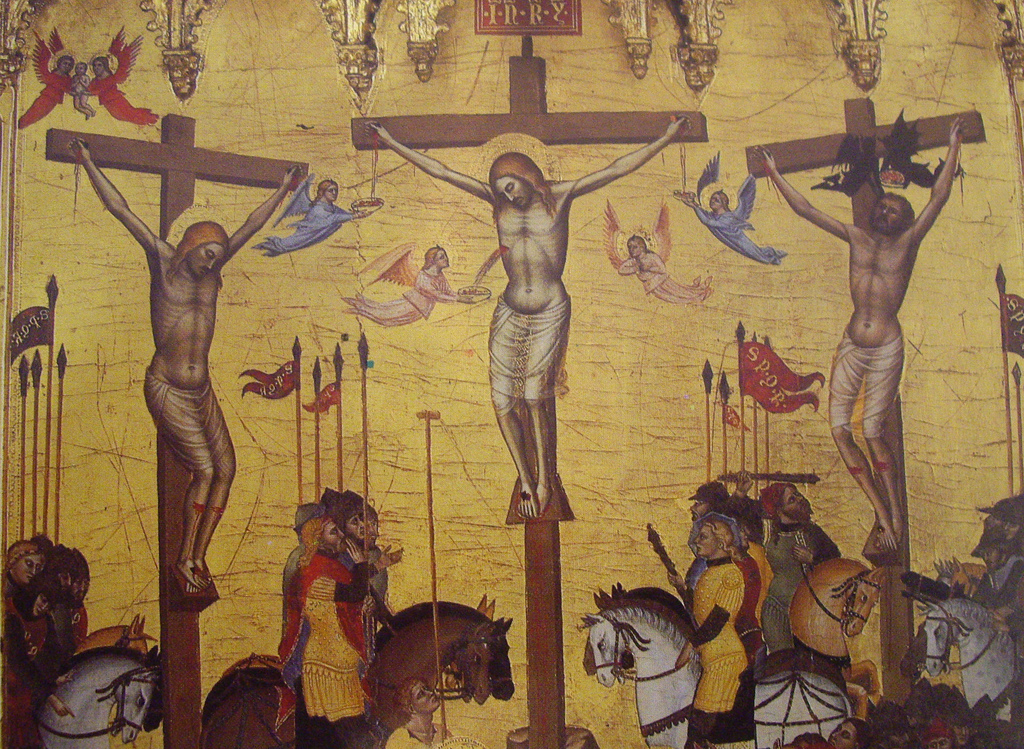
Recently, Mark Bilby successfully defended his PhD dissertation at the University of Virginia (advisor: Harry Y. Gamble). Mark’s thesis is entitled As the Bandit Will I Confess You: Luke 23.39-43 in Early Christian Interpretation. He was kind enough to use in his work my edition of the Coptic sermon attributed to Theophilus of Alexandria on the Cross and the Thief, which is forthcoming in Zeitschrift für antikes Christentum. At some point in the near future, Mark is also planning to publish a companion volume of Patristic homilies on the Good Thief. Below you can find the abstract of his dissertation, which he agreed to publish on this blog:

This dissertation comprises the first thorough, critical analysis of the early Christian interpretation of Luke 23.39–43 (up to 450 CE). Tatian’s Diatessaron is its earliest plausible reception, while the Gospel of Peter does not depend on Luke here but instead attests to an earlier, simpler apologetic narrative used by Luke. Contrary to the implication of modern commentaries, harmonization of Luke’s divergent criminals with the Markan/Matthean reviling bandits is not a major concern, nor do ancient views fit neatly into chronological vs. sylleptical positions. Several find intentional cooperation among the Evangelists, while early Syriac interpreters, starting with the Diatessaron itself, dismiss or ignore the Markan/Matthean tradition altogether.

Eschatological dissonance proves a far more prevalent concern. Origen’s interpretation—which provokes considerable criticism late in his own life—makes this apparent. Origen remains pivotal in eschatological debates for the next two centuries, though he is criticized for very different reasons.

By far the most common mode of interpretation finds in the second criminal a self-representative figure who models many Christian practices, beliefs and virtues, including prayer, beatitude, supersession, Nicene orthodoxy, faith, justification by faith without works, conversion, catechesis, confession, martyrdom, asceticism, simple speech, and penitence.

Augustine is the first on record to gainsay the traditional idea of the bandit as a martyr—an interpretation perhaps embedded in the original Lucan story—, though he reverses his position late in 419 CE. This shift calls for late dates for Sermons 53A, 285, 327, and 335C. Ephrem emerges as the most creative and influential purveyor of devotional, liturgical and typological readings. On the other hand, Chrysostom’s two Good Friday sermons on the bandit are the most influential texts in the early history of interpretation as they inspire Greek, Syriac, Coptic, Armenian and Latin imitations. By the late 4th century, Luke 23.39–43 appears as a standard lection (or part of a lection) during Good Friday noon services in the East. Despite the exclusive use of Matthew’s passion in the West, the influence of Eastern homilies helps carve out a place for the Lucan story in Western homilies during Holy Week and Easter Octave.

Posted in Guest Post, John Chrysostom, New Testament, Patristics, Theophilus of Alexandria | Tagged , , , , , , , | Leave a comment

An Old Testament Pseudepigraphon in Coptic: Yet Another Manuscript from the Sahidic Version of the Testament of Isaac

Here and here I wrote about the identification of some papyrus fragments which belonged once to the Catholic University in Louvain. They have been among the few unidentified items published by Louis Théophile Lefort in his catalogue of the Coptic manuscripts in this collection. As I have already said, all the manuscripts were burned in a fire which devastated the library in Louvain in May 1940. This was the second burning of the library, another fire reducing it to ashes in August 1914. Sad to say, in the 1940 fire perished also the entire photographic collection of Coptic manuscripts gathered by Lefort. Luckily, he reconstructed it patiently after the war, and the new series of photographs served as a nucleus of the much larger collection which Professor Tito Orlandi has formed later.

I shall continue the identifications of the Louvain material with two parchment fragments published by Lefort as nos. 52-53 of his catalogue. Although Lefort edited the texts separately, he already remarked their kinship, saying that “the quality of the parchment, as well as controllable paleographical features makes us believe that nos. 52 and 53 came from the same codex” (my translation from French). Although today we are not able to check anymore if the fragments were indeed paleographically related, Lefort’s assertion is confirmed by the fact that I identified both of them as coming from the same writing.

More precisely, the lost Louvain fragments came from an Old Testament pseudepigraphon: Continue reading

Posted in Apocrypha, Athanasius of Alexandria, Bible, Old Testament, Testament of Isaac | Tagged , , , , , , , | 2 Comments

A Lost Coptic Fragment from a Sermon on Penitence by Severian of Gabala (CPG 4186)

In a recent post, I identified a series of papyrus fragments from the Coptic version of the Asceticon of Abba Isaiah. The fragments formerly belonged to the library of the University of Louvain, but they disappeared forever in a fire which destroyed the library during the bombings in WW2. Luckily, all the Louvain fragments were published by Louis Théophile Lefort shortly before their physical disappearance. The Belgian Coptologist in this way granted us access to documents which today are lost.

Here I should like to introduce another of the papyrus fragments in Louvain, which have remained unidentified until now.

Under no. 48, Lefort published an unidentified papyrus fragment which he tentatively dated to the 6th or 7th century.[1] In fact, the text can be identified as a portion from a Continue reading

Posted in John Chrysostom, Patristics, Severian of Gabala | Tagged , , , , , , , , | 4 Comments

Travel Grants for the Next International Congress of Coptic Studies (Rome, 17-22 September, 2012)

The organizing committee of the Tenth International Congress of Coptic Studies, which will take place in Rome between 17-22 September 2012, announces that

Four travel grants of Euro 500,00 each will be attributed by “COMSt – Comparative Oriental Manuscript Studies” networking project to young scholars who will attend the Tenth International Congress of Coptic Studies presenting a paper on one of the following subjects: manuscript studies, codicology, philology. For details about how to apply (during the month of May, 2012), please visit COMSt web site: http://www1.uni-hamburg.de/COMST/bandi.html.

Posted in Uncategorized | Tagged , , , , | Leave a comment

Guest Post: Ivan Miroshnikov on 4 Maccabees in Coptic

According to David A. deSilva, 4 Maccabbees: Introduction and Commentary on the Greek Text in Codex Sinaiticus (Leiden/Boston: Brill, 2006), xi, there are two most important witnesses to the Greek text of 4 Maccabees, Codex Sinaiticus and Codex Alexandrinus. deSilva also admits that the Peshitta version ‘carries significant weight in textual criticism of 4 Maccabees.’ Curiously enough, no other ancient version of the text is mentioned by deSilva at all.

Still, there is at least one Sahidic manuscript of 4 Macc, briefly described in two notes by Enzo Lucchesi (‘Découverte d’une traduction copte du Quatrième livre des Maccabées (BHG 1006),’ Analecta Bolandiana 99 (1981): 302; ‘Encore trois feuilles coptes du Quatrième livre des Maccabées,’ Écritures et traditions dans la littérature coptes, journée d’études coptes, Strasbourg 28 mai 1982 (Louvain, Belgique: Éditions Peeters, 1983), 21-22). The manuscript is incomplete, and the fragments that survive cover the first and the last chapters of the text. The fragments of the first chapter belong to the Bibliothèque nationale de France, the fragments of the last ones belong to the library of the University of Michigan. My and Alin’s intention is to publish all the Sahidic fragments of 4 Maccabees that are known so far.

The Coptic fragments might probably shed some new light on the textual criticism and the reception history of 4 Maccabees. Below is my transcription and translation of the only undamaged leaf Continue reading

Posted in Bible, Guest Post, Old Testament | Tagged , , , , , , | 2 Comments

The Corpus dei Manoscritti Copti Letterari Project has moved to Hamburg

The Corpus dei manoscritti copti letterari research project (director: Tito Orlandi) became recently part of the Hiob Ludolf Zentrum für Äthiopistik, Hamburg University. Details about researchers of the centre can be found here.

Here is the description and aims of the project:

Corpus dei Manoscritti Copti Letterari

The Corpus dei Manoscritti Copti Letterari (CMCL) is a digital philology project that in 2011 moved from Rome to Hamburg. Its focus lies in Christian Egyptian culture.

The project reconstructs manuscripts virtually from digitized manuscript fragments; critically edits the Coptic texts; it also maintains an extensive electronic database.

The database includes: (1) Clavis Patrum Copticorum: list of the authors and works of the Coptic literature with information on manuscripts, content, and critical problems; (2) Manuscripts: list (a) of the individual collections, (b) of the Coptic codices either well preserved or reconstructed, especially from the Monastery of St. Shenoute, Atripe (White Monastery); (3) Texts: electronic edition of Coptic texts with Italian translation; (4) Grammar: a computational grammar of Sahidic with a list of words according to the grammatical categories; and (5): Bibliography: Complete bibliography for Coptic studies.

The rich project library, with publications in Egyptology, Coptology and Christian Orient, is located on the premises of the HLCES.

Contact

Prof. Tito Orlandi
Paola Buzi
Alin Suciu

Corpus dei Manoscritti Copti Letterari
Hiob Ludolf Centre for Ethiopian Studies
Hamburg University
Alsterterrasse 1
20354 Hamburg

For the source of this information click here; for the new CMCL website (available for subscribers only) click here.

Posted in Uncategorized | Tagged , , , , , , , , | Leave a comment