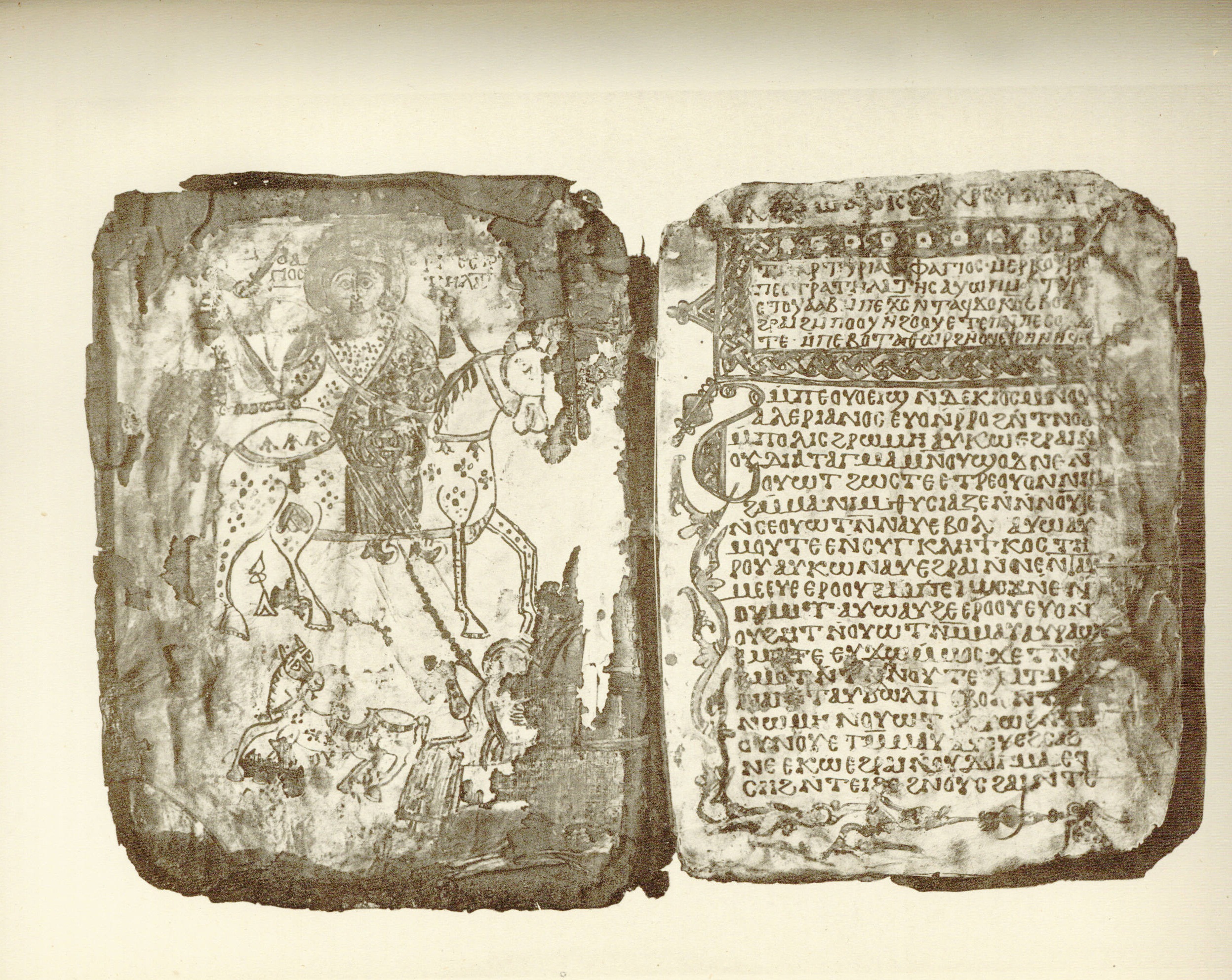
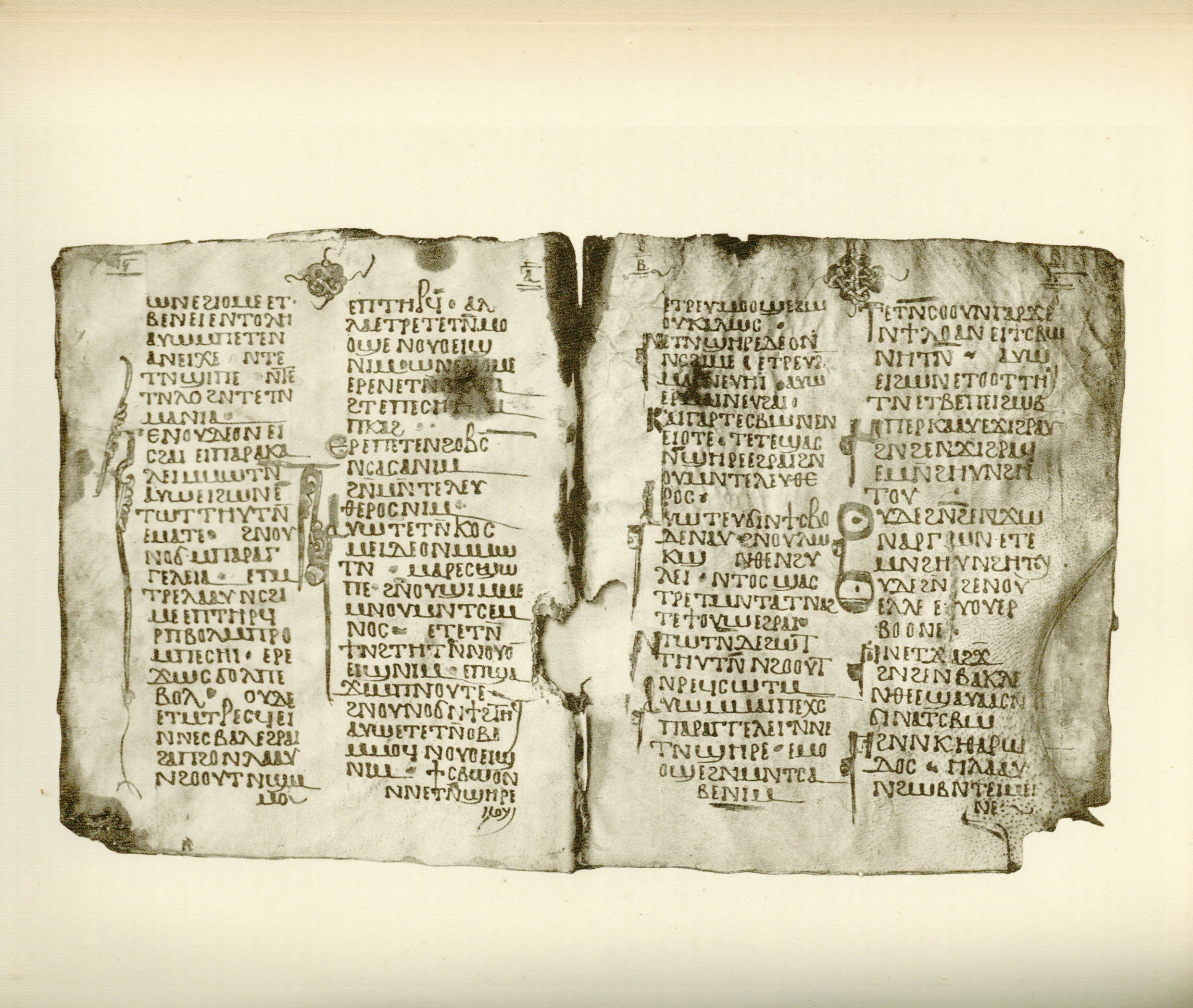
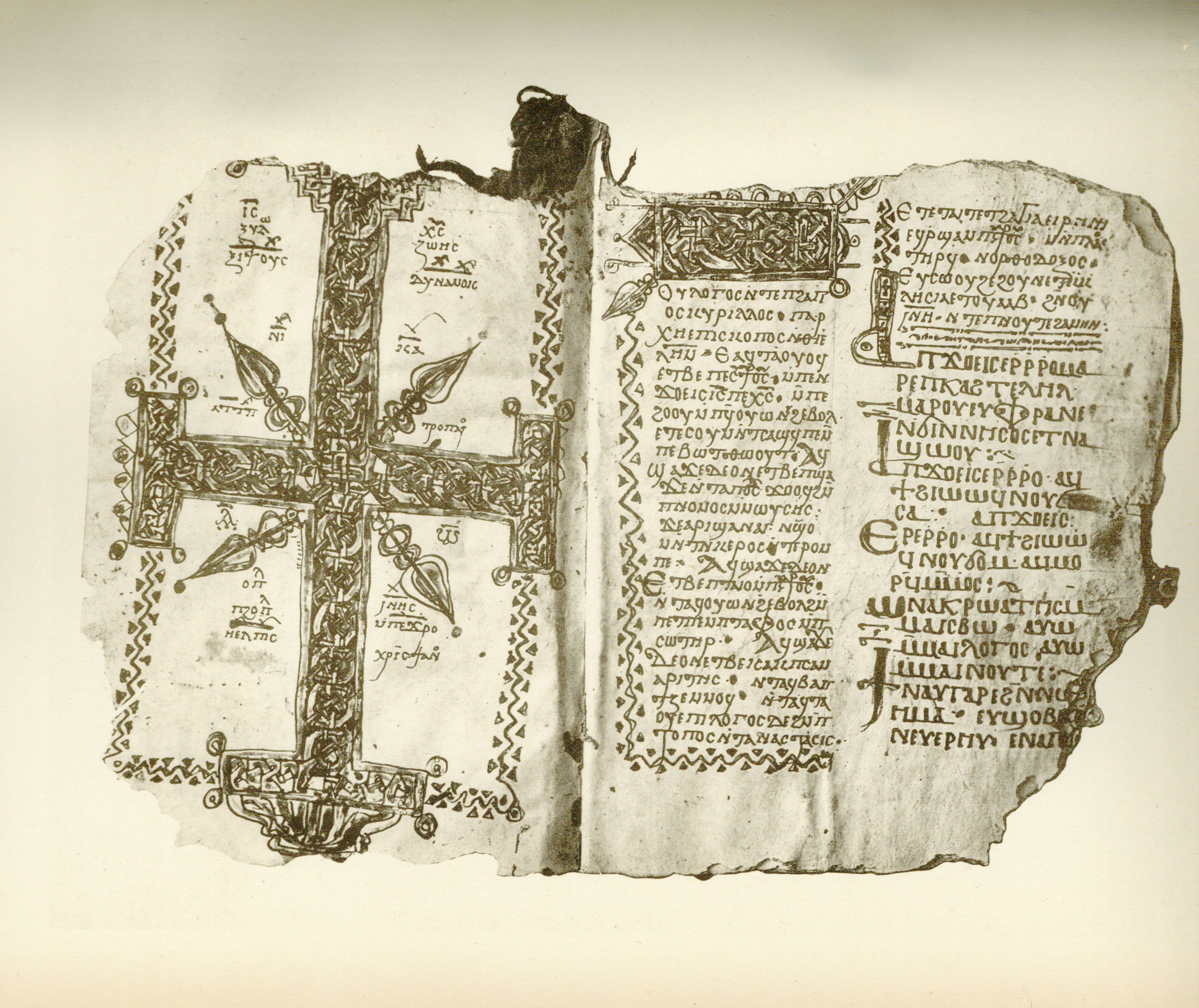
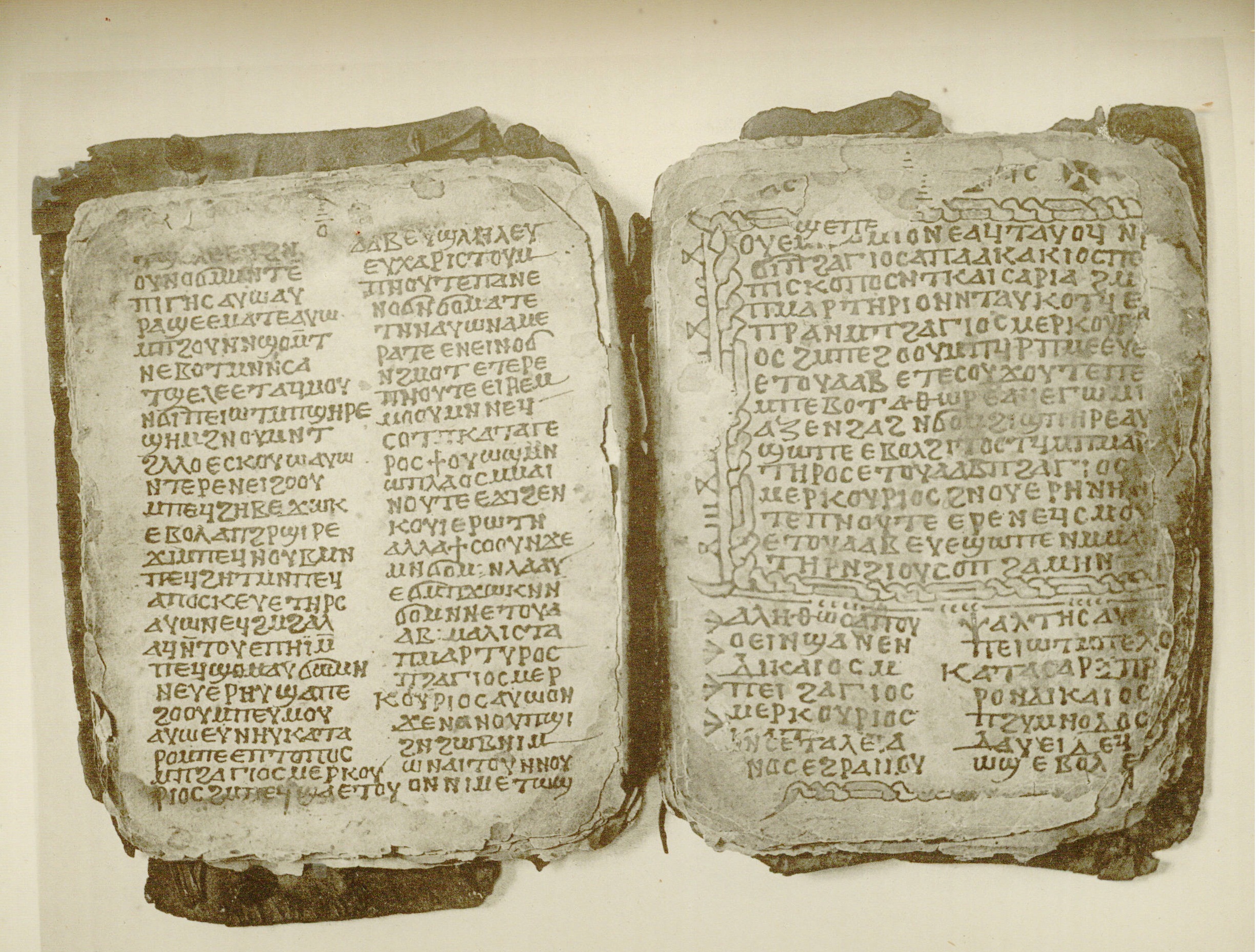
Zeitschrift für Papyrologie und Epigraphik Article

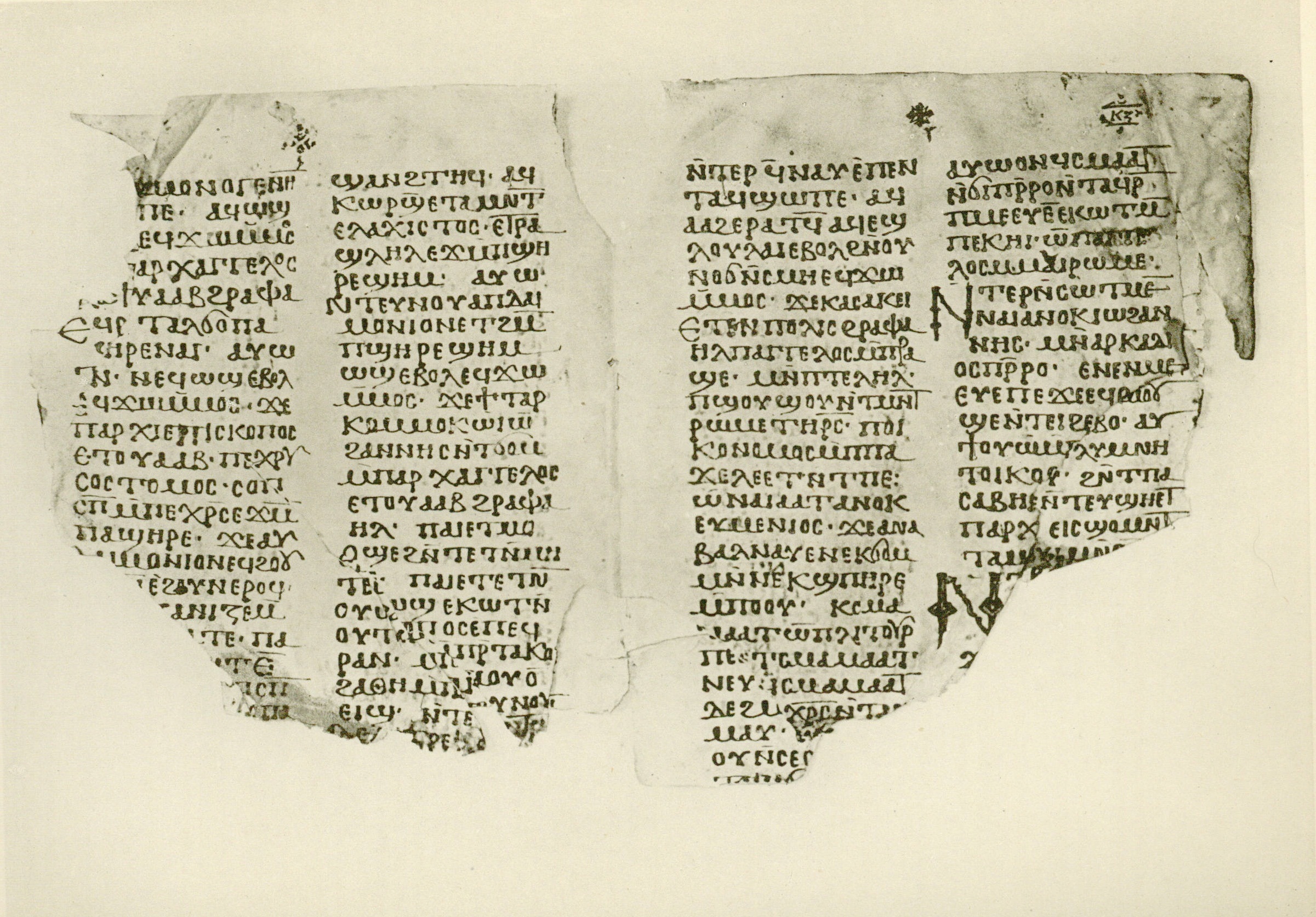
My edition of the Coptic fragments in the Trinity College in Dublin appeared in the latest issue of the Zeitschrift für Papyrologie und Epigraphik.

You can download it for free here: A. Suciu, “Coptic Biblical Fragments in the Possession of the Trinity College in Dublin,” Zeitschrift für Papyrologie und Epigraphik 183 (2012) 101-107.

The content of ZPE 182 (2012)

INHALT

Abascal, J. M., Cinco inscripciones del sur del conventus Carthaginiensis (Hispania citerior) 277

Continue reading

Posted in Articles, Bible, New Testament, Old Testament | Tagged , , , , , , | 4 Comments

Cairo 2008 Coptic Congress Papers Publication

Important message from Christian Askeland:

“Anne Boud’hors and Peeter’s publishing house have generously agreed to publish papers from the 2008 Cairo congress within a 2013 edition of the Journal of Coptic Studies.  The effort will be organized by Christian Askeland, Alain Delattre and Gesa Schenke.  Cairo 2008 attendees should indicate their intent to participate in this publication by 14 December.  The deadline for submissions is 28 February.  Contributions must not exceed 15 pages with 2500 characters per page.  Coptic texts should be encoded with a Unicode font (e.g., Antinoou, IfaoGrec).  The edition reading committee (Askeland, Delattre, Schenke) will referee the contributions to ensure a standard of quality.  While their hope is to include a broad range of contributions, publication is not guaranteed.  Papers should be edited to conform to the Journal of Coptic Studies stylesheet.

Within the next few days, 2008 conference attendees should receive an email announcement with a stylesheet.  Any questions can be directed to Alain (adelattr@ulb.ac.be), Christian (caskeland3@yahoo.com) or Gesa (gesa.schenke@orinst.ox.ac.uk).”

Posted in Uncategorized | Tagged , , , , , , , , | 3 Comments

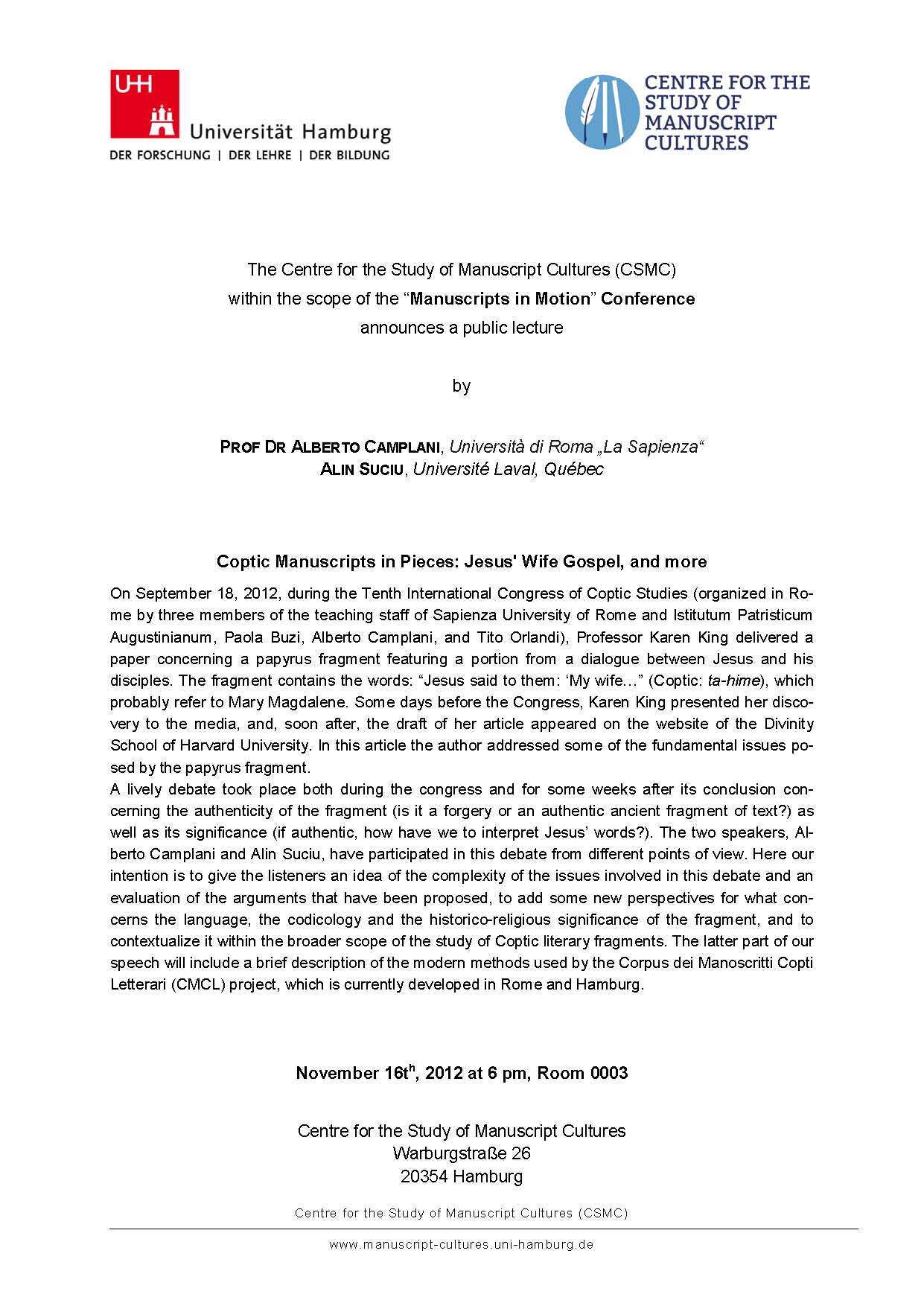
Lecture by Prof Dr Alberto Camplani and Alin Suciu on November 16th, 2012 at 6 pm (CSMC)

Dear Colleagues,

The Centre for the Study of Manuscript Cultures (CSMC), within the scope of the “Manuscripts in Motion” Conference, cordially invites you to a public lecture on

“Coptic Manuscripts in Pieces: the Gospel of Jesus’ Wife and more”

by Prof Dr Alberto Camplani, Università di Roma „La Sapienza“
and Alin Suciu, Université Laval, Québec

on November 16th, 2012 at 6 pm,

CSMC, Room 0003

With best regards,

Alexandra Nowak, Dipl.-Übers.

Centre for the Study of Manuscript Cultures

Sonderforschungsbereich Manuskriptkulturen in Asien, Afrika und Europa

Warburgstr. 26

20354 Hamburg

Tel.: +49-(0)40-42838-7127

Fax: +49-(0)40-42838-4899

E-Mail: alexandra.nowak[at]uni-hamburg.de

Posted in Uncategorized | Tagged , , , , , , , , | 6 Comments

Abba Isaiah of Scetis: Bibliography 2

The first part of the bibliography here

Monk Augoustinos, Tou hosiou patros hemon abba Esaiaou logoi 29 (Jerusalem 1911)

John Chryssavgis and P. R. Penkett, eds., Abba Isaiah of Scetis: Ascetic Discourses (CS 150; Kalamazoo, MI: Cistercian Publications, 2002)

Posted in Ascetic Authors, Bibliographies, Isaiah of Scetis | Tagged , , , , | Leave a comment

Roberta Mazza presents P.Ryl. 463 (the Gospel of Mary) and offers a new translation of the fragment.

Roberta Mazza's avatarRoberta Mazza

P.Ryl. 463: The Gospel of Mary

I’ve recently realised that few people in Manchester know that one of the two extant Greek fragments of the Gospel of Mary is in the John Rylands Library, and now on exhibition. The gospel in question is an apocryphal (a writing that has not been included later in the Church canon of the Bible) where a Mary – possibly Mary of Magdala, but this is uncertain since other Christian women brought this name – has a central role in the inner circle of Jesus’ first disciples.

There’s no surviving extant copy of this book, but only three fragmentary manuscripts are preserved from antiquity (P.Ryl. 463, P.Oxy 3525 and P.Berol. 8502). On the basis of these, scholars have reconstructed the Gospel main content as follows. It started with Jesus, the Saviour, appearing to the disciples after the resurrection. He gives a speech and instructs them…

View original post 1,305 more words

Posted in Uncategorized | 2 Comments

K.E. Verrone – Mighty Deeds and Miracles by Saint Apa Phoebammon

Kerry E. Verrone, Mighty Deeds and Miracles by Saint Apa Phoebammon: Edition and Translation of Coptic Manuscript M582 ff. 21r-30r in the Pierpont Morgan Library (Senior honors thesis, 2002 series; Providence, R.I.: Brown , 2002).

This is a useful (and very rare!) edition of the Miracles of Phoibammon (clavis coptica 0235), as preserved in Pierpont Morgan codex M582, ff. 21r-30r, a 9th century parchment manuscript from the library of the Monastery of the Archangel Michael at Hamuli, Fayyum. The book is actually the undergraduate thesis written by Kerry Verrone at Brown University in 2002 (advisor: Leo Depuydt). It appears here with consent of the author.

(PHOTO copyright: Morgan Library)

Donald B. Spanel’s article about the martyr Phoibammon, published in Coptic Encyclopedia vol. 6, 1963a-1965b:

Continue reading

Posted in Apa Phoibammon | Tagged , , , , , , , | Leave a comment

Article to Appear in the Next Issue of the Zeitschrift für Antikes Christentum

Today I received the galley proofs of my article “Pseudo-Theophili Alexandrini Sermo de Cruce et Latrone. An Edition from M595 with Parallels and Translation,” which will be published in the next issue of the Zeitschrift für Antikes Christentum – Journal of Ancient Christianity (due to appear in December 2012). I will put up on the blog the PDF version once it is published. Up until then, if you are interested to read the text I edited, you can find the proofs in the “Curriculum vitae” page.

The abstract of the article:

The present article offers the edition, accompanied by an English translation, of a Coptic homily on the Cross and the Good Thief (CPG 2622; clavis coptica 0395) attributed to Theophilus of Alexandria. The edition is based on the Pierpont Morgan codex M595, ff. 141ro-148ro, a 9th century parchment codex, which belonged to the Monastery of the Archangel Michael, situated near Hamuli in the Fayyum oasis. The critical apparatus records the variant readings of the three other surviving manuscripts of Ps.-Theophilus’ sermon. The introduction contains the description of the manuscripts, as well as a commentary which links the sermon on the Cross and the Good Thief by Ps.-Theophilus to the Patristic exegetical tradition. Literary connections between the long hymn to the Cross, which appears in the text edited here, and similar material in the pseudo-Chrysostomic work In venerabilem crucem sermo (CPG 4525) are also pointed out.

Der vorliegende Beitrag bietet Edition und Übersetzung einer koptischen Homilie zum „Kreuz und dem guten Dieb“ (CPG 2622; clavis coptica 0395), welche Theophilus von Alexandria zugeschrieben wird. Die Edition basiert auf dem Pierpont Morgan Codex M595, ff. 141ro-148ro, einem Pergament-Codex aus dem 9. Jahrhundert, der zum Kloster des Erzengels Michael bei Hamuli in der Fayyum Oase gehörte. Der kritische Apparat belegt die verschiedenen Lesarten der drei anderen verbliebenen Manuskripte dieser Predigt. In der Einleitung fi ndet sich eine Beschreibung der Manuskripte sowie ein Kommentar, der die Predigt über das „Kreuz und den guten Dieb“ von Pseudo-Theophilus ins Verhältnis zur patristischen exegetischen Tradition setzt. Auf literarische Verbindungen zwischen der langen Hymne auf das Kreuz im hier editierten Text und vergleichbarem Stoff im pseudo-Chrysostsomischen Werk In venerabilem crucem sermo (CPG 4525) wird hingewiesen.

Posted in Articles, Theophilus of Alexandria | Tagged , , , , , , , , , | Leave a comment

Guest Post: Steve Johnston – Le motif du blasphème de l’Archonte. Les multiples visages du Dieu des Écritures juives dans la littérature gnostique

Steve Johnston, my Canadian colleague, shall defend his Ph.D. thesis on October 26, at the Faculté de théologie et de sciences religieuses, Université Laval, Québec. His thesis explores the theme of arrogance of the Archon in some Gnostic texts. Here is the resume of his thesis.

À l’aide d’une approche littéraire et socio-anthropologique, cette recherche propose la comparaison critique de toutes les utilisations attestées du blasphème de l’Archonte et l’étude de la transformation de la citation du texte d’Isaïe dans les textes gnostiques en examinant les particularités de chaque attestation de ce motif en fonction du but poursuivi par l’œuvre dans laquelle il est inséré.

Cette thèse permettra, entre autres, de bien distinguer les différentes versions du blasphème de l’Archonte et de retracer, autant que possible, les différentes étapes de sa diffusion dans la littérature gnostique. Le blasphème de l’Archonte apparaîtra alors comme un des volets de la crise identitaire du christianisme au IIe siècle, qui s’est cristalisée, entre autres, autour de la question de la véritable connaissance de Dieu.

Cette thèse est divisée en six parties : (1) Introduction ; (2) Les versions ophites du blasphème de l’Archonte ; (3) Les versions barbélo-séthiennes ; (4) Les versions valentiniennes ; (5) Les autres versions ; (6) Conclusion. Après un survol de la recherche sur le motif du blasphème et de ses fondements scripturaires (partie I), la deuxième partie présente une analyse détaillée de ses attestations dites « ophites » (Adv. Haer. I, 30, 6, Ecr sT, HypArch, SJC et GrSeth), caractérisées par la seule citation du texte d’Isaïe. Dans la troisième partie, les attestations dites « barbélo-séthiennes » (Adv. Haer. I, 29, 4, ApocrJn, PrôTri et GrEsp) sont étroitement comparées, car elles semblent dépendre littérairement les unes des autres. Le blasphème de l’Archonte est composé d’une juxtaposition d’Ex 20, 5 et d’Is 45, 21. Les versions valentiniennes (Grande Notice d’Irénée, Adversus Valentinianos de Tertullien et notice sur Valentin de l’Elenchos) sont étudiées dans la quatrième partie et mettent en scène un archonte en chef portant le titre de « Démiurge », dont le blasphème est tiré du seul texte isaïen. La cinquième partie regroupe les attestations plus difficiles à classer (Adversus Marcionem de Tertullien, notice d’Eznik contre Marcion, notice sur Justin et sur Basilide de l’Elenchos, notice sur les nicolaïtes d’Épiphane, 2ApocJac). Cette partie illustre très bien les multiples visages du Dieu des Écritures juives dans la littérature gnostique. En effet, ce regroupement des attestations du blasphème de l’Archonte, s’il illustre leurs ressemblances, souligne d’abord et avant tout leurs différences. Toutes ces variantes sont précieuses car elles permettent de préciser les destinataires visés par les différentes œuvres et les contextes socioreligieux spécifiques à chacune de celles-ci. L’Archonte apparaît tantôt comme un modèle de conversion à imiter, tantôt comme un anti-modèle à rejeter, comme le type de l’impiété religieuse.

Ces présentations impliquent des destinataires et des situations communautaires bien différents, si bien que les origines du motif du blasphème de l’Archonte sont diverses, comme nous le constaterons dans la conclusion de cette recherche, mais doivent être situées à l’intérieur du cadre de la construction du discours interreligieux.

Posted in Apocrypha, Guest Post | Tagged , , , , | 2 Comments

A Letter from Colonel Robert de Rustafjaell

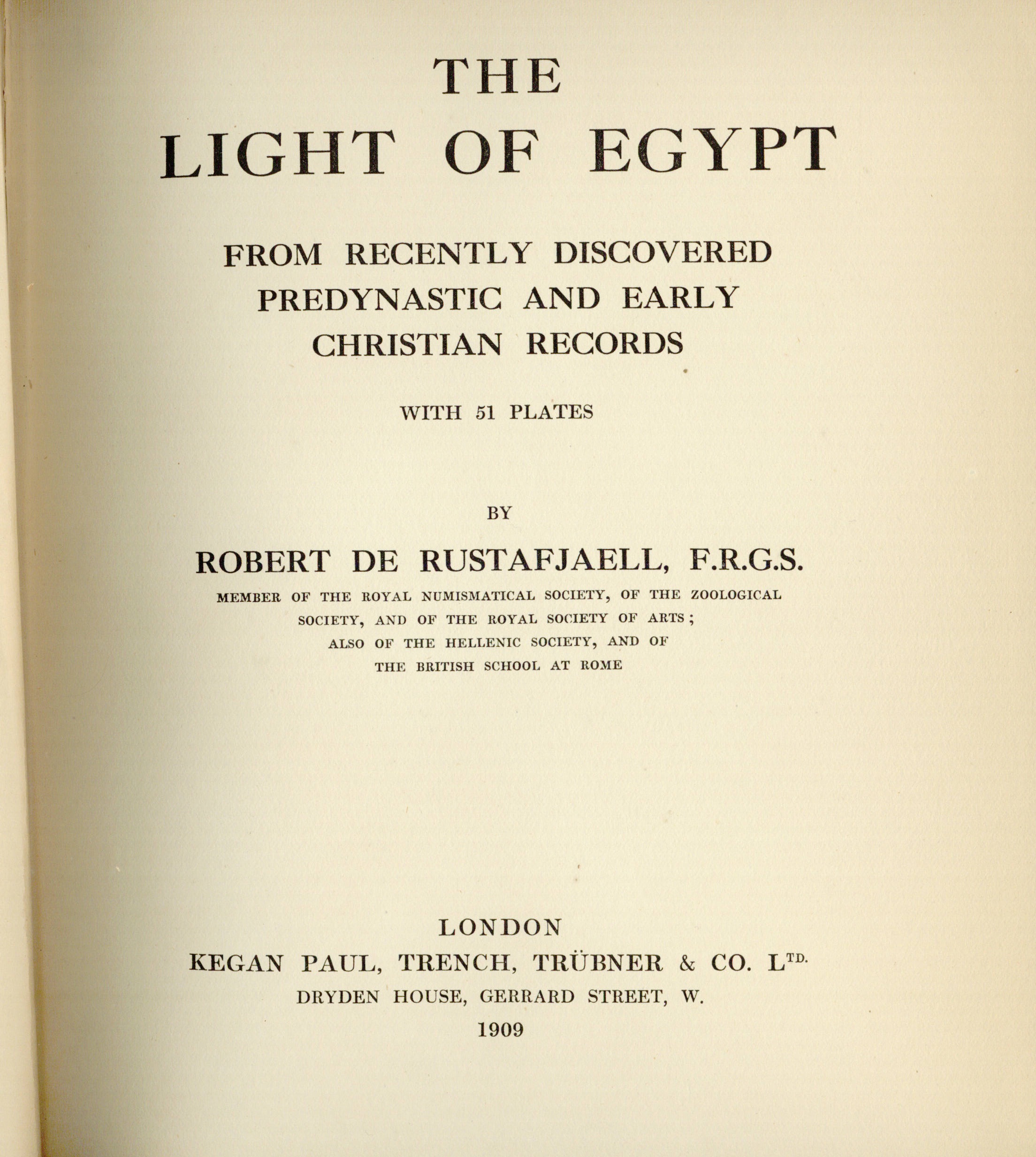
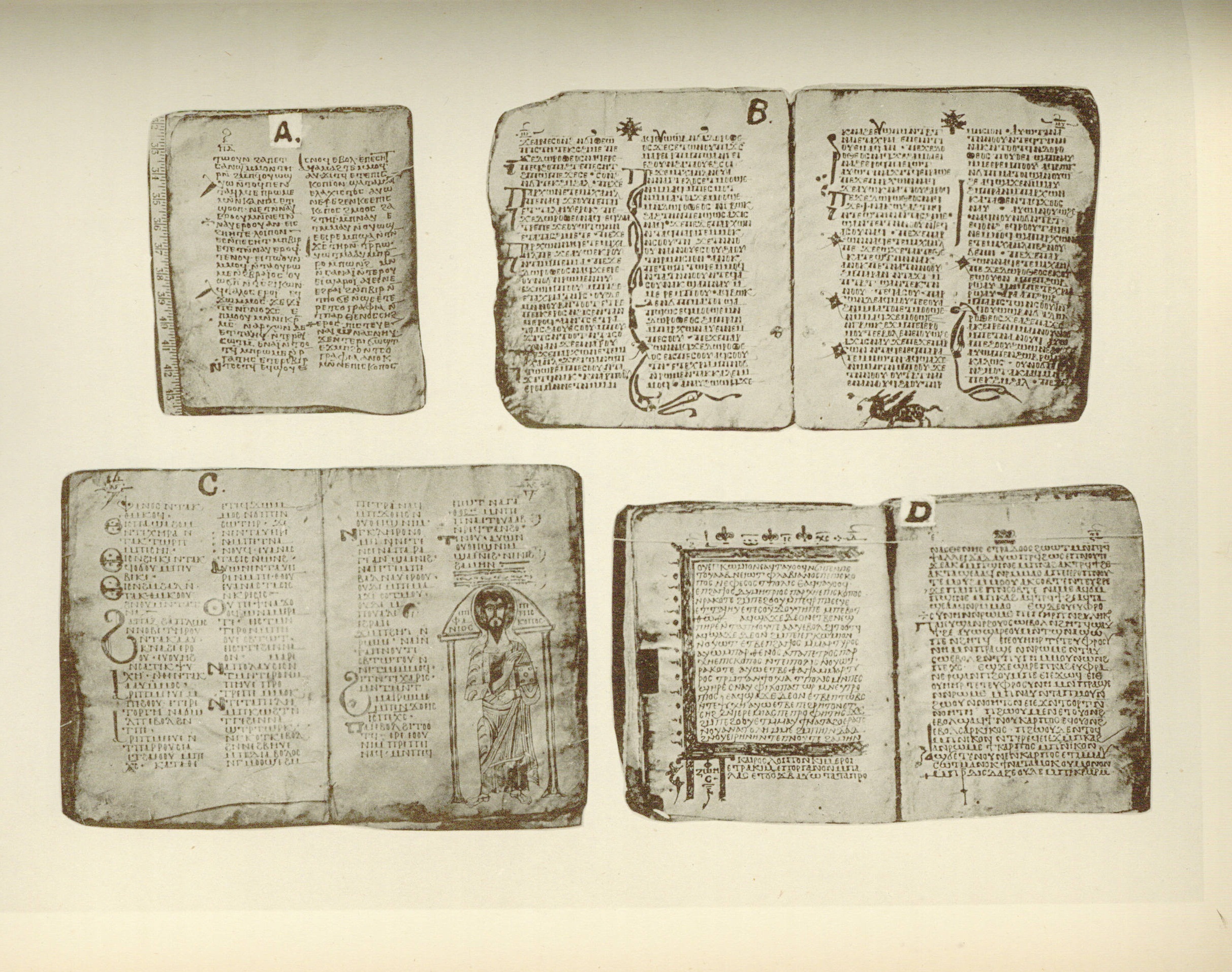
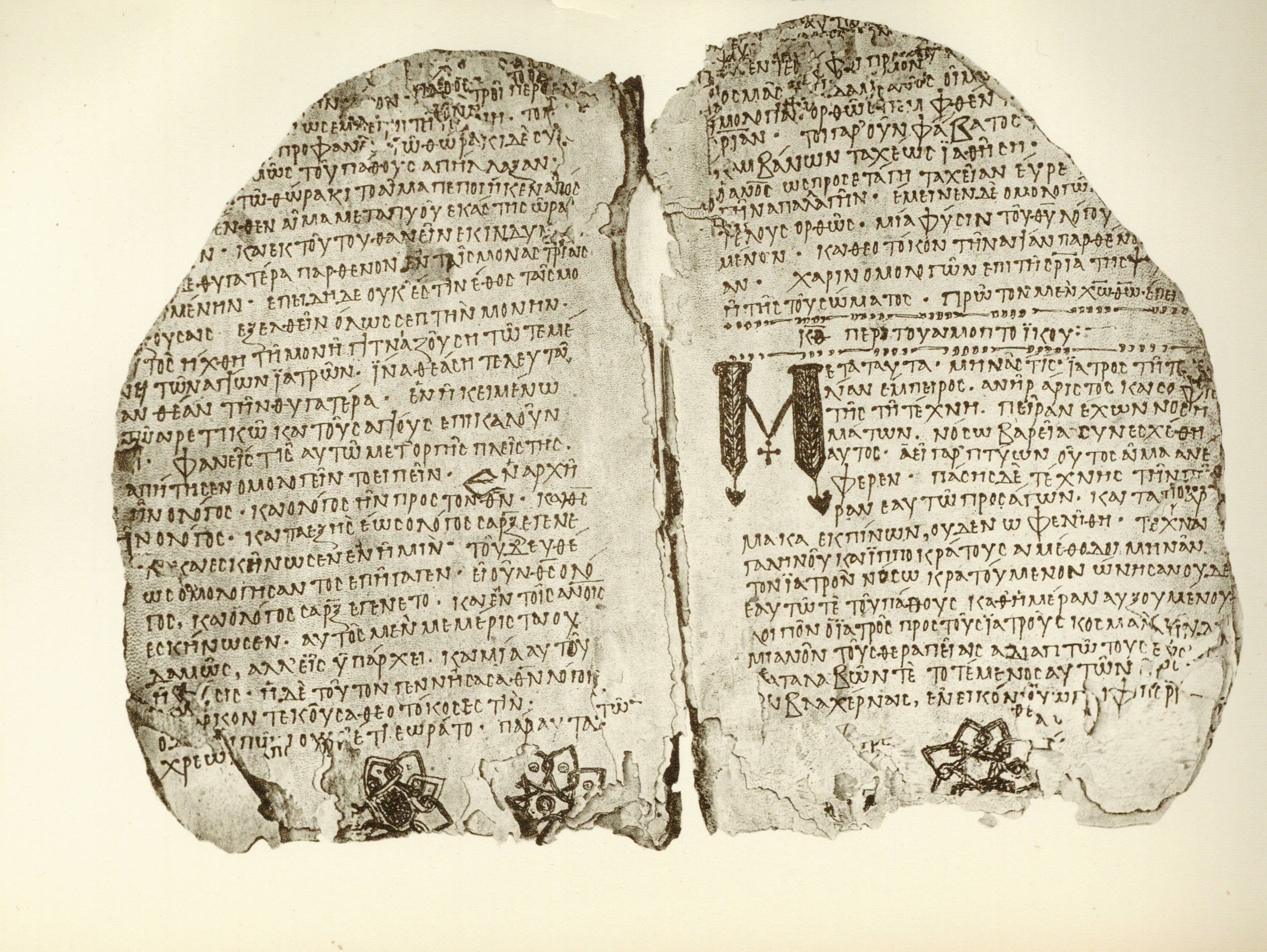
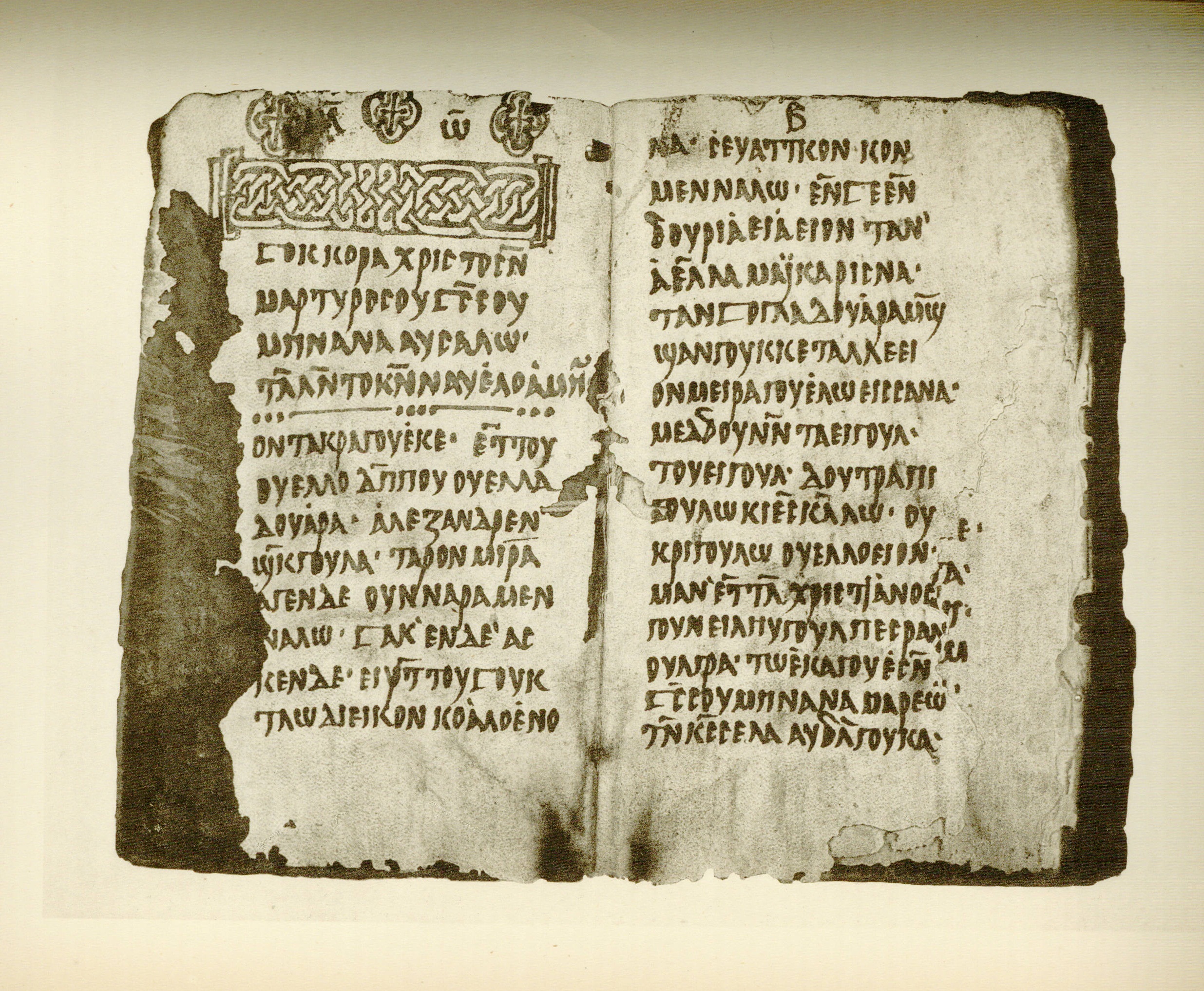
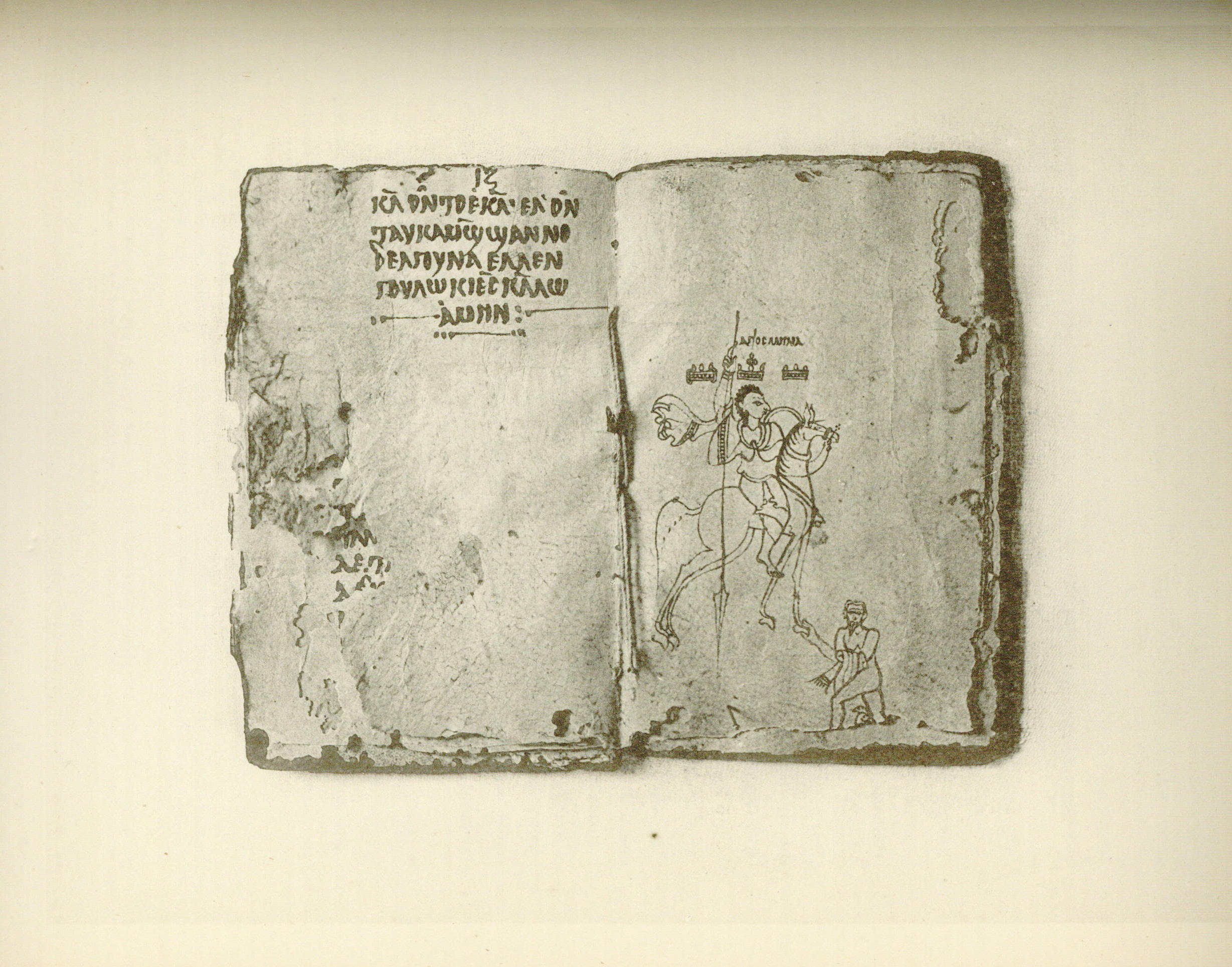
Some time ago, I bought on the internet a bibliographical rarity: Robert de Rustafjaell’s The Light of Egypt from Recently Discovered Predynastic and Early Christian Records (London: Kegan Paul, Trench, Trübner & Co., 1909).

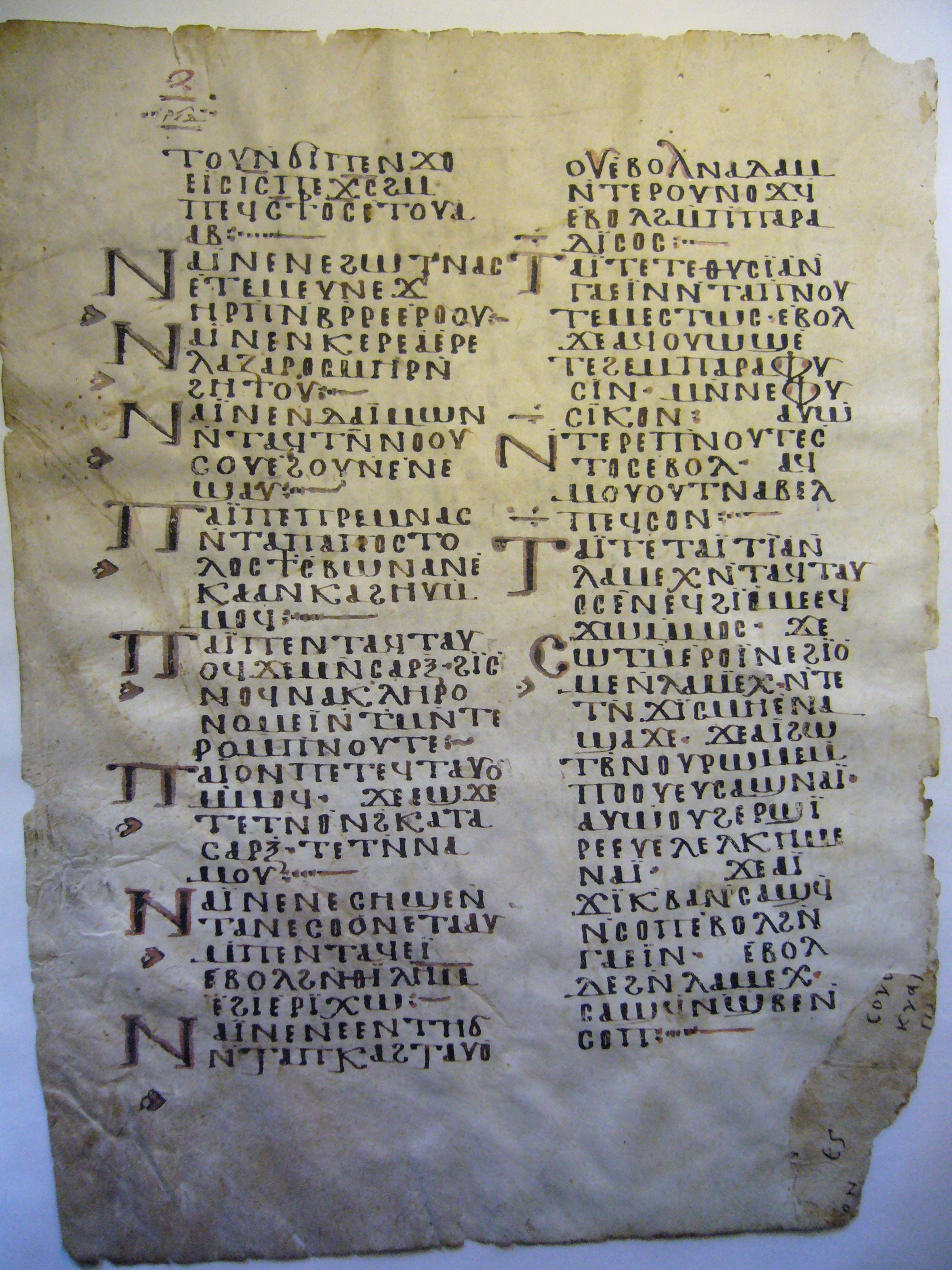
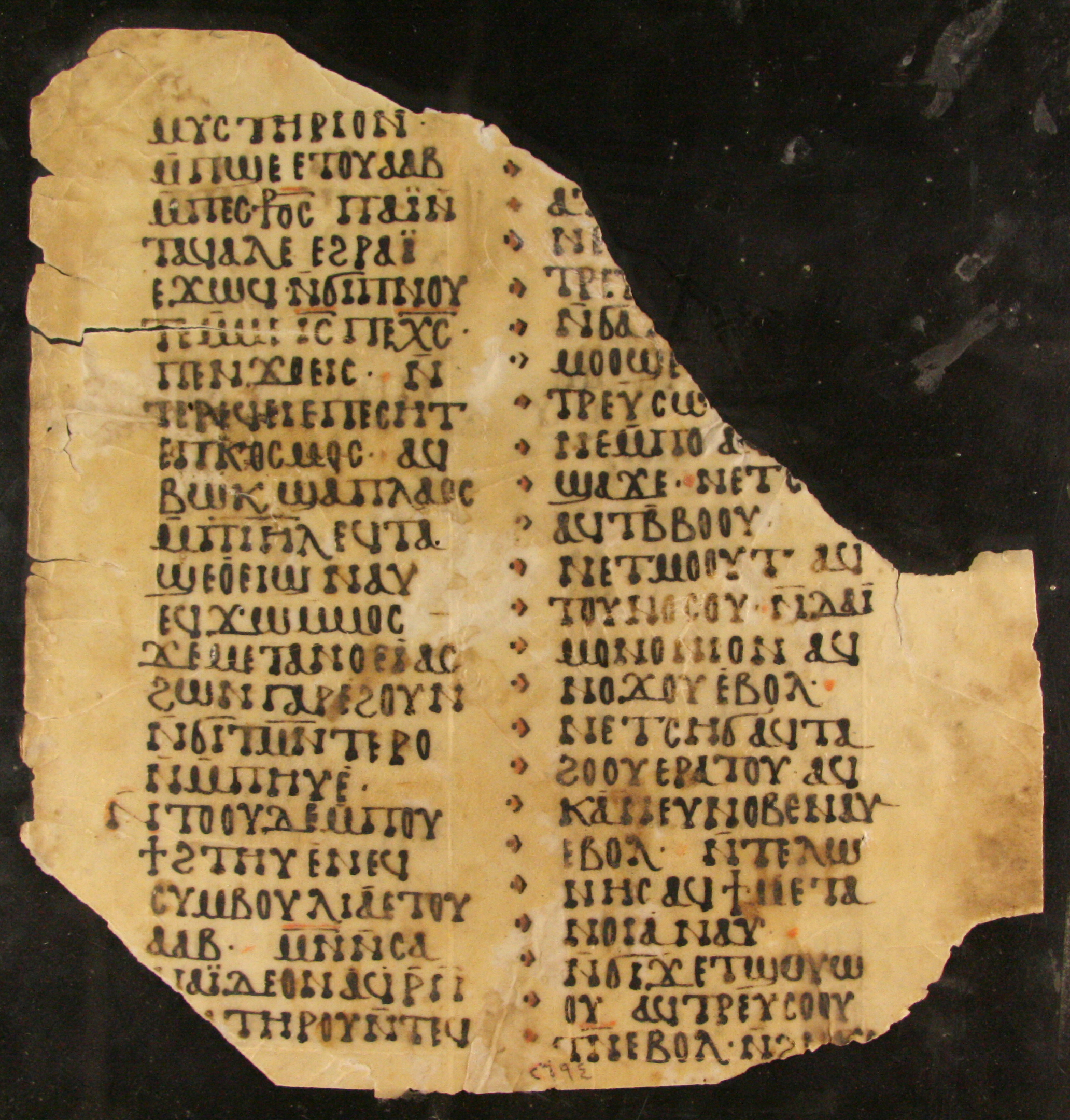
I had been looking for a long time to buy this book because it offers interesting details concerning the Coptic parchment and paper codices which belonged to the Monastery of St. Mercurius at Edfu, in Upper Egypt.

The circumstances of the discovery of these manuscripts are not clear. According to some early reports, they were unearthed at the very beginning of the 20th century by an Egyptian peasant in the ruins of a Coptic monastery situated near Edfu. Soon after their discovery, the manuscripts came into the hands of a dealer, from whom some of them (seven, if I remember correctly) were purchased by Robert de Rustafjaell, aka Colonel Prince Roman Orbeliani, an aristocrat interested in ancient Egypt. In November 1907, Rustafjaell sold them, in turn, to the British Museum. Here the manuscripts were studied and edited by Ernest A. T. Wallis Budge during his tenure as Keeper of the Department of Egyptian and Assyrian Antiquities. Finally, the Edfu codices were later transferred to the British Library where they are found today. If you want to know more about these manuscripts, you should check Bentley Layton’s “Introduction” to his Catalogue of Coptic Literary Manuscripts in the British Library Acquired Since the Year 1906 (London: British Library, 1987).

One cannot overestimate the importance of the Edfu codices for our knowledge of Coptic literature. They are well-preserved manuscripts which offer us not only complete texts but also a glimpse into book production in Medieval Egypt.

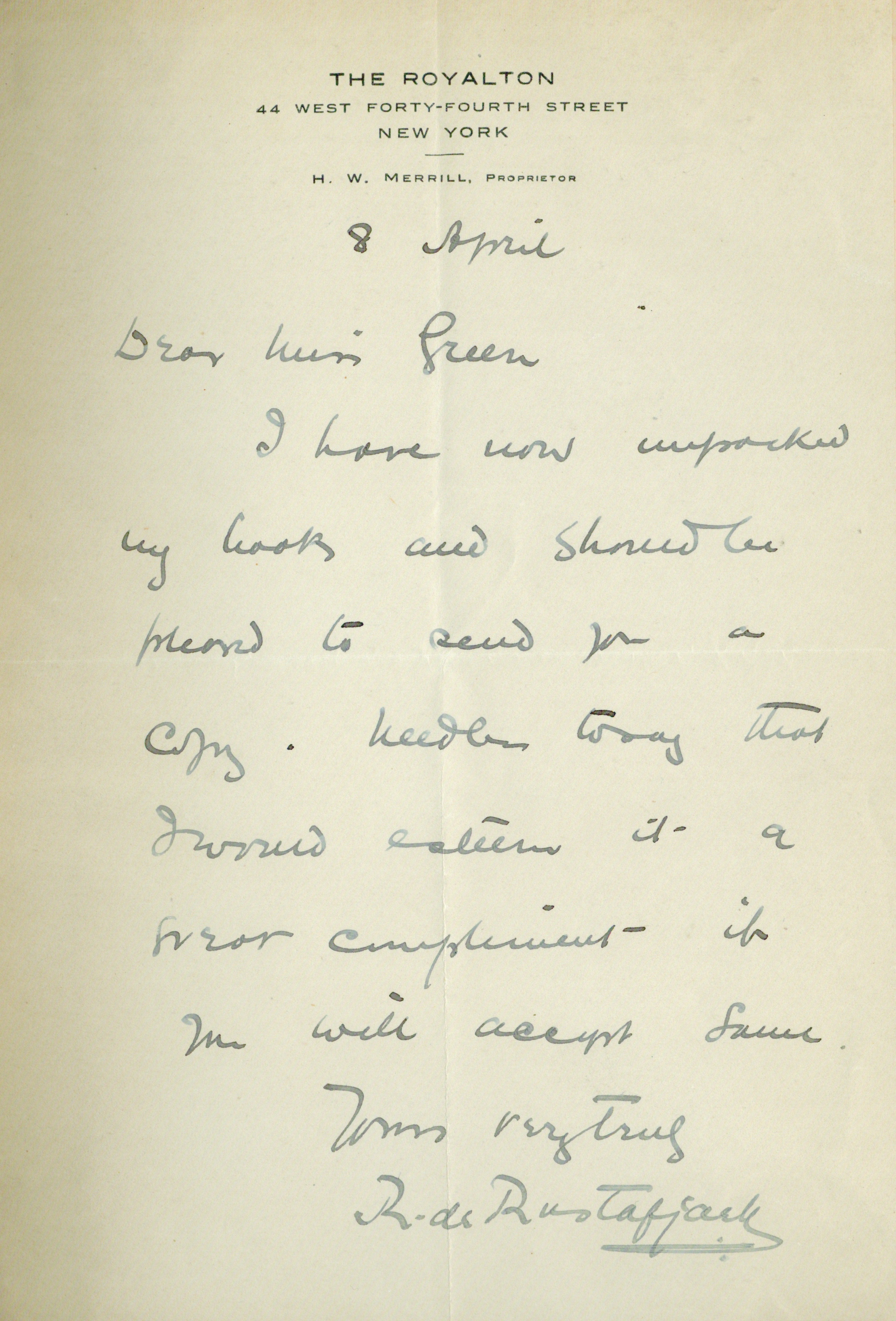
Now, I was surprised to find inside the cover of Rustafjaell’s book a handwritten dedication letter sent by him to a certain “Miss Green.” The letter was sent from the Royalton Hotel, on 44 West Street in New York (which is still there!), and it is not dated. As to the mysterious recipient simply called “Miss Green,” I not sure who she is. Can she be Belle da Costa Greene, John Pierpont Morgan’s private librarian? That’s a possibility.

Here is the photograph of the letter and its transcription. I deciphered it only through the help of Paul Leopold (Stockholm, Sweden), as the handwriting was otherwise nearly illegible to me.

8 April

Dear Miss Green

           I have now unpacked my books and should be pleased to send you a copy. Needless to say that I would esteem it a great compliment if you will accept same.

Yours very truly
R. de Rustafjaell

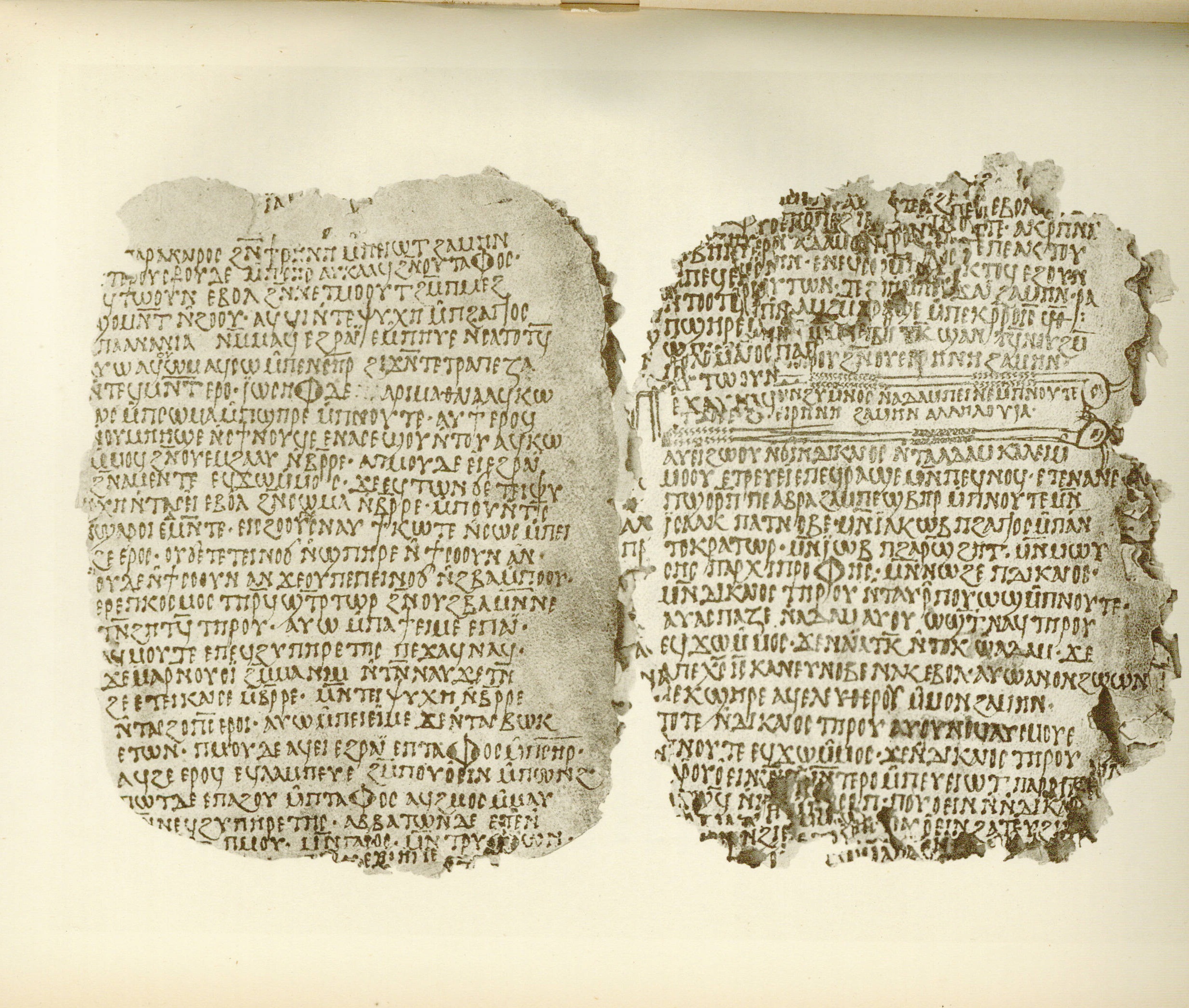
And now here are the plates of Rustafjaell’s book, which contain some beautiful Greek, Coptic and Nubian manuscripts. Enjoy!

Posted in Uncategorized | Tagged , , , , , , | 16 Comments

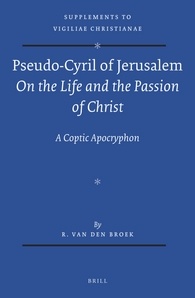
Guest Post: Roelof van den Broek – Pseudo-Cyril of Jerusalem, On the Life and the Passion of Christ

Roelof van den Broek, Pseudo-Cyril of Jerusalem, On the Life and the Passion of Christ. A Coptic Apocryphon (Supplements to Vigiliae Christianae, 118), Leiden-Boston: Brill 2013; 215 pp. Price: 101,- Euro; 140,- US Dollar.

In the early seventies of the last century I became acquainted with the homily On the Life and the Passion of Christ, contained in manuscript M610 of the Pierpont Morgan Library, New York, and attributed to Cyril of Jerusalem. It is an interesting text, in particular because of its many apocryphal stories. The work was accessible only in Hyvernat’s facsimile edition of the Pierpont Morgan Coptic codices, vol. 44, and I decided to ask the authorities of the Library to grant me permission to publish the text, with an introduction, translation and notes. I got the permission and began to work on the edition and announced its publication to the scholarly world. But then my career and my research took another direction and I had to leave the project unfinished for several decades. In 2010 I took up the work again and brought it to completion in the spring of 2012.

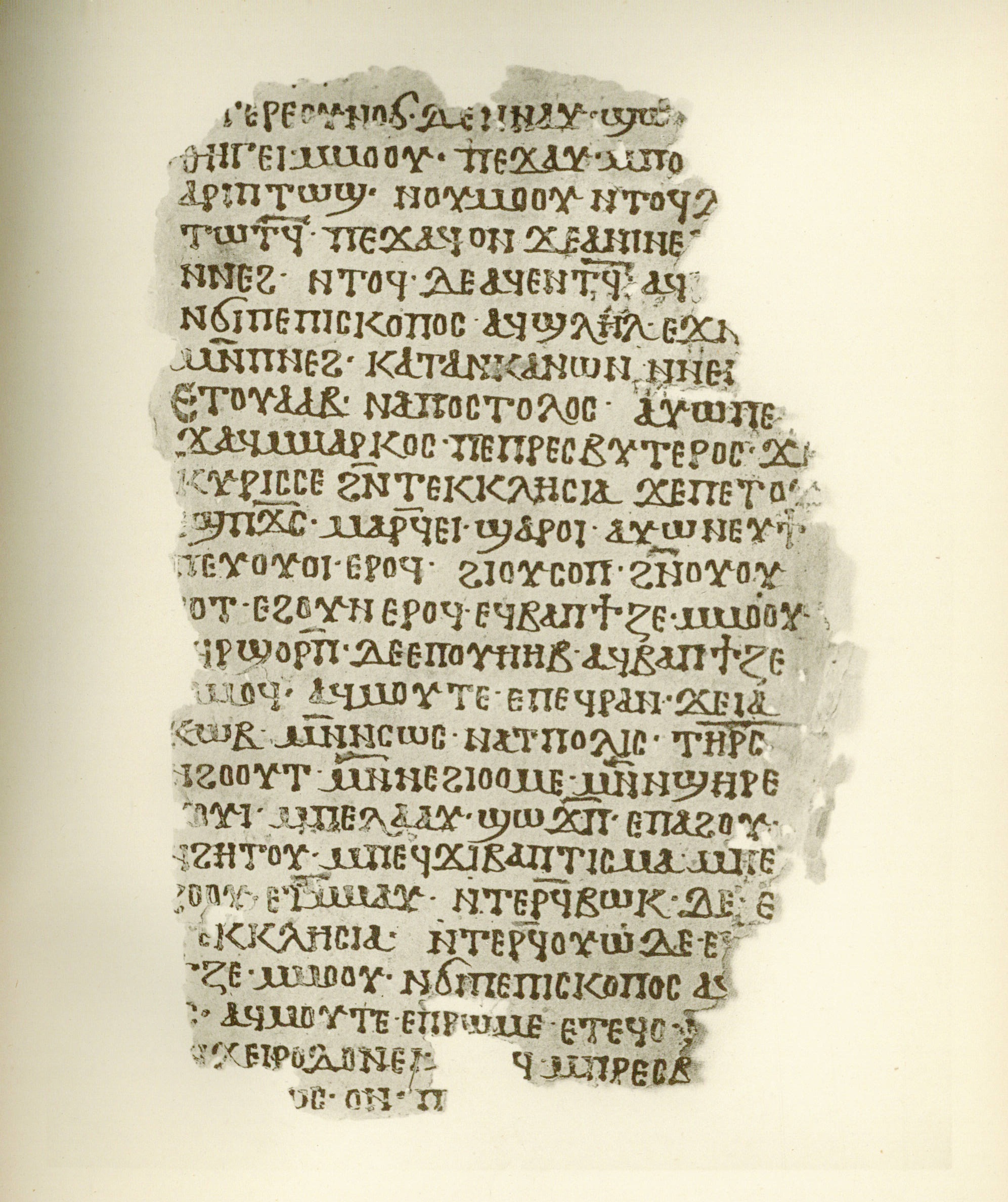
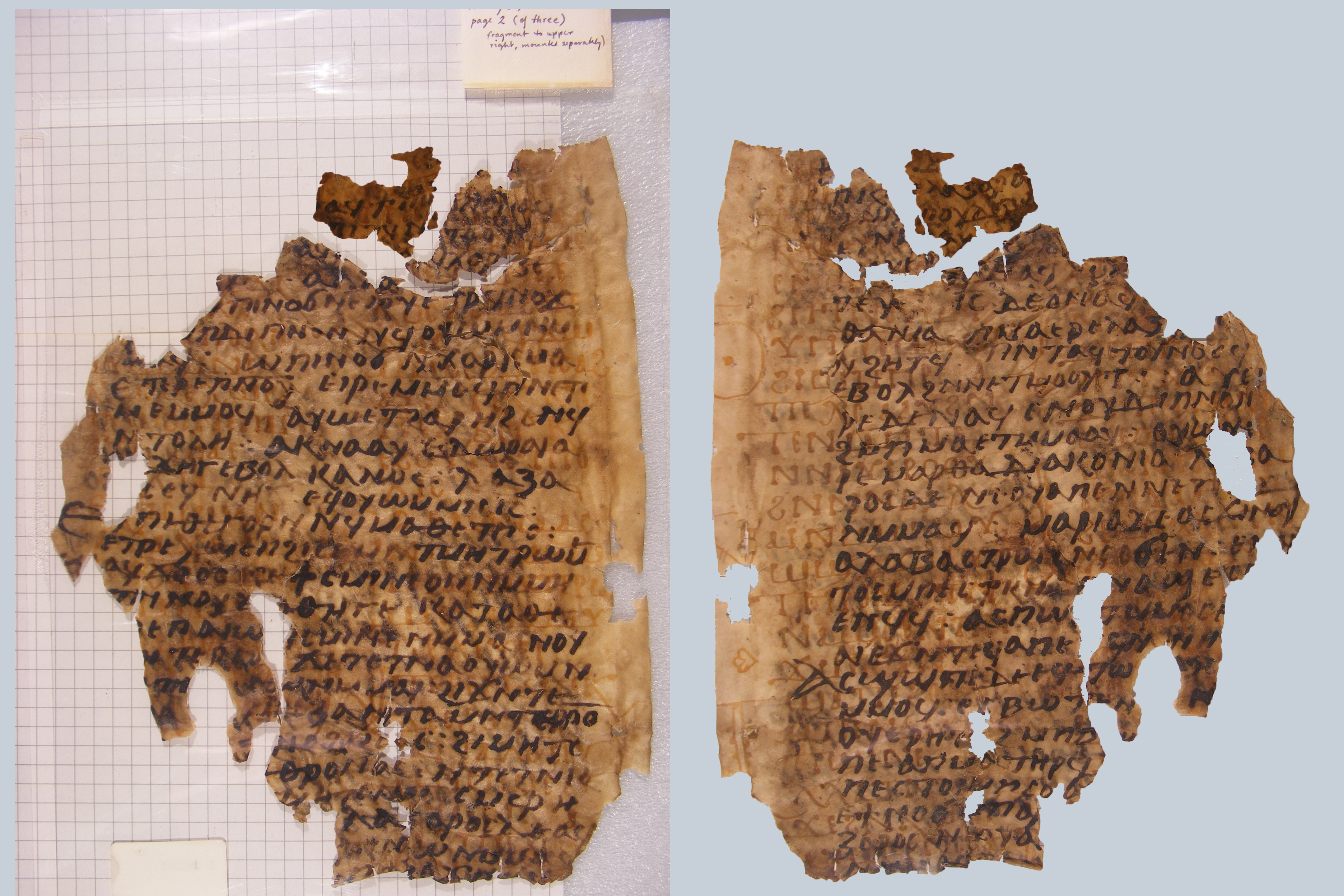
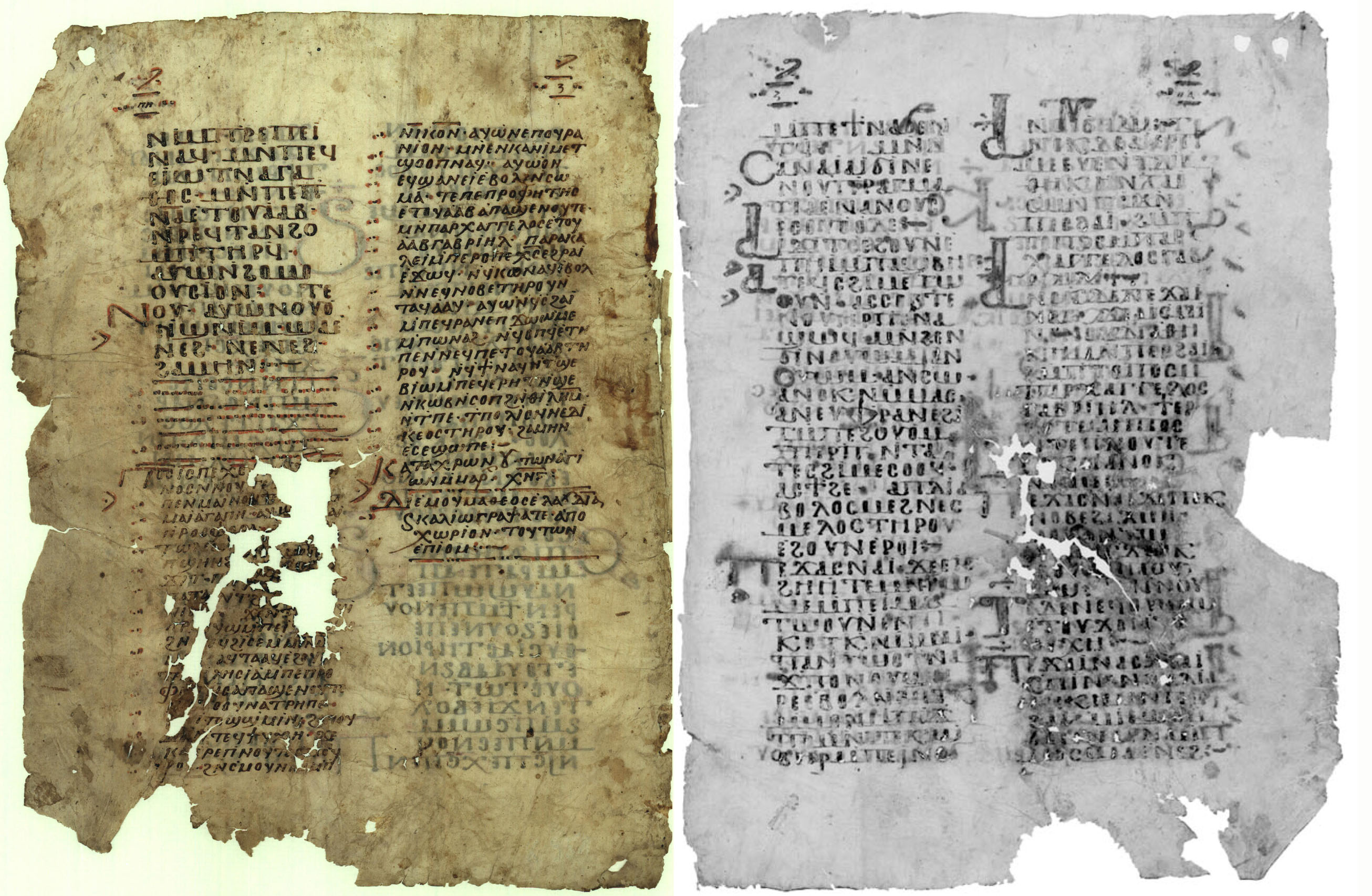
Some poor remains of another copy of Pseudo-Cyril’s homily have been preserved in Ms. E16262 of the University of Pennsylvania, as the underwriting of a palimpsest of which the overwriting contains parts of the homily On the Resurrection of Lazarus, attributed to Athanasius of Alexandria. Of the six pages of E16262 only four contain a part of Pseudo-Cyril’s text, but because of the overwriting and the bad state of the manuscript, only a few portions are legible. In my edition all indubitable variant readings of E 16262 have been recorded in the critical apparatus.

University of Pennsylvania Museum, E 16262 (SOURCE OF THE PHOTOGRAPH)

In my view, the edition and translation of a Coptic text is complete only if it is accompanied by a thorough commentary which clarifies the content of the text and puts it into a wider context. I have tried to do this in the long introduction and the notes to the translation.

Continue reading

Posted in Apocrypha, Cyril of Jerusalem, Guest Post | Tagged , , , , , , , , , | 7 Comments

Newly Found Fragments from Codex Tchacos

My thanks to David Tibet for his kind help

NOTE: I introduced for the first time the Tchacos fragments discussed below during the annual reunion of the Association pour l’étude de la littérature apocryphe chrétienne (AELAC), which took place June 28-30, 2012, in Dole, France. More recently, Gregor Wurst mentioned them as well in his report on Gnosticism, which he delivered in Rome at the Tenth International Congress of Coptic Studies (September 17-22, 2012). I am currently preparing together with Louis Painchaud (Université Laval, Québec) an edition of the fragments.

For the last couple of years, I have been picking through some little-known collections of Coptic manuscripts. Moreover, I have also been trying to locate fragments of Coptic manuscripts in private collections. Although my main purpose was to find parchment fragments from the Monastery of Apa Shenoute (also called the White Monastery) for our Corpus dei manoscritti copti letterari  project, from time to time other unexpected things surfaced.

I shall briefly present here one such surprising discovery, which occurred recently.

Not so long ago, I found out that the Lafayette College in Easton, Pennsylvania, possesses, among other Egyptian antiquities, two Coptic papyrus fragments. As I was curious enough to know what they were, I asked the staff for more details about them. In this way I came to know that despite the fact that the fragments have been labeled as “Egyptian Gospel Books,” actually they do not belong to any of the canonical Gospels. The first thing that struck me when I read the papyrus fragments was the occurrence of a Middle Egyptian dialectal form in the Sahidic text, which is very rarely found in the manuscripts I usually investigate. This was already curious enough to make me think it could be something interesting. But, more importantly than that, very peculiar paleographical features suggested that the papyri could belong to Codex Tchacos.

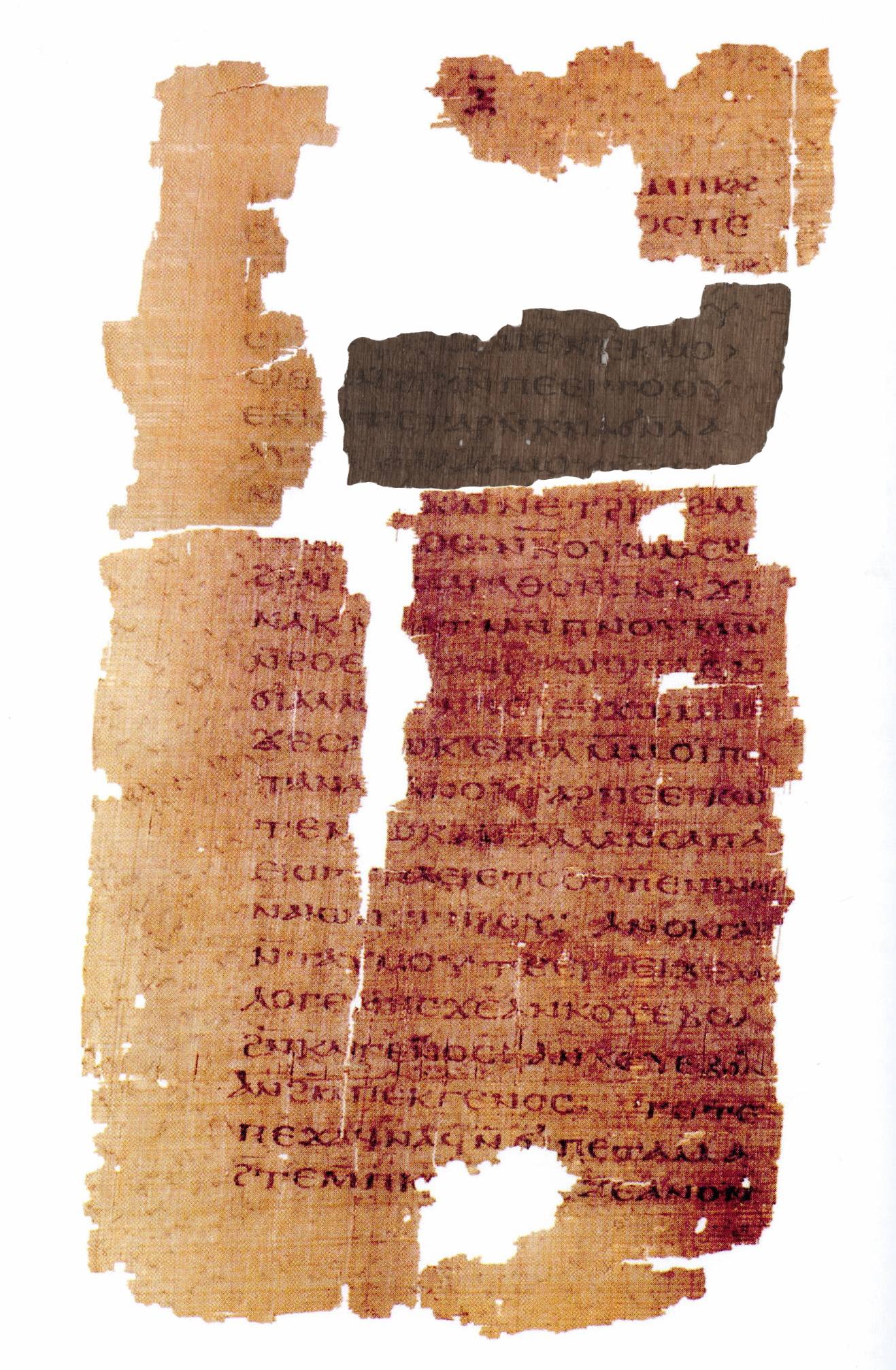
Perhaps you remember the impact this manuscript had in the media in 2006, mainly due to the fact that it contains the now famous Gospel of Judas. Indeed, the comparison of the two Lafayette fragments to the facsimile of Codex Tchacos published by National Geographic confirmed that they are paleographically related. Moreover, the largest of the fragments shares with several fragments of Codex Tchacos a similar damage pattern. In papyrology, if we find more pieces of the same manuscript which exhibit a similar damage pattern, it usually means that they belonged to successive leaves which suffered the same kind of erosion due to their proximity in the codex.

Codicologically, it appeared to me that the largest fragment belongs to pages 59/60 of Codex Tchacos. Here is a digital reconstruction of page 60 (the Lafayette fragment is the dark one):

As the Gospel of Judas ends on the previous page, that is, 58, the new Lafayette fragment belongs to the Book of Allogenes, which begins on page 59 of the manuscript. Continue reading

Posted in Apocrypha | Tagged , , , , , , , , , , | 5 Comments

Successful Thesis Defense!

On October 6, 2012, my wife, Päivi Vähäkangas, successfully defended her doctoral dissertation, titled Rejection and Reception of Philosophy in the Letter of Eugnostos (NHC III,3 and V,1) and Pseudo-Clementine Recognitions, at the Faculty of Theology, University of Helsinki. The opponent was Prof. Nicole Kelley (Florida State University). Prof. Antti Marjanen from the University of Helsinki served as custos.

Päivi’s thesis focuses on two little-known early Christian texts: the Letter of Eugnostos, preserved in Coptic among the Nag Hammadi manuscripts, and the Recognitions attributed to Clement of Rome. Here is the thesis’ abstract (SOURCE):

Eugnostos and Recognitions represent diverging early Christian traditions. Eugnostos, a religious-philosophical treatise from the Nag Hammadi library, was born on Egyptian soil and read in Gnostic Christian circles. It describes the divine realm from the Primal God up to the completion of his emanations. Recognitions arose out of Syrian Jewish Christian speculations and shows an interest in earthly affairs: the missionary journeys of the apostles, the history of the early Church, the right teaching and praxis. What connects these writings is their concern with philosophy. Both sources contain an explicit refutation of philosophy and philosophers. They use similar arguments and a similar pattern: first they point out how philosophers have erred, and then they reveal what constitutes the source of the truth. Both consider knowledge gained in the right manner and from a proper source antithetical to philosophy. In presenting the concept of philosophy as something voluntarily adopted and maintained they simultaneously sketch an idea of religion in a similar way: becoming a Christian means adopting and maintaining a distinct way of life and a set of beliefs.

Eugnostos and Recognitions stress the correct teaching concerning God and the origin of the world. It is a crucial theme that dominates their theology. The interest Platonists showed in the distinction between the nature and functions of the first and the second principles was also reflected in Christian theology. Eugnostos stresses the importance of making a distinction between the absolute transcendent Primal God and his emanations that represent the beginning of multiplicity and the visible things. Recognitions also offers a philosophically oriented exposition of the distinction between the Father and the Son as regards their nature.

Another major theme in Eugnostos and Recognitions is salvation. The Platonic emphasis on saving knowledge also holds a special position in these writings. Salvation is connected with possessing the right kind of knowledge of God and the origin of the cosmos. The key position in the process of salvation belongs to the figure that originally brought the revelation to the ignorant/erring humankind and to those who faithfully transmit the correct teaching for future generations.

Posted in Uncategorized | Tagged , , , , , , , , , , , | 6 Comments

What is Clavis Coptica?

Because many people have been asking me lately what means clavis coptica to which I often refer in my studies and on this blog, I am posting here a response from Tito Orlandi, the director of the Corpus dei manoscritti copti letterari project:

“The Clavis Coptica (or Clavis Patrum Copticorum) is the complete list of the literary and Patristic works which form the Coptic literature, modeled on the example of the Clavis Patrum Graecorum (by Geerard) and the Bibliotheca Hagiographica Graeca/Latina/Orientalis.

Each work has an identification number of 4 digits, which may be quoted as: cc0000.

The list is presently found on the web page of the Corpus dei Manoscritti Copti Letterari
(http://cmcl.let.uniroma1.it) accompanied by information on manuscripts, content, and
critical problems.

The bare list (id. number, author-title) will soon be found for free on the Hamburg web page of the CMCL. A printed Clavis Coptica is in preparation.”

Posted in Uncategorized | Tagged , , , , , | 2 Comments

A Coptic Apocryphal Manuscript from Nubia (the Qasr el-Wizz Codex)

When the High Dam was built in the 1960s, almost the entire Nile valley between Aswan and Wadi Halfa had been inundated in order to create the Lake Nassar. As the waters were rising, many archeological sites were destroyed, while others, such as the well-known temples of Abu-Simbel, were removed from their original location and re-erected elsewhere. During the construction of the dam, more precisely in October-November 1965, the archeological team from the Oriental Institute of the University of Chicago was excavating a Christian monastery at Qasr el-Wizz, situated just a couple of kilometers north of Faras, in Lower Nubia. I will not detail all the results of their excavations because good reports are available, for example, in G.T. Scanlon – G. Hingot, “Slip-Painted Pottery from Wizz,” African Arts 2 (1968) 8-13, 65-69 (article in English and French).

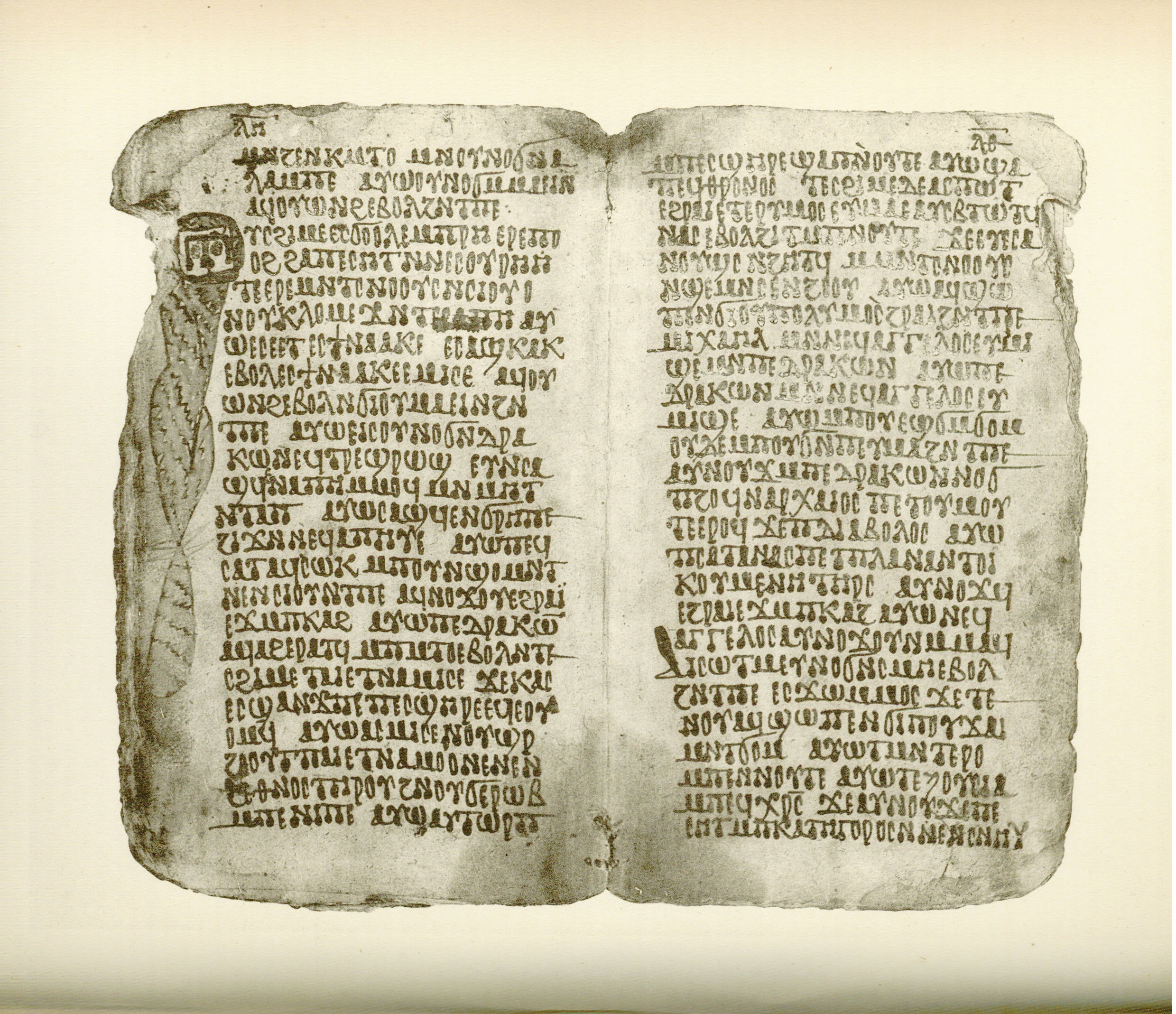
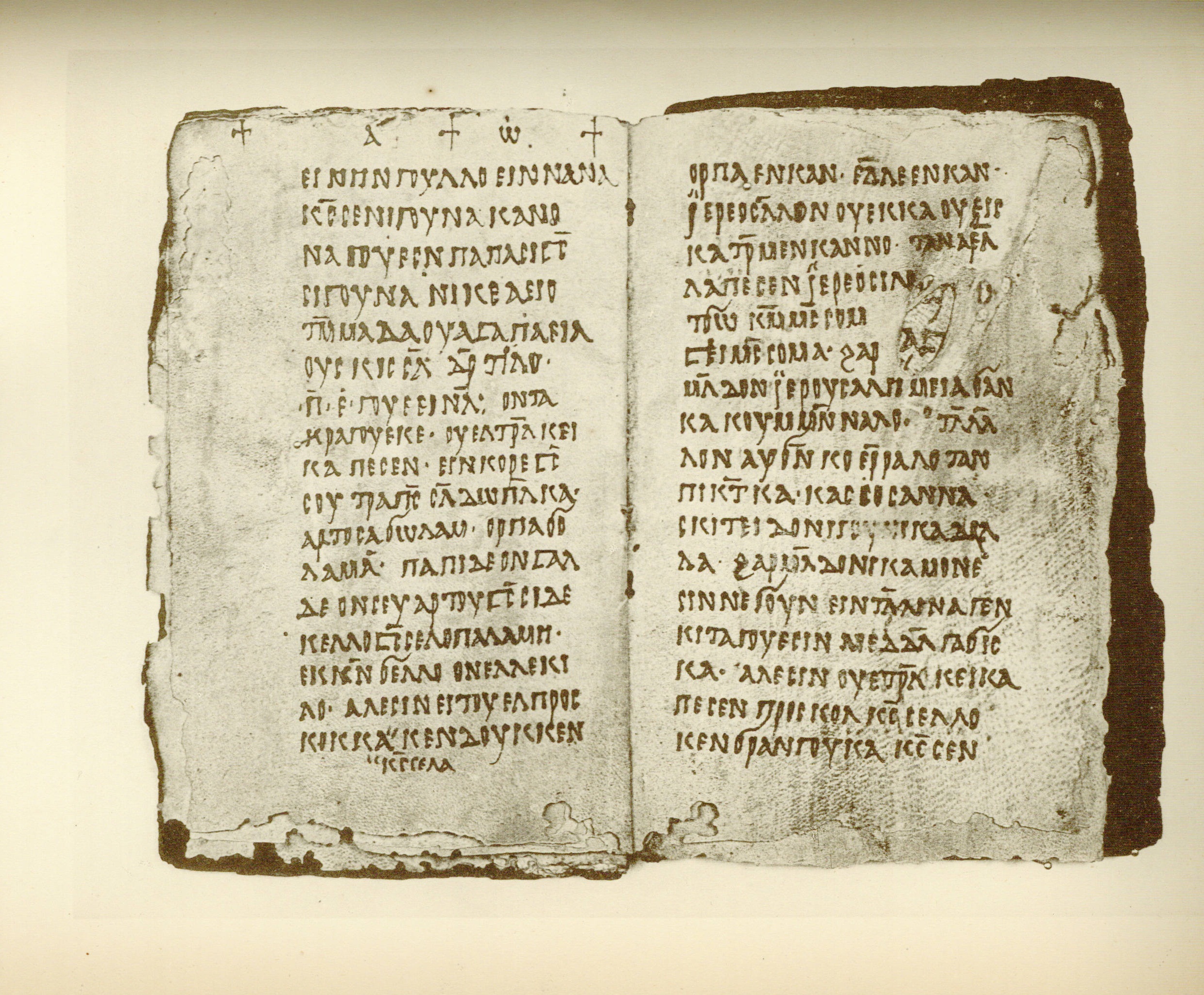
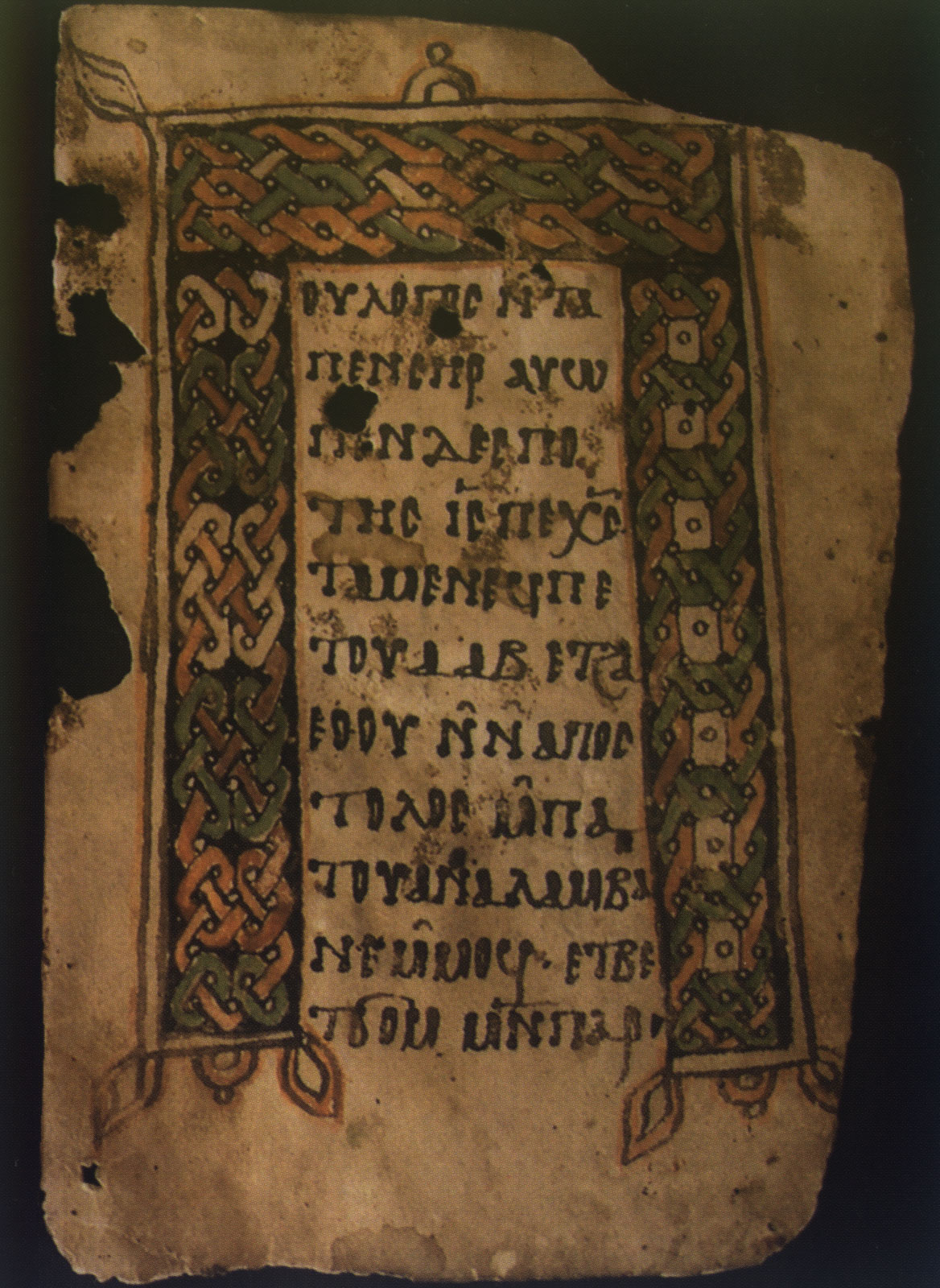
Perhaps the most exciting discovery of the Chicago team at Qasr el-Wizz was a small parchment book written in Coptic. The manuscript was found almost intact, virtually the entire text being preserved. The Qasr el-Wizz codex was initially housed in the Coptic Museum in Cairo, but was later been moved to the new Nubian Museum in Aswan.

(PHOTOGRAPH from Péter Hubai, A Megváltó a keresztről: Kopt apokrifek Núbiából (A Kasr El-Wizz kódex) (Cahiers Patristiques, Textes Coptes; Budapest: Szent István Társulat, 2006)

It contains two short apocryphal pieces. The first of them, which begins on fol. 2r – see photo above, is a revelation of Jesus Christ to the apostles on the Mountain of Olives. It contains a dialogue of the apostle Peter with the resurrected Christ concerning the eschatological and soteriological function of the Cross. The second text (fol. 12v-17r) is a hymn sung by Jesus whilst the apostles are dancing around the Cross.

The discovery made some fuss, Continue reading

Posted in Apocrypha, Uncategorized | Tagged , , , , , , , , , | 28 Comments

More Coptic Fragments from an Encomium on the Apostles (Ps-Severian of Gabala, Encomium in XII apostolos)

In this post I drew attention to a Coptic encomium on the twelve apostles, attributed to Severian of Gabala (CPG 4281; clavis coptica 0331). Sever Voicu published, in the journal Apocrypha, an extensive and well-documented article concerning the apocryphal traditions related to the apostles, which appear in the encomium of Ps-Severian.[1]

The encomium on the twelve apostles is known to survive in the Sahidic dialect of Coptic (Recension A) and in Arabic (Recension B). The Arabic recension, preserved in two manuscripts, one in the Vatican and the other in the Coptic Museum in Cairo, is radically different from the Coptic version. The latter was edited and translated into English by Michael E. Foat after a Sahidic manuscript from the Monastery of the Archangel Michael, situated near Hamouli, in the Fayyum oasis.[2] In 2005, Davide Righi published a fresh edition of the Hamouli manuscript together with the editio princeps of the two Arabic manuscript witnesses.[3]

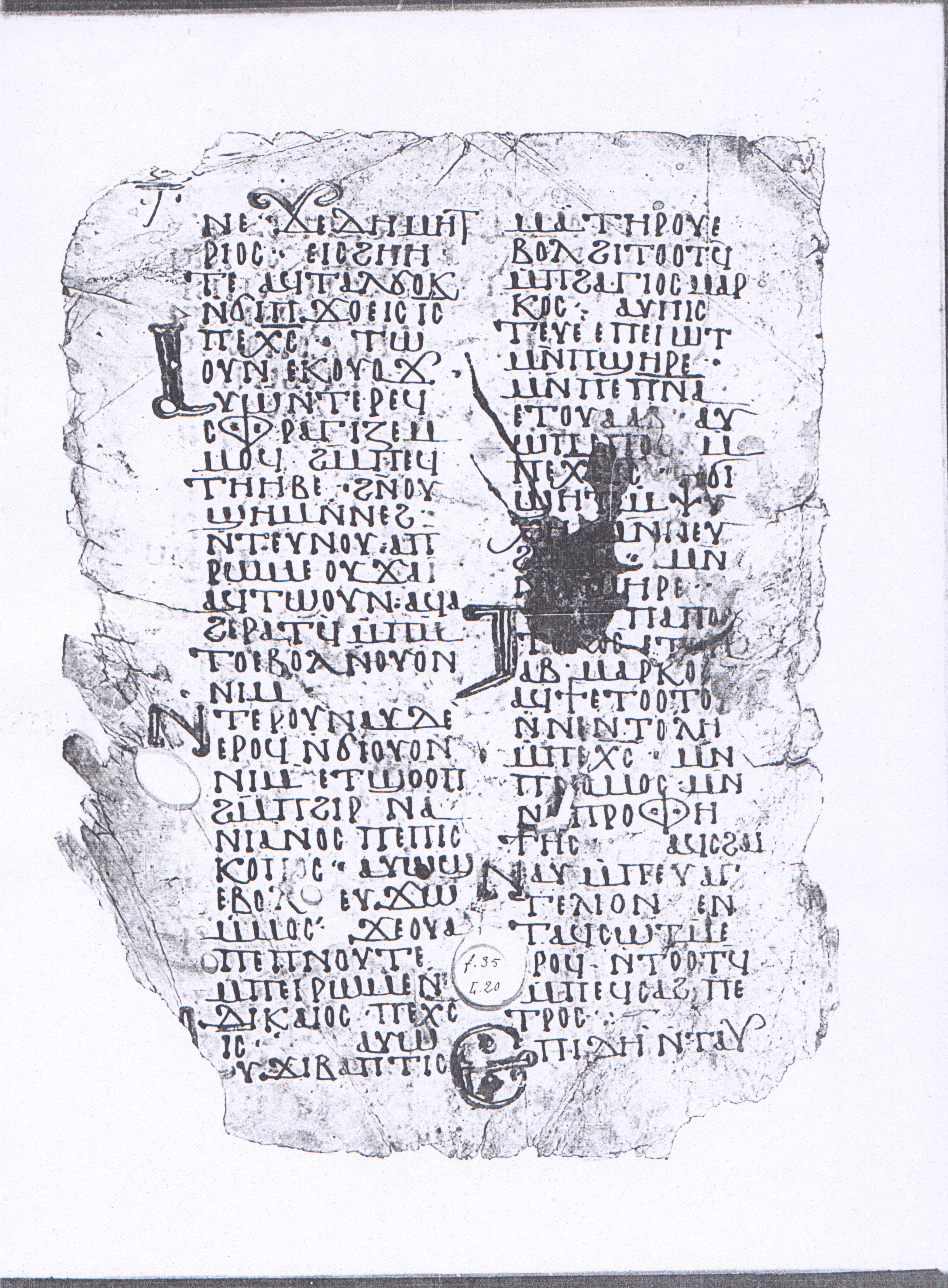
In my previous post on Ps-Severian’s Encomium on the Twelve Apostles I pointed out that there is another manuscript of the Coptic recension (Recension A), from which only a few scattered leaves have survived. You may check there the directory of the fragments that I have identified until now.

Further research on different collections of Coptic manuscripts revealed other fragments of the same encomium. The most interesting thing about these new fragments is that they contain the recension of the encomium on the apostles which has been known until now only in Arabic (Recension B). This clearly shows that the Arabic version is not a late reworking of the Sahidic, but it rather goes back to a Coptic original.

Continue reading

Posted in Apocrypha, Patristics, Severian of Gabala | Tagged , , , , , , , , , , | 1 Comment

Alin Suciu – Hugo Lundhaug: A Peculiar Dialectal Feature in the Gospel of Jesus’s Wife, Line 6

In our previous post on the Gospel of Jesus’s Wife, we remarked, as others have done, that line 6 of the papyrus also goes back to a logion from the Gospel of Thomas. Here is the parallel:

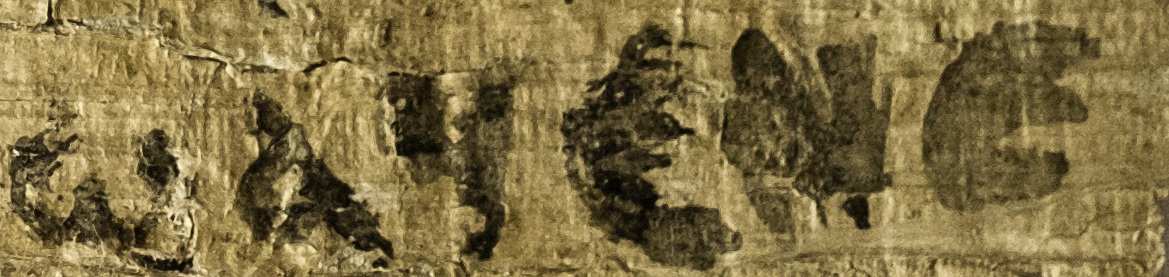
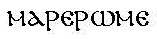
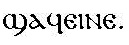
There are several arguments which point to this possibility: 1) the previous rendering of this line as “Let wicked people swell up […],” although not entirely impossible, would constitute an awkward and unparalleled cursing formula; 2) with the exception of all surviving words on this line are recoverable in the Gospel of Thomas, 41.1-3; 3) seems to be a misspelling which the copyist attempted to correct. This is relatively clear from the unusual shape of the first epsilon, which seems to derive from an iota:

The problem is that in this case the text is grammatically incorrect and such a mistake could have been done only by someone who does not have a proper knowledge of Coptic language. If we have the imperative , then we would not find there which marks the aorist of the third person masculine singular. The correct form of the sentence would be , “] let wicked man bring [forth] …” (the relative particle goes better with a definite noun, but Ariel Shisha-Halevy suggested us that this form is also acceptable).

Another more likely possibility is that the intention was to write “No wicked man brings [forth]” (perhaps ‘good deeds’), taking as a dialectal variant of the negative aorist Michael Grondin remarked in a comment to our post that precisely this form of the negative aorist is attested several times in the Gospel of Thomas (cf. 39.6; 39.13; 41.17; 46.21). To be sure, in the Gospel of Thomas 41.17, is employed exactly in this sense, that is, “no man.” Consequently, we believe now that the text was meant to say “no wicked man brings [forth] …,” but the result is still ungrammatical if we take to be a misspelling of

We now have a better picture of GosJesWife line 6, which takes over from the Coptic version of the Gospel of Thomas logia 45 & 47 not only a cluster of words, but also a dialectal feature.

Posted in Apocrypha, Articles | Tagged , , , , , , , , | 24 Comments

On the So-Called Gospel of Jesus’s Wife. Some Preliminary Thoughts by Hugo Lundhaug and Alin Suciu

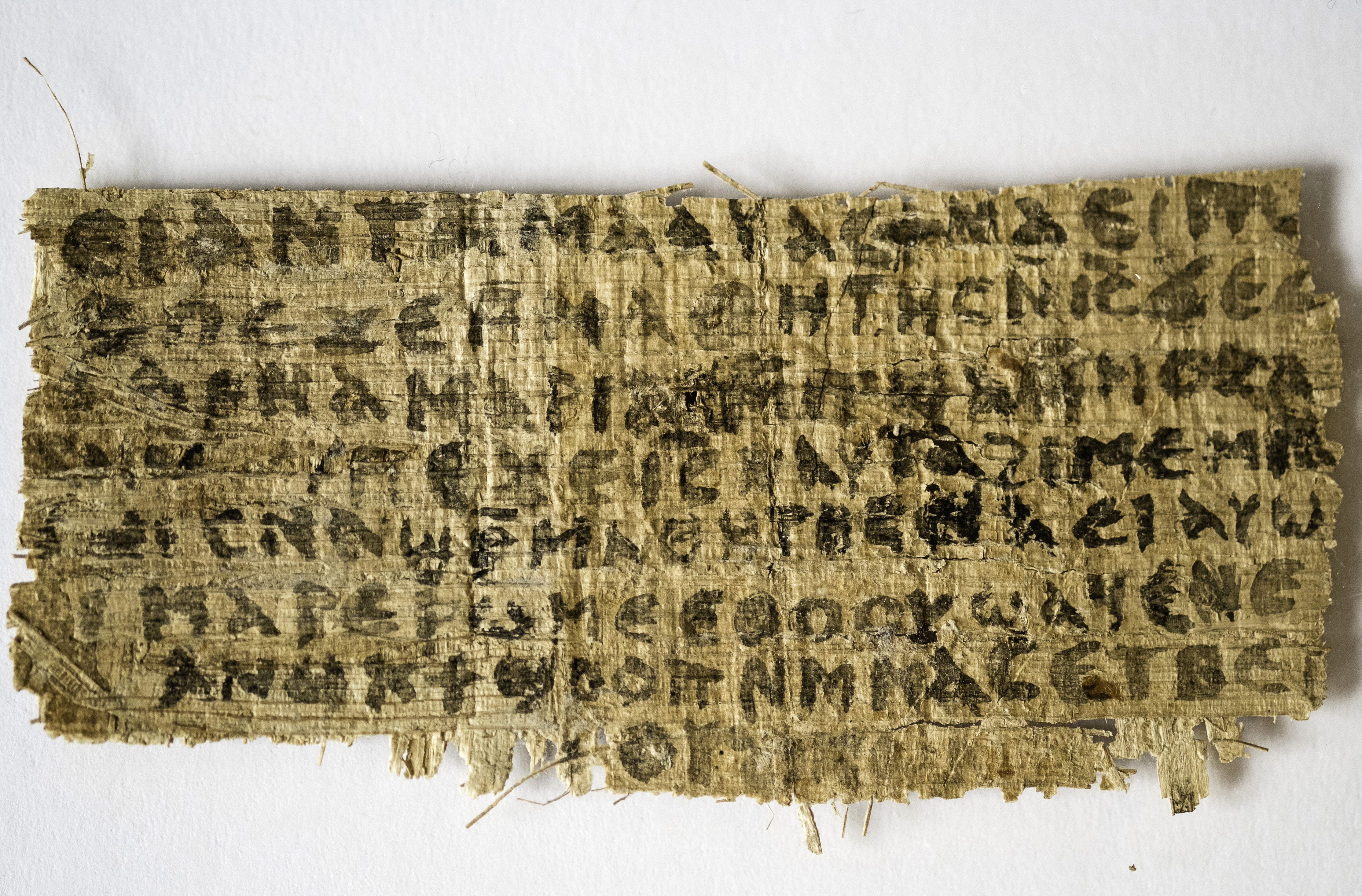
First of all, it should be clearly stated that, although in the following lines we shall express our doubts concerning the authenticity of the so-called Gospel of Jesus’s Wife, our suggestions remain hypothetical until the ink of the document has been properly tested. Secondly, our analysis does not refer either to the figure of the historical Jesus, or to his marital status, which are beyond our field of expertise, but only to a literary fragment written in Coptic, whose identity is suspicious.

During the 10th International Congress of Coptic Studies, which took place September 17-22, 2012 in Rome, the Harvard Professor Karen L. King introduced to us a previously unknown Coptic papyrus fragment.

(SOURCE OF THE PHOTOGRAPH)

Her paper was delivered on Tuesday, September 18, from 7.00 o’clock P.M., in one of the rooms of the Patristic Institute ‘Augustinianum.’  We estimate that about 20 colleagues listened to her paper.

The text seems to be a dialogue between Jesus and the disciples, its most notable feature being, nevertheless, the fact that Jesus mentions his wife. In her presentation, Karen King already stated that there are some doubts concerning the authenticity of the fragment. In a paper she submitted for publication to the Harvard Theological Review, which she graciously made available on the Harvard Divinity School website, she wrote:

“Although the authenticity is not absolutely settled beyond any question, we are sufficiently confident to offer our results here. We anticipate that publication of the fragment at this stage will facilitate further conversation among scholar regarding the fragment’s authenticity, interpretation, and significance.” (King, p. 5)

We shall not summarize here the whole succession of events, which is quite well-known. Fresh updates can be found HERE, HERE, or HERE. Suffice to say that doubts concerning the document have been raised by several scholars since the very beginning. While some denied the authenticity of the fragment on paleographical grounds, others pointed out the inconsistencies of the text.

Continue reading

Posted in Articles | Tagged , , , , , , , , , | 44 Comments

2008-2012 Bibliography on Coptic Literature

A bibliography on Coptic literature for the years 2008-2012 is now available on the website of the Tenth International Congress of Coptic Studies (Rome, September 17-22, 2012). The document was compiled by Heike Behlmer (University of Göttingen). Those interested will find there the articles which have been published since the previous congress (Cairo, September 14-20, 2008). I am grateful to Heike for mentioning also the brief articles which have been posted on this blog during the past year and a half. Actually, I was planning to put everything together in a book which shall be published in the collection of the Corpus dei manoscritti copti letterari.

Posted in Bibliographies | Tagged , , , , | 2 Comments

The Tenth International Congress of Coptic Studies: Programme

SOURCE

10.30-11.15: INAUGURAL SESSION Welcome address
Alberto Camplani, Congress Secretary (Sapienza Università di Roma)
Luigi Frati, Rettore della Sapienza Università di Roma
Antonello Biagini, Prorettore per la Cooperazione e rapporti internazionali Mariano Pavanello, Direttore del Dipartimento di Storia, Culture, Religioni Claudio Pacifico, Italian Ambassador to Egypt

Other authorities
11.15-11.45: IACS PRESIDENTIAL ADDRESS
Chair: Alberto Camplani
Anne Boud’hors

11.45-13.15: PLENARY REPORTS
Chair: Tito Orlandi
11.45-12.30: Heike Behlmer, Report on Coptic Literature (2008-2012)
12.30-13.15: James E. Goehring, Report Egyptian Monasticism (2008-2012)
13.15-14.40: LUNCH – Welcome reception served on the terrace of the Aula Magna
14.45-16.15: PLENARY REPORTS Chair: Paola Buzi
14.45-15.30: Andrew Crislip, Report on Shenoutean studies
15.30-16.15: Karel C. Innemée, Report on Coptic Archaeology (2008-2012)

16.15-16.40: COFFEE BREAK

16.45-17.30: Gertrud J.M. van Loon, Report on Coptic Art (2008-2012)

17.30-18.40: ONGOING PROJECTS RELATED TO COPTIC STUDIES
Chair: Alberto Camplani
17.30-17.50: Rosanna Pirelli, Paola Buzi, The Coptic site of Manqabad: an Italo-Egyptian project
17.50-18.10: Louay Mahmoud Saied, Maher Eissa, A course of Coptic Studies in Egypt
18.10-18-25: Training Curators of the Coptic Museum: Researching Museum Collection (Netherlands-Flemish Institute in Cairo)
18.25-18.40: Alessandro Bausi, Comparative Oriental Manuscript Studies (COMSt): a presentation
18.40-18.45: Practical information

TUESDAY, SEPTEMBER 18th Institutum Patristicum “Augustinianum”
9.00-9.20: Welcome Address of Prof. Robert Dodaro, Director of the Institutum Patristicum “Augustinianum”
9.20-9.30: Communications and practical information
9.30-11.00: PLENARY REPORTS (Aula Magna) Chair: Alberto Camplani
9.30-10.15: Gregor Wurst, Report on Gnosticism and Manichaeism (2008-2012)
10.15-11.00: Tonio Sebastian Richter, Report on Coptic Linguistics (2008-2012)
11.00-11.20 COFFEE BREAK
11.30-13.00: SHORT PAPERS and PANELS in five parallel sessions (Aula Magna, Aula Minor, Rooms 1, 2, and 3)

13.00-14.30: LUNCH

14.30-16.30 SHORT PAPERS and PANELS in five parallel sessions (Aula Magna, Aula Minor, Rooms 1, 2, and 3)

16.30-16.50: COFFEE BREAK

17.00-19.30 SHORT PAPERS and PANELS in five parallel sessions (Aula Magna, Aula Minor, Rooms 1, 2, and 3)

Aula Magna (ground floor) – Tuesday, September 18th

PANEL: The Reconstruction and Edition of Coptic Biblical Manuscripts (first part)
Chair: Frank Feder
SESSION 1: OLD TESTAMENT AND MANUSCRIPT STUDIES
11.30-12.00: Heike Behlmer – Frank Feder, The present state of the edition of the Coptic Old Testament – plans and perspectives
12.00-12.30: Karlheinz Schüssler, Zur exakten Datierung koptischer Papyrus- und Pergamenthandschriften am Beispiel von sa 11, sa 615 und sa 924
12.30-13.00: Alin Suciu, Newly identified fragments from the Fayyumic and Sahidic versions of the Bible
Continue reading

Posted in Uncategorized | Tagged , , , | 3 Comments

A Solved Riddle: The Authorship of a Coptic Encomium on the Archangel Gabriel

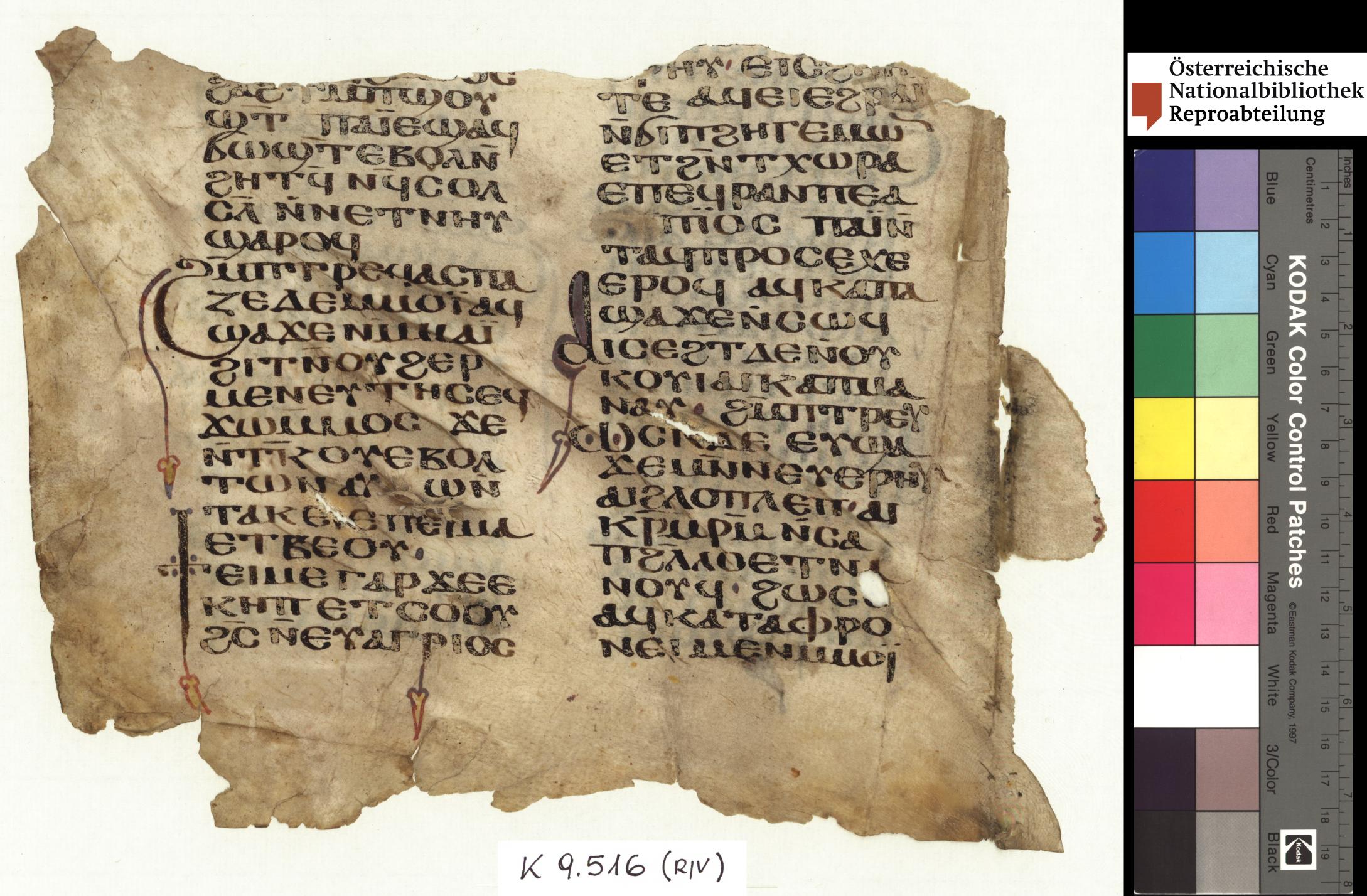
In a previous blog post (August 2011), I drew attention to the editio princeps of P. Vindob. K 9670, a parchment leaf in Vienna which had been published by Hans Förster in a recent issue of the Zeitschrift für Antikes Christentum.[1] The text of the fragment belongs to an encomium on the Archangel Gabriel, which I was not able to identify. In my post, I merely remarked that another fragment of the same codex is preserved in the National Library in Vienna. Thus, I showed that P. Vindob. K 351 and the fragment published by Hans Förster originally formed a single bifolio.

This sheet used to be the outermost bifolio of the seventh quire of the codex. It is interesting to note that the verso of K 351 contains a colophon which says that the manuscript was copied by the scribe Matthew of Touton (in the Fayyum) in the year 656 of the Era of the Martyrs (= A.D. 939-940).

Now, more information has recently been presented by Enzo Lucchesi in an article published in Analecta Bollandiana.[2] Lucchesi identified independently, not only the fragment K 351, but also pointed out that there is another fragment in the National Library in Paris which parallels the text of Vienna K 9670. Thus, we now know two manuscript witnesses of the same encomium. But, more importantly than that, Lucchesi solved the riddle of the authorship, indicating that the fragments come from an Encomium on the Archangel Gabriel which is preserved in Arabic under the name of John Chrysostom. We have, therefore, a new text to add to our Coptic clavis.


[2] E. Lucchesi, “Deux témoins coptes de l’homélie sur l’Archange Gabriel, attribuée à Jean Chrysostome,” Analecta Bollandiana 129 (2011) 324.

Posted in Archangel Gabriel, John Chrysostom | Tagged , , , , , , , , , , | Leave a comment